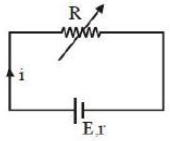
A cell of internal resistance $r$ drives current through an external resistance $R$ . The power delivered by the cell to the external resistance will be maximum when:
JEE MAIN 2019, Medium


Download our appand get started for free
Experience the future of education. Simply download our apps or reach out to us for more information. Let's shape the future of learning together!No signup needed.*
Similar Questions
- 1A $25\, watt$, $220\, volt$ bulb and a $100\, watt$, $220\, volt$ bulb are connected in series across a $220\, volt$ lines. Which electric bulb will glow more brightlyView Solution
- 2Every atom makes one free electron in copper. If $1.1$ $ampere$ current is flowing in the wire of copper having $1\, mm$ diameter, then the drift velocity (approx.) will be (Density of copper $ = 9 \times {10^3}\,kg\,{m^{ - 3}}$ and atomic weight = $63$)View Solution
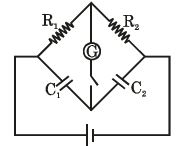
- 3View SolutionCircuit shown is in steady state, now when switch is closed, galvanometer shows no deflection, then correct relation is
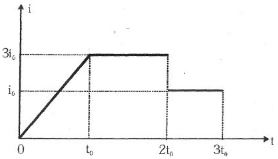
- 4A time varying current $i$ is passed through a resistance $R$ as shown in figure. The total heat generated in the resistance isView Solution
- 5The resistivity of alloys $ = {R_{{\rm{alloy}}}}$; the resistivity of constituent metals ${R_{{\rm{metal}}}}$. Then, usuallyView Solution
- 6One end of a Nichrome wire of length $2\,L$ and cross-sectional area $A$ is attatched to an end of another Nichrome wire of length $L$ and cross-sectional area $2\,A$. If the free end of the longer wire is at an electric potential of $8.0$ $\mathrm{volts}$, and the free end of the shorter wire is at an electric potential of $1.0$ $\mathrm{volt}$, the potential at the junction of the two wires is equal to ............. $V$View Solution
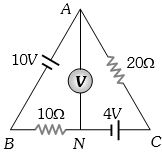
- 7The reading of the ideal voltmeter in the adjoining diagram will be ................. $V$View Solution
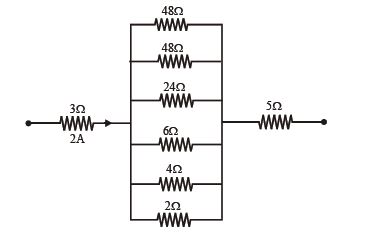
- 8Find potential difference across $24\,\Omega $ ............. $\mathrm{volt}$View Solution
- 9The $H$ amount of thermal energy is developed by a resistor in $10\,s$ when a current of $4\,A$ is passed through it. If the current is increased to $16\,A$, the thermal energy developed by the resistor in $10\,s$ will be $........\,H$View Solution
- 10A current source drives a current in a coil of resistance $R_1$ for a time $t$. The same source drives current in another coil of resistance $R_2$ for same time. If heat generated is same, find internal resistance of source.View Solution