A cell of negligible resistance and $e.m.f.$ $2$ $volts$ is connected to series combination of $2$, $3$ and $5\, ohm$. The potential difference in volts between the terminals of $3\, ohm$ resistance will be
Medium
Download our app for free and get started
Current supplied by cell $i = \frac{2}{{2 + 3 + 5}} = \frac{1}{5}\,A$
So potential difference across $3$ will be $V = \frac{{3 \times 1}}{5} = 0.6\,V$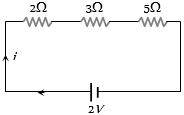

Download our appand get started for free
Experience the future of education. Simply download our apps or reach out to us for more information. Let's shape the future of learning together!No signup needed.*
Similar Questions
- 1View SolutionThermopile is used for
- 2A $25\, watt$, $220\, volt$ bulb and a $100\, watt$, $220\, volt$ bulb are connected in series across a $220\, volt$ lines. Which electric bulb will glow more brightlyView Solution
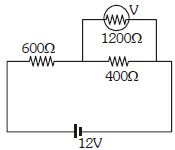
- 3Find the error in reading of voltmeter ................ $\%$View Solution
- 4The combination of two identical cells, whether connected in series or parallel combination provides the same current through an external resistance of $2 \,\Omega$. The value of internal resistance of each cell is ............ $\Omega$View Solution
- 5The current in a simple series circuit is $5.0\, amp$. When an additional resistance of $2.0\, ohms$ is inserted, the current drops to $4.0\, amp$. The original resistance of the circuit in $ohms$ wasView Solution
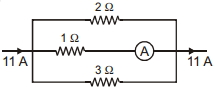
- 6The ammeter reading in the circuit below is .............. $A$View Solution
- 7$n$ identical bulbs, each designed to draw a power $p$ from a certain voltage supply, are joined in series across that supply. The total power which they will draw isView Solution
- 8The resistance of a wire is$10\,\Omega $. Its length is increased by $10\%$ by stretching. The new resistance will now be .......... $\Omega$View Solution
- 9A rod of a certain metal is $1.0\, m$ long and $0.6\, cm$ in diameter. Its resistance is $3.0 × {10^{ - 3}}\, ohm$. Another disc made of the same metal is $2.0\, cm$ in diameter and $1.0\, mm$ thick. What is the resistance between the round faces of the discView Solution
- 10In the circuit shown, $R_1$ is increased. What happens to the reading of the voltmeter (ideal)?View Solution