The current in a simple series circuit is $5.0\, amp$. When an additional resistance of $2.0\, ohms$ is inserted, the current drops to $4.0\, amp$. The original resistance of the circuit in $ohms$ was
Medium
Download our app for free and get started
(b) $i \propto \frac{1}{R}\, \Rightarrow \,\frac{{{i_1}}}{{{i_2}}} = \frac{{{R_2}}}{{{R_1}}}$ $ \Rightarrow $ $\frac{5}{4} = \frac{{(R + 2)}}{R}$ $ \Rightarrow $ $R = 8 \,\Omega$

Download our appand get started for free
Experience the future of education. Simply download our apps or reach out to us for more information. Let's shape the future of learning together!No signup needed.*
Similar Questions
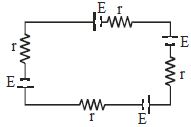
- 1Four identical cells of $EMF$ $E$ and internal resistance $r$ are connected as shown in figure, find terminal voltage across any one cellView Solution
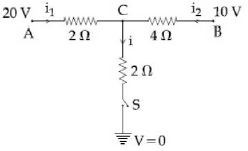
- 2When the switch $S$, in the circuit shown, is closed, then the value of current $i$ will be ................. $A$View Solution
- 3A wire of resistance $20 \Omega$ is divided into $10$ equal parts. A combination of two parts are connected in parallel and so on. Now resulting pairs of parallel combination are connected in series. The equivalent resistance of final combination is_______.0$\Omega$.View Solution
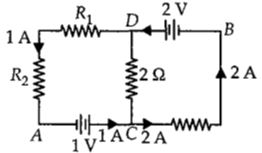
- 4In the circuit shown in the figure, if the potential at point $A$ is taken to be zero, the potential at point $B$ is ................ $V$View Solution
- 5An electric wire of length ‘$I$’ and area of cross-section $a$ has a resistance $R\, ohms$. Another wire of the same material having same length and area of cross-section $4a$ has a resistance ofView Solution
- 6Column $- I$ gives certain physical terms associated with flow of current through a metallic conductor. Column $- II$ gives some mathematical relations involving electrical quantities. Match Column $- I$ and Column $- II$ with appropriate relations.View Solution
Column $- I$ Column $- II$ $(A)$ Drift Velocity $(P)$ $\frac{m}{n e^{2} \rho}$ $(B)$ Electrical Resistivity $(Q)$ $\mathrm{ne} v_{\mathrm{d}}$ $(C)$ Relaxation Period $(R)$ $\frac{\mathrm{eE}}{\mathrm{m}} \tau$ $(D)$ Current Density $(S)$ $\frac{E}{J}$ - 7The charge flowing through a resistor $R$ varies with time $t$ as $Q = 3t -6t^2.$ The heat produced in $R$ till the current in it becomes zero isView Solution
- 8$3$ identical bulbs are connected in series and these together dissipate a power $P$. If now the bulbs are connected in parallel, then the power dissipated will beView Solution
- 9Two electric bulbs ($60\,W$ and $100\,W$ respectively) are connected in series. The current passing through them isView Solution
- 10Two bulbs of $(40 \;W, 200\; V)$ and $(100\; W, 200 \;V)$. Then correct relation for their resistanceView Solution