A certain block weight $15\, N$ in air. It weight $12\, N$ when immersed in water when immersed in another liquid it weighs $13\, N$, the relative density of the block is
Easy
Download our app for free and get started
$\frac{{{\rho _s}}}{{{\rho _w}}} = \frac{w}{{w - {w_{app}}}} = \frac{{15}}{{15 - 12}}\quad $
$\frac{{{\rho _s}}}{{{\rho _w}}} = 5$

Download our appand get started for free
Experience the future of education. Simply download our apps or reach out to us for more information. Let's shape the future of learning together!No signup needed.*
Similar Questions
- 1Two water pipes $P$ and $Q$ having diameters $2$$ \times 10^{-2} $ $m$ and $4$ $\times 10^{-2}$ $m$, respectively, are joined in series with the main supply line of water. The velocity of water flowing in pipe $P$ isView Solution
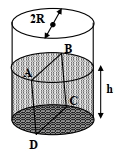
- 2Water is filled up to a height $h$ in a beaker of radius $R$ as shown in the figure. The density of water is $\rho$, the surface tension of water is $T$ and the atmospheric pressure is $P_0$. Consider a vertical section $A B C D$ of the water column through a diameter of the beaker. The force on water on one side of this section by water on the other side of this section has magnitudeView Solution
- 3What is the pressure in $atm$ on a swimmer $10\; m$ below the surface of a lake?View Solution
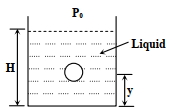
- 4A small spherical monoatomic ideal gas bubble $\left(\gamma=\frac{5}{3}\right)$ is trapped inside a liquid of density $\rho_{\ell}$ (see figure). Assume that the bubble does not exchange any heat with the liquid. The bubble contains n moles of gas. The temperature of the gas when the bubble is at the bottom is $\mathrm{T}_0$, the height of the liquid is $\mathrm{H}$ and the atmospheric pressure is $\mathrm{P}_0$ (Neglect surface tension).View Solution
Figure: $Image$
$1.$ As the bubble moves upwards, besides the buoyancy force the following forces are acting on it
$(A)$ Only the force of gravity
$(B)$ The force due to gravity and the force due to the pressure of the liquid
$(C)$ The force due to gravity, the force due to the pressure of the liquid and the force due to viscosity of the liquid
$(D)$ The force due to gravity and the force due to viscosity of the liquid
$2.$ When the gas bubble is at a height $\mathrm{y}$ from the bottom, its temperature is
$(A)$ $\mathrm{T}_0\left(\frac{\mathrm{P}_0+\rho_0 \mathrm{gH}}{\mathrm{P}_0+\rho_t \mathrm{gy}}\right)^{2 / 5}$
$(B)$ $T_0\left(\frac{P_0+\rho_t g(H-y)}{P_0+\rho_t g H}\right)^{2 / 5}$
$(C)$ $\mathrm{T}_0\left(\frac{\mathrm{P}_0+\rho_t \mathrm{gH}}{\mathrm{P}_0+\rho_t \mathrm{gy}}\right)^{3 / 5}$
$(D)$ $T_0\left(\frac{P_0+\rho_t g(H-y)}{P_0+\rho_t g H}\right)^{3 / 5}$
$3.$ The buoyancy force acting on the gas bubble is (Assume $R$ is the universal gas constant)
$(A)$ $\rho_t \mathrm{nRgT}_0 \frac{\left(\mathrm{P}_0+\rho_t \mathrm{gH}\right)^{2 / 5}}{\left(\mathrm{P}_0+\rho_t \mathrm{gy}\right)^{7 / 5}}$
$(B)$ $\frac{\rho_{\ell} \mathrm{nRgT}_0}{\left(\mathrm{P}_0+\rho_{\ell} \mathrm{gH}\right)^{2 / 5}\left[\mathrm{P}_0+\rho_{\ell} \mathrm{g}(\mathrm{H}-\mathrm{y})\right]^{3 / 5}}$
$(C)$ $\rho_t \mathrm{nRgT} \frac{\left(\mathrm{P}_0+\rho_t g \mathrm{H}\right)^{3 / 5}}{\left(\mathrm{P}_0+\rho_t g \mathrm{~g}\right)^{8 / 5}}$
$(D)$ $\frac{\rho_{\ell} \mathrm{nRgT}_0}{\left(\mathrm{P}_0+\rho_{\ell} \mathrm{gH}\right)^{3 / 5}\left[\mathrm{P}_0+\rho_t \mathrm{~g}(\mathrm{H}-\mathrm{y})\right]^{2 / 5}}$
Give the answer question $1,2,$ and $3.$
- 5A particle released from rest is falling through a thick fluid under gravity. The fluid exerts a resistive force on the particle proportional to the square of its speed. Which one of the following graphs best depicts the variation of its speed $v$ with time $t$ ?View Solution
- 6A vertical U-tube of uniform cross-section contains water in both the arms. A $10 \,cm$ glycerine column ($R.D$. $=1.2$ ) is added to one of the limbs. The level difference between the two free surfaces in the two limbs will be ...... $cm$View Solution
- 7Water flows steadily through a horizontal pipe of variable cross-section. If the pressure of water is $P$ at a point where flow speed is $v$ , the pressure at another point where the flow speed is $2v$ , is (Take density of water as $\rho $ )View Solution
- 8The fraction of a floating object of volume ${V_0}$ and density ${d_0}$ above the surface of a liquid of density $d$ will beView Solution
- 9View SolutionFigures below show water flowing through a horizontal pipe from left to right. Note that the pipe in the middle is narrower. Choose the most appropriate depiction of water levels in the vertical pipes.
- 10We have two (narrow) capillary tubes $T_1$ and $T_2$. Their lengths are $l_1$ and $l_2$ and radii of cross-section are $r_1$ and $r_2$ respectively. The rate of flow of water under a pressure difference $ P$ through tube $T_1$ is $8cm ^3/sec$. If $l_1 = 2l_2$ and $ r_1 =r_2$, what will be the rate of flow when the two tubes are connected in series and pressure difference across the combination is same as before $ (= P)$View Solution