Question
A certain gas at atmospheric pressure is compressed adiabatically so that its volume becomes half of its original volume. Calculate the resulting pressure in $Nm^{-2}$. Take $\gamma=1.4$ for air.

Answer

Let the original volume, $V_1 = V $
$\therefore$ Final valume, $\text{V}_2=\frac{\text{V}}{2}$ Initial pressure, $P_1 = 0.76$ metre of Hg column. Let $P_2$ be the fanal pressure after compression. As the change is adiabatic, $\therefore\text{P}_1\text{V}_1^\gamma=\text{P}_2\text{V}_2^\gamma$
$\text{P}_2=\text{P}_1\Big(\frac{\text{V}_1}{\text{V}_2}\Big)^\gamma=\text{P}_1\bigg(\frac{\text{V}}{\frac{\text{V}}2{}}\bigg)^{1.4}$
$\text{P}_2=0.76\times(2)^{1.4}$
$\text{P}_2=2.00$ metre of Hg column, As $\text{P}=\text{h}\rho\text{g}$
$\therefore\text{P}_22.00\times(13.6\times10^3)\times9.8\text{ Nm}^{-2}$
$\text{P}_2=2.672\times10^5\text{Nm}^{-2}$

Need a full question paper?

Generate a complete, print-ready paper with questions like this in minutes — across 16+ boards, with answer keys.
Start Generating Free

Similar questions

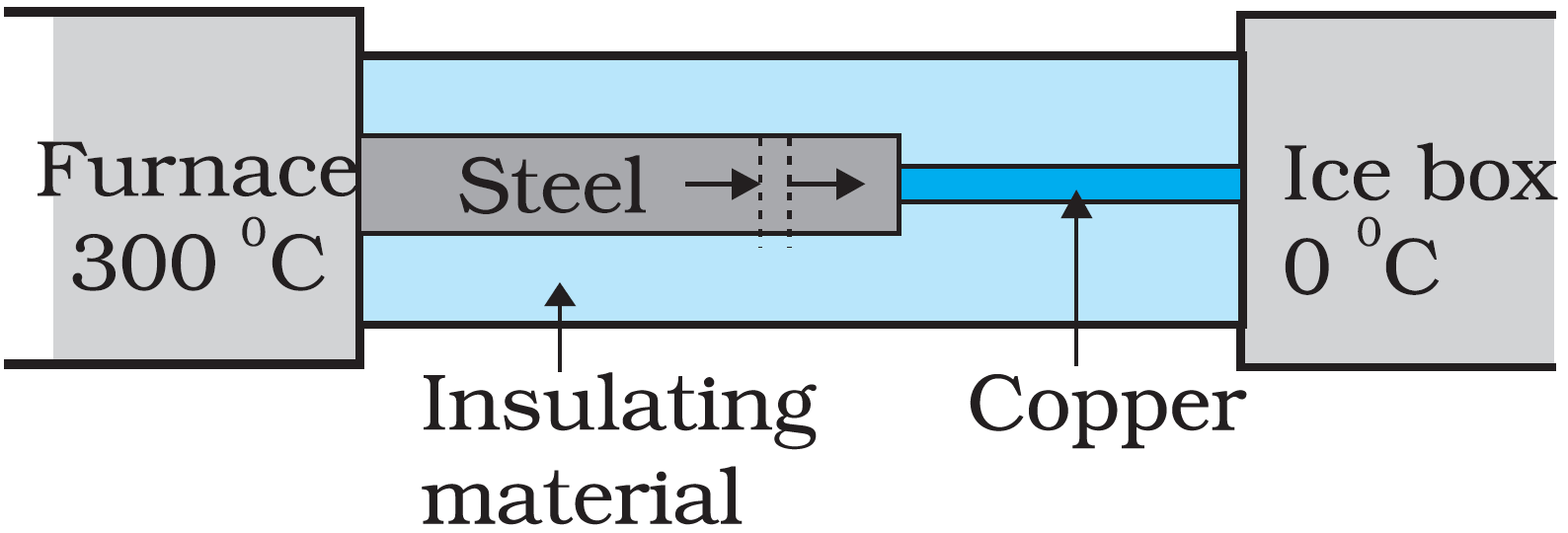
What is the temperature of the steel-copper junction in the steady state of the system shown in the figure. Length of steel rod = $15.0cm$, length of copper rod = $10.0cm$, temperature of the furnace = $300°C$, temperature of the other end = $0°C$. The area of cross-section of steel rod is twice that of copper rod. (Thermal conductivity of steel = $50.2Js^{-1}m^{-1}K^{-1}$ and of copper = $385Js^{-1}m^{-1}K^{-1}$).
A body of mass ‘m' suspended from a spring executes S.H.M. Calculate the ratio of the kinetic energy and potential energy of the body when it is at half the amplitude far from the mean position.
If a body is taken to a height equal to the radius of earth from its surface, how much the weight of a body will decrease?
If the radius of the earth were increased by a factor of 3, by what factor would its density have to be changed to keep 'g' the same?
What is meant by the term 'Molar specific heat of a gas? The molar specific heat of hydrogen in the temperature range of about 250K to 750K is about $\Big(\frac52\Big)\text{R}.$ At lower temperatures, the value of molar specific heat of hydrogen decreases to the value typical of monoatomic gases $\Big(\frac32\Big)\text{R}$ while at higher temperatures, it tends to the value $\Big(\frac72\Big)\text{R.}$ Explain.
A wheel rotating with uniform angular acceleration covers 50 revolutions in the first five seconds after the start. Find the angular acceleration and the angular velocity at the end of five seconds.
A force of $10^6 \mathrm{Nm}^{-2}$ is required for breaking a material. If the density of the material is $3 \times 10^3 \mathrm{~kg} / \mathrm{m}^{-3}$, then what should be the length of the wire made of material so that it breaks by its own weight?
The near point and the far point of a child are at 10cm and 100cm. If the retina is 2.0cm behind the eye-lens, what is the range of the power of the eye-lens?
A wheel of mass 10kg and radius 20cm is rotating at an angular speed of 100rev/min when the motor is turned off. Neglecting the friction at the axle, calculate the force that must be applied tangentially to the wheel to bring it to rest in 10 revolutions.
Consider the situation of the previous question from a frame moving with a speed v0 parallel to the initial velocity of the block.
  1. What are the initial and final kinetic energies?
  2. What is the work done by the kinetic friction?