A certain stellar body has radius $50 \,R_{s}$ and temperature $2 \,T_{s}$ and is at a distance of $2 \times 10^{10} \,AU$ from the earth. Here, $AU$ refers to the earth-sun distance and $R_{s}$ and $T_{s}$ refer to the sun's radius and temperature, respectively. Take, both star and sun to be ideal black bodies. The ratio of the power received on earth from the stellar body as compared to that received from the sun is close to
KVPY 2019, Diffcult
Download our app for free and get started
$(d)$ Intensity of radiation of sun on earth or solar constant,
$S_{1} =-\frac{P}{4 \pi R_{0}^{2}}=\frac{4 \pi R_{s}^{2} \cdot \sigma \cdot T_{s}^{4}}{4 \pi R_{0}^{2}}$
$=\sigma \frac{R_{s}^{2}}{R_{s}^{2}} \cdot T_{s}^{4}$ ....................$(i)$
where, $R_{s}=$ radius of sun,
$R_{o} =\text { radius of orbit, }$
$\sigma =\text { Stefan.Boltzmann constant and }$
$T_{s} =\text { temperature of sun. }$
Now, intensity of radiation received from steller body on carth's surface,
$S_{2} =\frac{\sigma\left(50 R_{z}\right)^{2}}{\left(2 \times 10^{10} R_{0}\right)^{2}} \cdot\left(2 T_{s}\right)^{4}$
$\Rightarrow \quad S_{2} =\frac{2500 \times 16}{4 \times 10^{2}} \times \sigma \cdot \frac{R_{s}^{2}}{R_{0}^{2}} \cdot T_{s}^{4}$
$\Rightarrow \quad S_{2}=10^{-16} S_{1} \quad$ (from Eq. $(i)$)
$\Rightarrow \quad \frac{S_{2}}{S_{1}}=10^{-16}$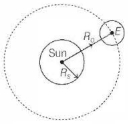

Download our appand get started for free
Experience the future of education. Simply download our apps or reach out to us for more information. Let's shape the future of learning together!No signup needed.*
Similar Questions
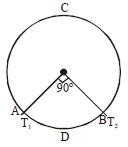
- 1For the figure shown, when arc $ACD$ and $ADB$ are made of same material, the heat carried between $A$ and $B$ is $H$ . If $ADB$ is replaced with another material, the heat carried becomes $2H$ . If the temperatures at $A$ and $B$ are fixed at $T_1$ and $T_2$ , what is the ratio of the new conductivity to the old one of $ADB$View Solution
- 2A black body at a temperature of $127°C$ radiates heat at the rate of $1 cal/cm^2 × sec$. At a temperature of $527°C$ the rate of heat radiation from the body in ($cal/cm^2 × sec$) will beView Solution
- 3The ratio of thermal conductivity of two rods of different material is $5 : 4$ . The two rods of same area of cross-section and same thermal resistance will have the lengths in the ratioView Solution
- 4View SolutionCan we boil water inside the earth satellite by convection
- 5A container with $1 kg$ of water in it is kept in sunlight, which causes the water to get warmer than the surroundings. The average energy per unit time per unit area received due to the sunlight is $700 Wm ^{-2}$ and it is absorbed by the water over an effective area of $0.05 m ^2$. Assuming that the heat loss from the water to the surroundings is governed by Newton's law of cooling, the difference (in ${ }^{\circ} C$ ) in the temperature of water and the surroundings after a long time will be. . . . . . . . (Ignore effect of the container, and take constant for Newton's law of cooling $=0.001 s ^{-1}$, Heat capacity of water $\left.=4200 J kg ^{-1} K ^{-1}\right)$View Solution
- 6Two spheres made of same material have radii in the ratio $1: 2$ Both are at same temperature. Ratio of heat radiation energy emitted per second by them isView Solution
- 7View SolutionHeat travels through vacuum by
- 8On observing light from three different stars $P, Q$ and $R$, it was found that intensity of violet colour is maximum in the spectrum of $P$, the intensity of green colour is maximum in the spectrum of $R$ and the intensity of red colour is maximum in the spectrum of $Q$. If $T_P, T_Q$ and $T_R$ are the respective absolute temperatures of $P, Q$ and $R$, then it can be concluded from the above observations thatView Solution
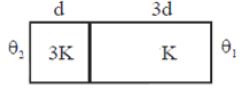
- 9Two materials having coefficients of thermal conductivity $3K$ and $K$ and thickness $d$ and $3d$, respectively, are joined to form a slab as shown in the figure. The temperatures of the outer surfaces are $\theta_2$ and $\theta_1$ respectively $\left( {\theta _2} > {\theta _1} \right)$ . The temperature at the interface isView Solution
- 10View SolutionThe Wien’s displacement law express relation between