A black body at a temperature of $127°C$ radiates heat at the rate of $1 cal/cm^2 × sec$. At a temperature of $527°C$ the rate of heat radiation from the body in ($cal/cm^2 × sec$) will be
Medium


Download our appand get started for free
Experience the future of education. Simply download our apps or reach out to us for more information. Let's shape the future of learning together!No signup needed.*
Similar Questions
- 1On investigation of light from three different stars $A, B$ and $C$ , it was found that in the spectrum of $A$ the intensity of red colour is maximum, in $B$ the intensity of blue colour is maximum and in $C$ the intensity of yellow colour is maximum. From these observations it can be concluded thatView Solution
- 2A solid copper cube of edges $1\;cm$ is suspended in an evacuated enclosure. Its temperature is found to fall from ${100^o}C$ to ${99^o}C$ in $100\;s$. Another solid copper cube of edges $2\;cm$, with similar surface nature, is suspended in a similar manner. The time required for this cube to cool from ${100^o}C$ to ${99^o}C$ will be approximately ...... $\sec$View Solution
- 3A liquid cools down from ${70^o}C$ to ${60^o}C$ in $5$ minutes. The time taken to cool it from ${60^o}C$ to ${50^o}C$ will beView Solution
- 4Two cylinders $P$ and $Q$ have the same length and diameter and are made of different materials having thermal conductivities in the ratio $2 : 3$ . These two cylinders are combined to make a cylinder. One end of $P$ is kept at $100°C$ and another end of $Q$ at $0°C$ . The temperature at the interface of $P$ and $Q$ is ...... $^oC$View Solution
- 5View SolutionIf a liquid is heated in weightlessness, the heat is transmitted through
- 6A body of length 1m having cross sectional area $0.75\;m^2$ has heat flow through it at the rate of $ 6000\; Joule/sec$ . Then find the temperature difference if $K = 200\;J{m^{ - 1}}{K^{ - 1}}$ ...... $^oC$View Solution
- 7Two spheres of the same material have radii $1\; m$ and $4\; m$ and temperatures $4000 \;K$ and $2000 \;K$ respectively. The ratio of the energy radiated per second by the first sphere to that by the second isView Solution
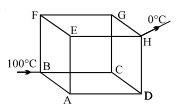
- 8Twelve conducting rods form the riders of a uniform cube of side $'l'.$ If in steady state, $B$ and $H$ ends of the rod are at $100^o C$ and $0^o C$. Find the temperature of the junction $'A'$ ....... $^oC$View Solution
- 9View SolutionWe consider the radiation emitted by the human body. Which of the following statements is true
- 10A black coloured solid sphere of radius $R$ and mass $M$ is inside a cavity with vacuum inside. The walls of the cavity are maintained at temperature $T_0$. The initial temperature of the sphere is $3T_0$. If the specific heat of the material of the sphere varies as $\alpha T^3$ per unit mass with the temperature $T$ of the sphere, where $\alpha $ is a constant, then the time taken for the sphere to cool down to temperature $2T_0$ will be ( $\sigma $ is Stefan Boltzmann constant)View Solution