Question
A certain substance has a mass of $50 g /$ mole. When 300 J of heat is added to 25 g of sample of this material, its temperature rises from $25^{\circ} C$ to $45^{\circ} C$. Calculate
i. the thermal capacity,
ii. specific heat capacity, and
iii. molar heat capacity of the sample.
Need a full question paper?

Generate a complete, print-ready paper with questions like this in minutes — across 16+ boards, with answer keys.

Start Generating Free

Similar questions

A SONAR (sound navigation and ranging) uses ultrasonic waves to detect and locate objects under water. In a submarine equipped with a SONAR, the time delay between generation of a probe wave and the reception of its echo after reflection from an enemy submarine is found to be $77.0s$. What is the distance of the enemy submarine? (Speed of sound in water = $1450m s^{–1}$).
Two particles, carrying charges -q and +q and having equal masses m each, are fixed at the ends of a light rod of length a to form a dipole. The rod is clamped at an end and is placed in a uniform electric field E with the axis of the dipole along the electric field. The rod is slightly tilted and then released. Neglecting gravity find the time period of small oscillations.
A steel wire and a copper wire of equal length and equal cross$-$sectional area are joined end to end and the combination is subjected to a tension. Find the ratio of :
  1. The stresses developed in the two wires,
  2. The strains developed in two wires. Given that $Y$ of steel $= 2.0 \times 10^{11}N/ m^2$ and $Y$ of copper $= 1.1 \times 10^{11}N/ m^2$.
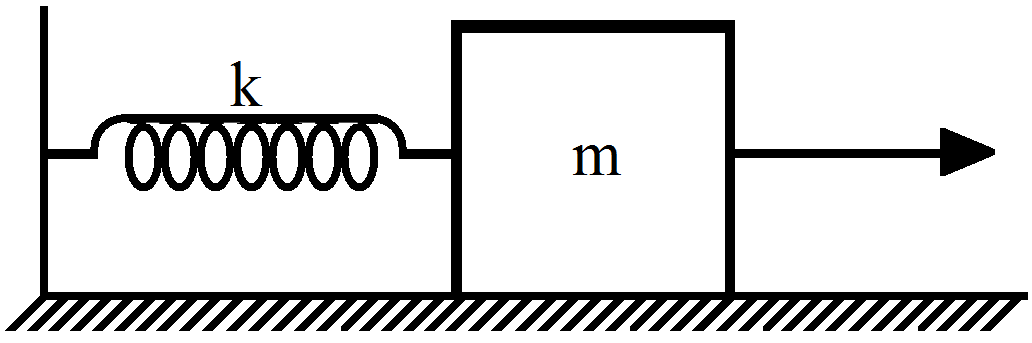
The spring shown in figure is unstretched when a man starts pulling on the cord. The mass of the block is $M.$ If the man exerts a constant force $F,$ find
  1. The amplitude and the time period of the motion of the block,
  2. The energy stored in the spring when the block passes through the equilibrium position and,
  3. The kinetic energy of the block at this position.
You have the following group of particles, $n_i$ represents no. of molecules with speed $v_i(ms^{-1})$:
$n_i$ $2$ $4$ $8$ $6$ $3$
$v_i$ $1.0$ $2.0$ $3.0$ $4.0$ $5.0$
Calculate:
  1. The average speed.
  2. The $\text{r.m.s}$. speed.
  3. The most probable speed.
A capacitor of capacitance $\text{C}=(2.0\pm0.1)\mu\text{F}$ is charged to a voltage$\text{V}=(20\pm0.5)\text{V}$ Calculate the charge Q with error limits.
What is an elastic collision? What will happen, when
  1. A heavy body collides with a light mass at rest.
  2. A light body collides with a heavy mass at rest.
State the law of conservation of momentum. Establish the same for a 'n' body system.
Calculate the radius of new bubble formed when two bubbles of radius $r_1$ and $r_2$ coalesce?
A particle located at x = 0 at time t = 0 starts moving along the positive x direction with a velocity v that varies as $\text{v}=\alpha\sqrt{\text{x}}.$ How do the displacement, velocity and acceleration of the particle vary with time? What is the average velocity of the particle over the first s metres of its path?