Question
You have the following group of particles, $n_i$ represents no. of molecules with speed $v_i(ms^{-1})$:
$n_i$ $2$ $4$ $8$ $6$ $3$
$v_i$ $1.0$ $2.0$ $3.0$ $4.0$ $5.0$
Calculate:
  1. The average speed.
  2. The $\text{r.m.s}$. speed.
  3. The most probable speed.

Answer

$n_i$ = Number of molecules $v_i$ = Speed of molecules
$n_i$ $2$ $4$ $8$ $6$ $3$
$v_i$ $1.0$ $2.0$ $3.0$ $4.0$ $5.0$
  1. The average speed
$\text{v}_{\text{avg}}=\frac{\text{n}_1\text{v}_1+\text{n}_2\text{v}_2+\text{n}_3\text{v}_3+...+\text{n}_5\text{v}_5}{\text{n}_1+\text{n}_2+\text{n}_3+...+\text{n}_5}$
$=\frac{(2\times1)+(4\times2)+(8\times3)+(6\times4)+(3\times5)}{2+4+8+6+3}$
$=\frac{2+8+24+24+15}{23}=\frac{73}{23}=3.17\text{ms}^{-1}$
  1. $\text{v}_{\text{rms}}=\sqrt{\frac{\text{n}_1\text{v}_1^2+\text{n}_2\text{v}_2^2+\text{n}_3\text{v}_3^2+\text{n}_4\text{v}_4^2+\text{n}_5\text{v}_5^2}{\text{n}_1+\text{n}_2+\text{n}_3+\text{n}_4+\text{n}_5}}$
$=\sqrt{\frac{2(1)^2+4(2)^2+8(3)^2+6(4)^2+3(5)^2}{2+4+8+6+3}}$
$=\sqrt{\frac{2+16+72+96+75}{23}}$
$=\sqrt{\frac{261}{23}}=\sqrt{11.347}$
$=3.37\text{ms}^{-1}$
  1. The most probable sped $=3\text{ms}^{-1}$

Need a full question paper?

Generate a complete, print-ready paper with questions like this in minutes — across 16+ boards, with answer keys.

Start Generating Free

Similar questions

Work done by a force is given by $\text{W}=\vec{\text{F}.}\vec{\text{S}}\text{ Where}\vec{\text{ F}}$ is the force and $\vec{\text{S}}$is the displacement. Show that:
  1. Work done is also equal to change in K.E.
  2. Work done is also equal to change in potential energy using this expression.
Radius of earth and Mars is about 6370km and 3440km respectively. An object weighs 200N on earth. What would it weigh on Mars? What is the acceleration due to gravity on Mars? Mars has a mass 0.11 of that of the Earth.
Find the angle between force $\vec{\text{F}}=(3\vec{\text{i}}+4\vec{\text{j}}-5\vec{\text{k}})$ unit and displacement $\vec{\text{d}}=(5\vec{\text{i}}+4\vec{\text{j}}+3\vec{\text{k}})$ unit. Also find the projection of $\vec{\text{F}}$ on $\vec{\text{d}}.$
Discuss the variation of 'g' with depth. What happens to 'g' at the centre of earth?
A particle is doing simple harmonic motion. If the velocity of the particle at distances $x_1$ and $x_2$ from the mean position are $v_1$ and $v_2$ respectively, then prove that its time period will be
$ T =2 \pi \sqrt{\frac{x_2^2-x_1^2}{ v _1^2- v _2^2}}. $
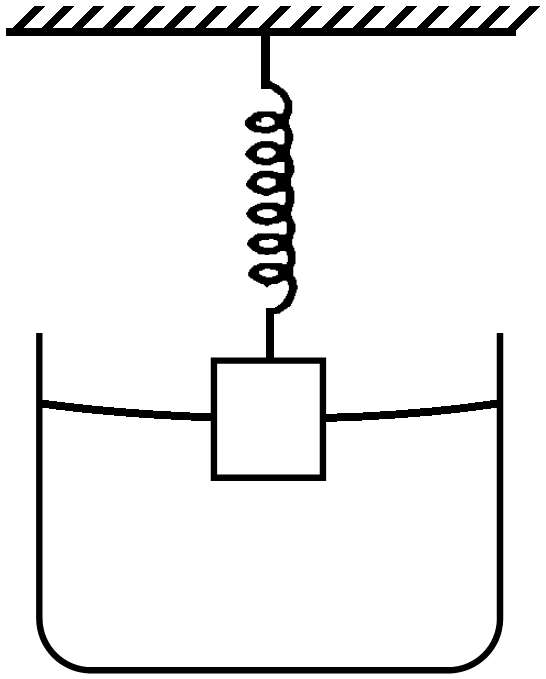
A cylindrical object of outer diameter $10\ cm$, height $20\ cm$ and density $8000\ kg/m^3$ is supported by a vertical spring and is half dipped in water as shown in.
  1. Find the elongation of the spring in equilibrium condition.
  2. If the object is slightly depressed and released, find the time period of resulting oscillations of the object. The spring constant $= 500N/m$.
On what parameter does the $\lambda ($mean free path$)$ depends?
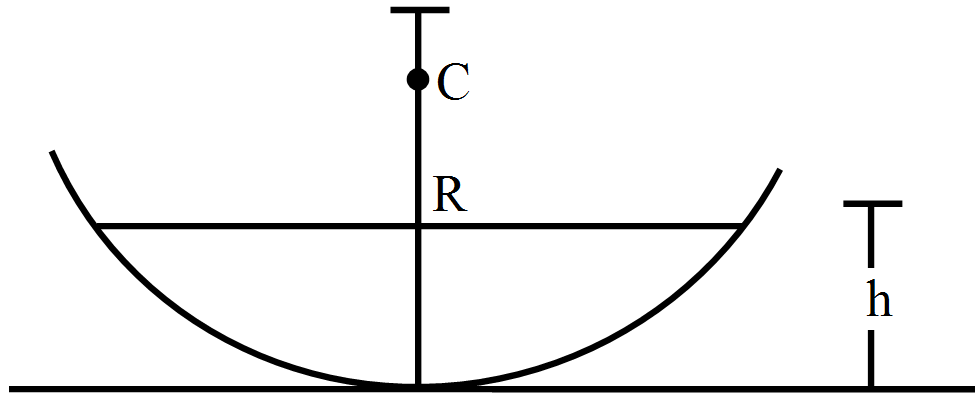
A concave mirror of radius R is kept on a horizontal. Water $\big($refractive index $=\mu\big)$ is poured into it upto a height h. Where should an object be placed so that its image is formed on itself?
Obtain an expression for position vector of centre of mass of a two particle system.
A bullet fired at an angle of 30° with the horizontal hits the ground 3km away. By adjusting its angle of projection, can one hope to hit a target 5km away? Assume the muzzle speed to be fixed, and neglect air resistance. (Take $g = 10ms^{-2}$)