MCQ
A chain reaction is continuous due to:
  • A
    production of more neutrons during fission
  • B
    large energy
  • C
    large mass defect
  • D
    daughter nuclei formed

Answer

A. production of more neutrons during fission
Explanation:
Due to the production of neutrons, a chain of nuclear fission is established which continues until the whole of the source substance is consumed.

Need a full question paper?

Generate a complete, print-ready paper with questions like this in minutes — across 16+ boards, with answer keys.
Start Generating Free

Similar questions

The position of a particle moving along $x$-axis given by $x=\left(-2 t^3+3 t^2+5\right) m$. The acceleration of particle at the instant its velocity becomes zero is ....... $m / s ^2$
Two steel wires having same length are suspended from a ceiling under the same load. If the ratio of their energy stored per unit volume is $1: 4,$ the ratio of their diameters is
For a photoelectric cell the graph showing the variation of cut of voltage ($V_o$) with frequency $(v)$ of incident light is best represented by
The maximum value of $a.c.$ voltage in a circuit is $707V$. Its rms value is.....$V$
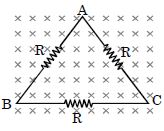
Three resistances of magnitude $R$ each are connected in the form of an equilateral triangle of side $a$ . The combination is placed in a magnetic field $B = {B_0}{e^{ - \lambda t}}$ perpendicular to its plane. The induced current in the circuit is given by 
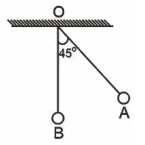
The bob $A$ of simple pendulum is released, then the string makes an angle of $45^{\circ}$ with the vertical. It hits another bob B of the same material and same mass kept at rest on the table. If the collision is elastic, then
Image
A ball is thrown upward with an initial velocity $V_0$ from the surface of the earth. The motion of the ball is affected by a drag force equal to $m\gamma {v^2}$ (where $m$ is mass of the ball, $v$ is its Instantneous velocity and $\gamma $ is a constant). Time taken by the ball to rise to its zenith is
Work done by a frictional force is
There is an air bubble of radius $1.0\,mm$ in a liquid of surface tension $0.075\,Nm ^{-1}$ and density $1000\,kg$ $m ^{-3}$ at a depth of $10\,cm$ below the free surface. The amount by which the pressure inside the bubble is greater than the atmospheric pressure is $....Pa \left( g =10\,ms ^{-2}\right)$
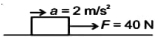
A block of mass $10 \,kg$. moving with acceleration $2 \,m / s ^2$ on horizontal rough surface is shown in figure The value of coefficient of kinetic friction is ...........