MCQ 14 Marks
A chain reaction is continuous due to:
- A
production of more neutrons during fission
- B
- C
- D
AnswerA. production of more neutrons during fission
Explanation:
Due to the production of neutrons, a chain of nuclear fission is established which continues until the whole of the source substance is consumed.
View full question & answer→MCQ 24 Marks
An electron from various excited states of hydrogen atom emits radiation to come to the ground state. Let $\lambda_n, \lambda_g$ be the de Broglie wavelength of the electron in the $n ^{\text {th }}$ state and the ground state respectively. Let $\Lambda_n$ be the wavelength of the emitted photon in the transition from the $n ^{\text {th }}$ state to the ground state. For large $n , ~(A, B$ are constants)
- A
$\Lambda_n \approx A+ B \lambda_n$
- B
$\Lambda_n^2 \approx A+ B \lambda_n^2$
- C
$\Lambda_n \approx A+\frac{B}{\lambda_n^2}$
- D
$\Lambda_n^2 \approx \lambda$
AnswerC. $\Lambda_n \approx A+\frac{B}{\lambda_n^2}$
Explanation:
Wavelength of emitted photon from nth state to the ground state,
$
\begin{array}{l}
\frac{1}{\Lambda_n}=R Z^2\left(\frac{1}{1^2}-\frac{1}{n^2}\right) \\
\Lambda_n=\frac{1}{R Z^2}\left(1-\frac{1}{n^2}\right)^{-1}
\end{array}
$
Since n is very large, using binomial theorem
$
\begin{array}{l}
\Lambda_n=\frac{1}{R Z^2}\left(1+\frac{1}{n^2}\right) \\
\Lambda_n=\frac{1}{R Z^2}+\frac{1}{R Z^2}\left(\frac{1}{n^2}\right)
\end{array}
$
As we know, $\lambda_n=\frac{2 \pi r}{n}=2 \pi\left(\frac{n^2 h^2}{4 \pi^2 m Z e^2}\right) \frac{1}{n} \propto n$
$
\Lambda_n \approx A+\frac{B}{\lambda_n^2}
$
View full question & answer→MCQ 34 Marks
The work function of a substance is 4.0 eV . The longest wavelength of light that can cause photoelectron emission from this substance is approximately:
AnswerD. 310 nm
Explanation:
If $\lambda_0$ be the threshold wavelength and $\lambda$ be the wavelength of the incident light, the condition for photoelectron emission is $\lambda<\lambda_0$
Thus, the threshold wavelength is the longest wavelength for photoelectron emission.
So, work function: $W =\frac{ hc }{\lambda_0}$
or, $\lambda_0=\frac{ hc }{ W }=\frac{\left(6.62 \times 10^{-34}\right)\left(3 \times 10^8\right)}{4 \times 1.6 \times 10^{-19}}=3.10 \times 10^{-7} m=310 \times 10^{-9} m=310 nm$
View full question & answer→MCQ 44 Marks
The velocity of the photoelectron emitted in the photoelectric effect depends only on:
- A
the frequency of incident light
- B
the frequency and intensity of incident light
- C
the frequency and intensity of incident light and the frequency of incident light
- ✓
the wavelength of the incident light
AnswerCorrect option: D. the wavelength of the incident light
View full question & answer→MCQ 54 Marks
Two coherent monochromatic light sources are located at two vertices of an equilateral triangle. If the intensity due to each of the sources independently is $1 Wm ^{-2}$ at the third vertex, the resultant intensity due to both the sources at that point (i.e., at the third vertex) is: (in $Wm ^{-2}$ )
View full question & answer→MCQ 64 Marks
A person who can see things most clearly at a distance of 10 cm , requires spectacles to enable to see clearly things at a distance of 30 cm . What should be the focal length of the spectacles?
AnswerD. 15 cm (concave)
Explanation:
For lens $u=u=$ wants to see $=-30 cm=-30 cm$ and $v = v =$ can see $=-10 cm$
$
\begin{array}{l}
\therefore \frac{1}{f}=\frac{1}{v}-\frac{1}{u}=\frac{1}{-10}-\frac{1}{(-30)} \\
\Rightarrow f=-15 cm
\end{array}
$
View full question & answer→MCQ 74 Marks
If $\vec{E}$ and $\vec{B}$ are the electric and magnetic field vectors of electromagnetic waves, then the direction of propagation of the electromagnetic wave is along the direction of:
- A
$\vec{E}$
- B
$\vec{E} \times \vec{B}$
- C
$\vec{E}+\vec{B}$
- D
$\vec{B}$
AnswerB. $\vec{E} \times \vec{B}$
Explanation:
We know that;
The direction of propagation of the electromagnetic wave is perpendicular to the plane of oscillation of electric and magnetic field of the EM wave.
Thus,
If, $\vec{E}$ and $\vec{B}$ are electric and magnetic field vectors of the EM wave, the direction of its propagation will be given by $\vec{E} \times \vec{B}$
As in an EM wave, the vectors $\vec{E}$ and $\vec{B}$ are perpendicular to each other, the direction of the wave propagation will be perpendicular to the plane containing the electric and magnetic field vectors.
View full question & answer→MCQ 84 Marks
A 5 cm long solenoid having 10 ohm resistance and 5 mH inductance is joined to a 10 V battery. At steady state, the current through the solenoid (in ampere) will be:
AnswerA. 1
Explanation:
In steady-state current passing through the solenoid
$
i=\frac{E}{R}=\frac{10}{10}=1 A
$
View full question & answer→MCQ 94 Marks
The magnetic flux through a coil is inversely proportional to:
AnswerC. none of these
Explanation:
The magnetic flux through some surfaces is proportional to the number of field lines passing through that surface.
View full question & answer→MCQ 104 Marks
A circular disc of radius 0.2 meter is placed in a uniform magnetic field of induction $\frac{1}{\pi}\left(\frac{w b}{m^2}\right)$ in such a way that its axis makes an angle of $60^{\circ}$ with B . The magnetic flux linked with the disc is:
AnswerC. 0.02 wb
Explanation:
$
\vec{B}=\frac{1}{\pi}\left(\frac{w b}{m^2}\right)
$
Area of the disc normal to B is $\pi R ^2 \cos 60^{\circ}$
Flux $= B \times$ Area normal
$\therefore$ Flux $=\frac{1}{2} \times 0.04=0.02 wb$
View full question & answer→MCQ 114 Marks
In an experiment with vibration magnetometer the value of $\frac{4 \pi^2 I}{T^2}$ for a short bar magnet is observed as $36 \times 10^{-4}$. In the experiment with deflection magnetometer with the same magnet the value of $\left(\frac{4 \pi d^3}{2 \mu_0}\right)$ is observed as $\frac{10^8}{36}$. The magnetic moment of the magnet used, is:
- A
$1000 A- m$
- B
$50 A- m$
- C
$200 A- m$
- D
$100 A- m$
AnswerD.$100 A- m$
Explanation:
For vibration magnetometer,
$
T^2=\frac{4 \pi^2 I}{M H}
$
Given: $\frac{4 \pi^2 I}{T^2}=36 \times 10^{-4}$ $\quad \quad \ldots \ldots(i)$
For deflection magnetometer,
$
H=\frac{\mu_0}{4 \pi} \times \frac{2 M}{d^3}
$
Given: $\frac{4 \pi d^3}{2 \mu_0}=\frac{10^8}{36}$
From eqns. (i) and (ii)
$
M=\frac{4 \pi^2 I}{T^2 H}=\frac{4 \pi^2 I}{T^2\left(\frac{2 \mu_0}{4 \pi d^3}\right) M}
$
or $M^2=\frac{\left(4 \pi^2 I / T^2\right)}{\left(2 \mu_0 / 4 \pi d^3\right)}=\frac{36 \times 10^{-4}}{\left(36 / 10^8\right)}=10^4$
$
\therefore M=100 A-m
$
View full question & answer→MCQ 124 Marks
A magnet is parallel to a uniform magnetic field. If it is rotated by $60^{\circ}$ the work done is 0.8 J . How much work is done in moving it $30^{\circ}$ further?
- A
- B
- C
- D
$0.8 \times 10^7 erg$
AnswerD.$0.8 \times 10^7 erg$
Explanation:
$
W=M B\left(\cos \theta_1-\cos \theta_2\right)
$
When the magnet is rotated from $0^{\circ}$ to $60^{\circ}$, then work done is 0.8 J.
$
\begin{array}{l}
0.8=M B\left(\cos 0^{\circ}-\cos 60^{\circ}\right)=\frac{M B}{2} \\
\therefore MB=1.6 N-M
\end{array}
$
In order to rotate the magnet through an angle of $30^{\circ}$, i.e., from $60^{\circ}$ to $90^{\circ}$, the work done is,
$
\begin{array}{l}
W^{\prime}=M B\left(\cos 60^{\circ}-\cos 90^{\circ}\right)=M B\left(\frac{1}{2}-0\right) \\
=\frac{M B}{2}=\frac{1.6}{2}=0.8 J=0.8 \times 10^7 erg
\end{array}
$
View full question & answer→MCQ 134 Marks
A galvanometer has a resistance of 3663 ohm. A shunt $S$ is connected across it such that $(1 / 34)$ of the total current passes through the galvanometer. the multiplying power of the shunt is:
AnswerA. 34
Explanation:
Multiplying power $=\frac{I}{I_g}=\frac{S+G}{S}=\frac{111+3663}{111}=34$
View full question & answer→MCQ 144 Marks
Silver and copper voltmeters are connected in parallel with a battery of emf 12 V . In 30 min 1 g of silver and 1.8 g of copper are liberated. The energy supplied by the battery is
AnswerD.$4.34 \times 10^4 J$
Explanation:
Current in silver voltmeter $i _1=\frac{m_1}{z_1 t_1} \frac{1}{\left(11.2 \times 10^{-4}\right)} \times(30 \times 60)=0.5 A i_2=\frac{m_2}{z_2 t_2}$
$
i_2=\frac{1.8}{\left(6.6 \times 10^{-4}\right) \times(30 \times 60)}=1.82 A
$
SO, the total current gives by battery $i = i _1+ i _2=2.01 A$
The energy supplied by the battery $=$ EiLW $=(12) \times(2.01) \times(30 \times 60)=4.34 \times 10^4 J$
View full question & answer→MCQ 154 Marks
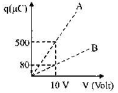
Figure shows charge $( q )$ versus voltage $( V )$ graph for series and parallel combination of two given capacitors. The capacitances are:
- A
$60 \mu F$ and $40 \mu F$
- B
$40 \mu F$ and $10 \mu F$
- C
$50 \mu F$ and $30 \mu F$
- D
$20 \mu F$ and $30 \mu F$
AnswerB. $40 \mu F$ and $10 \mu F$
Explanation:
Equivalent capacitance in series combination $\left( C ^{\prime}\right)$ is given by
$
\frac{1}{C^{\prime}}=\frac{1}{C_1}+\frac{1}{C_2} \Rightarrow C^{\prime}=\frac{C_1 C_2}{C_1+C_2}
$
For parallel combination equivalent capacitance
$
C^{\prime}=C_1+C_2
$
For parallel combination
$
\begin{array}{l}
q=10\left(C_1+C_2\right) \\
q_1=500 \mu C \\
500=10\left(C_1+C_2\right) \\
C_1+C_2=50 \mu F \ldots \text { (i) }
\end{array}
$
For Series Combination-
$
q_2=10 \frac{C_1 C_2}{\left(C_1+C_2\right)}
$
$
\begin{array}{l}
80=10 \frac{C_1 C_2}{50} \text { From equation }\ldots\text{(ii)} \\
C_1 C_2=400 \ldots \text { (iii) }
\end{array}
$
From equation (i) and (ii)
$
\begin{array}{l}
C_1=10 \mu F, C_2=40 \mu F \\
=40 \mu F \text { and } 10 \mu F
\end{array}
$
View full question & answer→MCQ 164 Marks
In finding the electric field using Gauss law the formula $|\vec{E}|=\frac{q_{\text {enc }}}{\varepsilon_0|A|}$ is applicable. In the formula $\varepsilon_0$ is permittivity of free space, A is the area of Gaussian surface and $q _{ enc }$ is charge enclosed by the Gaussian surface. This equation can be used in which of the following situation?
AnswerC. Only when the Gaussian surface is an equipotential surface
Explanation:
Only when the Gaussian surface is an equipotential surface.
View full question & answer→MCQ 174 Marks
The amplitude of sound is tripled and the frequency is reduced to one-third. The intensity of sound at the same point will:
- A
be decreased to one third
- B
- C
- D
be increased to three times
AnswerC. remain same
Explanation:
$
\begin{array}{l}
I \propto A^2 n^2 \\
\therefore \frac{I_1}{I_2}=\left(\frac{A_1}{A_2}\right)^2\left(\frac{n_1}{n_2}\right)^2 \\
=\left(\frac{A_1}{3 A_1}\right)^2\left(\frac{3 n_1}{n_1}\right)^2 \ldots\left(\because A_2=3 A_1, n_2=\frac{1}{3} n_1\right) \\
=1 \\
\therefore I_2=I_1
\end{array}
$
View full question & answer→MCQ 184 Marks
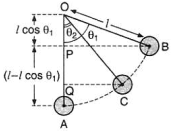
A simple pendulum of length 1 is moved aside till the string makes an angle $\theta_1$, with the vertical. If the acceleration due to gravity is $g$, the kinetic energy of the bob when the string is inclined at $\theta_2$ to the vertical is:
- A
$m g l\left(\cos \theta_2-\cos \theta_1\right)$
- B
$m g l \sin \left(\theta_1-\theta_2\right)$
- C
$m g l\left(\cos \theta_1-\cos \theta_2\right)$
- D
$mgl \cos \left(\theta_1-\theta_2\right)$
View full question & answer→MCQ 194 Marks
If the tension in the string of a sonometer changes by a small amount from T to $T +\Delta$ $T$, the fundamental frequency of vibration changes from $n$ to $n+\Delta n$, then:
- A
$\frac{\Delta n}{n}=-\left(\frac{1}{2}\right) \frac{\Delta T}{T}$
- B
$\frac{\Delta n}{n}=\frac{\Delta T}{T}$
- C
$\frac{\Delta n}{n}=\left(\frac{1}{2}\right) \frac{\Delta T}{T}$
- D
$\frac{\Delta n}{n}=2\left(\frac{\Delta T}{T}\right)$
AnswerC.$\frac{\Delta n}{n}=\left(\frac{1}{2}\right) \frac{\Delta T}{T}$
Explanation:
The fundamental frequency n of vibration is given by:
$
\begin{array}{l}
n=\frac{1}{2 L} \sqrt{\frac{T}{m}}=\left(\frac{1}{2 L \sqrt{m}}\right) T^{1 / 2}=KT^{1 / 2} \\
\therefore \log n=\log K+\frac{1}{2} \log T \\
\text { or } \frac{\Delta n}{n}=\frac{1}{2}\left(\frac{\Delta T}{T}\right)
\end{array}
$
View full question & answer→MCQ 204 Marks
The mass and the diameter of a planet are three times the respective values for the earth. The period of oscillation of a simple pendulum on the earth is 2 s . The period of oscillation of the same pendulum on the planet would be
- A
$\frac{\sqrt{3}}{2} s$
- B
$2 \sqrt{3}$ s
- C
$\frac{2}{\sqrt{3}} s$
- D
$\frac{2}{3} s$
AnswerB.$2 \sqrt{3} s$
Explanation:
Period of motion of a pendulum is given by
$
T=2 \pi \sqrt{\frac{l}{g}} \ldots\text{(i)}
$
On the surface of earth, let period of motion is $T _{ e }$ and acceleration due to gravity is $g _{ e }$
$
\therefore T_e=2 \pi \sqrt{\frac{l}{g_e}}\ldots\text{(ii)}
$
On the another planet, let period of motion is $T_p$ and gravitational acceleration is $g_p$
$\therefore T_p=2 \pi \sqrt{\frac{l}{g_p}} \ldots\text{(iii)}$
($\because$ Pendulum is same, so 1 will be same)
From Eqs. (ii) and (iii),
$\frac{T_e}{T_p}=\frac{2 \pi \sqrt{\frac{l}{g_e}}}{2 \pi \sqrt{\frac{l}{g_p}}}=\sqrt{\frac{g_p}{g_e}}\ldots\text{(iv)}$
Now, $g _{ e }=\frac{G M_e}{R_e^2}$ and $g _{ p }=\frac{G M_p}{R_p^2}$
Given, $M _{ p }=3 M _{ e }$ and $R _{ p }=3 R _{ e }$
$\therefore g_p=\frac{G \times 3 M_e}{9 R_e^2}=\frac{1}{3} \cdot \frac{G M_e}{R_e^2}=\frac{1}{3} g_e$
$\Rightarrow \quad \frac{g_p}{g_e}=\frac{1}{3}$ or $\sqrt{\frac{g_p}{g_e}}=\frac{1}{\sqrt{3}} \ldots$ (v)
From Eqs. (iv) and (v), $T _{ p }=\sqrt{3} T_{ e }$
or $T _{ p }=2 \sqrt{3} s\left(\because T _{ e }=2 s\right)$
View full question & answer→MCQ 214 Marks
Which one of the following is not an assumption of kinetic theory of gases?
- A
The collision between the molecules is elastic.
- B
All molecules have the same speed.
- C
The volume occupied by the molecules of the gas is negligible.
- D
The force of attraction between the molecules is negligible.
AnswerB. All molecules have the same speed.
Explanation:
Molecules of an ideal gas move randomly at different speeds.
View full question & answer→MCQ 224 Marks
During an adiabatic process, the pressure of a gas is proportional to the cube of its absolute temperature. The value of $\frac{C_p}{C_v}$ for the gas is:
- A
$\frac{3}{5}$
- B
$\frac{3}{2}$
- C
$\frac{4}{3}$
- D
$\frac{5}{3}$
AnswerB.$\frac{3}{2}$
Explanation:
Given: $P \propto T^3$
or $PT ^{-3}= K$...(i)
For adiabatic process:
$P V^\gamma=$ constant (C)
or $P\left(\frac{R T}{P}\right)^\gamma= C$
or $P^{1-\gamma} T^{-\gamma}=C^{\prime}$
or $P T^{\gamma / 1-\gamma}=C^{\prime \prime}= K . .$. (ii)
Comparing eqn. (i) and (ii), we get;
$
\frac{\gamma}{1-\gamma}=-3 \text { or } \gamma=\frac{3}{2}
$
View full question & answer→MCQ 234 Marks
One mole of an ideal monoatomic gas is heated at a constant pressure of one atmosphere from $0^{\circ} C$ to $100^{\circ} C$. Then, the change in internal energy is:
AnswerA. $12.48 \times 10^2$ joule
Explanation:
$
\begin{array}{l}
U=\frac{3}{2} R T \\
\Delta U=\frac{3}{2} R \Delta T=\frac{3}{2} \times 8.32 \times 100=12.48 \times 10^2 \text { joule }
\end{array}
$
View full question & answer→MCQ 244 Marks
1 kg of water is heated from $30^{\circ} C$ to $60^{\circ} C$, if its volume remains constant, then the change in internal energy is: (specific heat of water $=4148 Jkg ^{-1} K^{-1}$ )
- A
$1.24 \times 10^5 J$
- B
$1 \times 10^5 J$
- C
$2.48 \times 10^5 J$
- D
$2 \times 10^5 J$
AnswerA. $1.24 \times 10^5 J$
Explanation:
Since volume of water remains constant, then work done
$
\Delta W=PdV=0
$
According to first pair of thermodynamics
$
\begin{array}{l}
dQ=dU+dW \\
dU=dQ \\
=ms \Delta T \\
=1 \times 4148 \times(60-30) \\
=4148 \times 30 \\
=124440 J=1.24 \times 10^5 J
\end{array}
$
View full question & answer→MCQ 254 Marks
Which of the following statements is correct?
i. A gas has two specific heats only.
ii. A gas has an infinite number of specific heats.
iii. A material will have only one specific heat always.
iv. None of these
AnswerC. option (ii)
Explanation:
The specific heat of a gas is the amount of heat required to increase the temperature of one mole of the gas through the unit degree. During different processes, the work done by gas may be different. Hence, the specific heat of a gas depends on the process followed. Since the number of processes that are possible is infinite, therefore, gas has an infinite number of specific heats.
View full question & answer→MCQ 264 Marks
A rectangular block is heated from $0^{\circ} C$ to $100^{\circ} C$. The percentage increase in its length is $0.10 \%$. What will be the percentage increase in its volume?
- A
$0.03 \%$
- B
$0.10 \%$
- C
$0.30 \%$
- D
$0.50 \%$
AnswerC. $0.30 \%$
Explanation:
As $\frac{\Delta L}{L}=0.10 \%=0.001$ and $\Delta T=100^{\circ} C$, hence using $\frac{\Delta L}{L}= a \Delta T$,
we get; $a =\frac{0.001}{100}=\frac{10^{-5}}{{ }^{\circ} C }$
$\therefore \gamma=3 \alpha=\frac{3 \times 10^{-5}}{{ }^{\circ} C }$
and $\frac{\Delta V}{V}=\gamma \Delta T=3 \times 10^{-5} \times 100=3 \times 10^{-3}=0.30 \%$
View full question & answer→MCQ 274 Marks
A heavy uniform rod is suspended vertically from some rigid support. If it is stretched due to its own weight, then diameter of the rod is:
- A
the smallest at the top and gradually increases down the rod
- B
- C
the largest at the top and gradually decreases down the rod
- D
AnswerA. the smallest at the top and gradually increases down the rod
Explanation:
For a hanging heavy uniform rod, at any cross-section, the load is only of the part of the rod which is below it. At its lowest point, the load is zero which gradually increases as we go up. Since the cross-section is the same, the stress increases as we go up. The maximum stress will be at the top and so will be the effect of elongation. Since the transverse strain is proportional to longitudinal strain, hence the diameter of the rod will be smallest at the top and gradually increase down the rod.
View full question & answer→MCQ 284 Marks
A mass $M$ is split into two parts, $m$ and $(M-m)$, which are then separated by a certain distance. What ratio of $m / M$ maximizes the gravitational force between the two parts?
- A
$1 / 5$
- B
$1 / 4$
- C
$1 / 2$
- D
$1 / 3$
AnswerC. $1 / 2$
Explanation:
$
F=\frac{G m(M-m)}{r^2}
$
For maximum force, $\frac{d F}{d m}=0$
$
\begin{array}{l}
\frac{d}{d m}\left(\frac{G m M}{r^2}-\frac{G m^2}{r^2}\right)=0 \\
M-2 m=0 \Rightarrow \frac{m}{M}=\frac{1}{2}
\end{array}
$
View full question & answer→MCQ 294 Marks
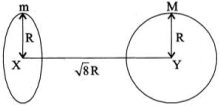
Find the gravitational force of attraction between the ring and sphere as shown in the diagram, where the plane of the ring is perpendicular to the line joining the centres. If $\sqrt{8} R$ is the distance between the centres of a ring (of mass ' m ') and a sphere (mass ' $M$ ') where both have equal radius '$R$ '
- A
$\frac{1}{3 \sqrt{8}} \cdot \frac{ GMm }{ R ^2}$
- B
$\frac{2 \sqrt{2}}{3} \cdot \frac{ GMm }{ R ^2}$
- C
$\frac{\sqrt{8}}{9} \cdot \frac{ GmM }{ R }$
- D
$\frac{\sqrt{8}}{27} \cdot \frac{ GmM }{ R ^2}$
AnswerD.$\frac{\sqrt{8}}{27} \cdot \frac{ GmM }{ R ^2}$
Explanation:
Gravitational field of ring
$
E=\frac{-G m x}{\left(R^2+x^2\right)^{3 / 2}}
$
Force between sphere and ring
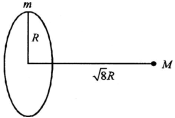
$\begin{array}{l}F=\frac{G M m \sqrt{8} R}{\left[R^2+8 R^2\right]^{3 / 2}} \\ \Rightarrow F=\frac{\sqrt{8} G M m}{27 R^2}\end{array}$ View full question & answer→MCQ 304 Marks
If the polar ice caps of the earth melt, how will it affect the length of the day?
- A
- B
Length of day would increase
- C
Length of day would remain unchange
- D
Length of day would decrease
AnswerB. Length of day would increase
Explanation:
Length of day would increase
View full question & answer→MCQ 314 Marks
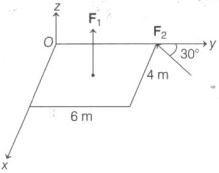
A slab is subjected to two forces $\vec{F}_1$ and $\vec{F}_2$ of same magnitude F as shown in the figure. Force $\vec{F}_2$ is in xy-plane while force $\vec{F}_1$ acts along Z-axis at the point $(2 \hat{ i }+3 \hat{ j })$. The moment of these forces about point O will be
- A
$(3 \hat{ i }+2 \hat{ j }+3 \hat{ k }) F$
- B
$(3 \hat{ i }-2 \hat{ j }+3 \hat{ k }) F$
- C
$(3 \hat{ i }-2 \hat{ j }-3 \hat{ k }) F$
- D
$(3 \hat{ i }+2 \hat{ j }-3 \hat{ k }) F$
AnswerB. $(3 \hat{ i }-2 \hat{ j }+3 \hat{ k }) F$
Explanation:
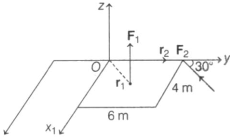
According to the question as shown in the figure below,
$
\begin{array}{l}
r _1=2 \hat{ i }+3 \hat{ j } \text { and } r _2=6 \hat{ j } \\
F_1=F \hat{ k } \text { and } F_2=\left(-\sin 30^{\circ} \hat{ i }-\cos 30^{\circ} \hat{ j }\right) F
\end{array}
$
Moment of force is given as, $\tau= r \times F$
where, r is the perpendicular distance and F is the force.
$\therefore$ Moment due to $F _1$
$
\begin{array}{l}
\tau_1=(2 \hat{ i }+3 \hat{ j }) \times(F \hat{ k }) \\
=-2 F \hat{ j }+3 F \hat{ i } \ldots(i)
\end{array}
$
Moment due to $F _2$
$
\begin{array}{l}
\tau_2=(6 \hat{ j }) \times\left(-\sin 30^{\circ} \hat{ i }-\cos 30 \hat{ j }\right) F \\
=6 \sin 30^{\circ} F \hat{ k }=3 F \hat{ k } \ldots \text { (ii) }
\end{array}
$
$\therefore$ Resultant torque,
$
\begin{array}{l}
\tau=\tau_1+\tau_2=3 F \hat{ i }-2 F \hat{ j }+3 F \hat{ k } \\
=(3 \hat{ i }-2 \hat{ j }+3 \hat{ k }) F
\end{array}
$ View full question & answer→MCQ 324 Marks
From a solid sphere of mass $M$ and radius $R$, a cube of maximum possible volume is cut. Moment of inertia of cube about an axis passing through its centre and perpendicular to one of its faces is
- A
$\frac{4 M R^2}{9 \sqrt{3} \pi}$
- B
$\frac{M R^2}{16 \sqrt{2} \pi}$
- C
$\frac{M R^2}{32 \sqrt{2} \pi}$
- D
$\frac{4 M R^2}{3 \sqrt{3} \pi}$
AnswerA.$\frac{4 M R^2}{9 \sqrt{3} \pi}$
Explanation:
Maximum possible volume of cube will occur when
$\sqrt{3} a=2 R ( a =$ side of cube $)$
$
\therefore a=\frac{2}{\sqrt{3}} R
$
Now, density of sphere, $\rho=\frac{M}{\frac{4}{3} \pi R^3}$
Mass of cube, $m =($ volume of cube $)(\rho)=\left( a ^3\right)(\rho)$
$
=\left[\frac{2}{\sqrt{3}} R\right]^3\left[\frac{m}{\frac{4}{3} \pi R^3}\right]=\left(\frac{2}{\sqrt{3} \pi}\right) M
$
Now, moment of inertia of the cube about the said axis is
$
\begin{array}{l}
I=\frac{m a^2}{6}=\frac{\left(\frac{2}{\sqrt{3} \pi}\right) M\left(\frac{2}{\sqrt{3}} R\right)^2}{\sigma} \\
=\frac{4 M R^2}{9 \sqrt{3} \pi}
\end{array}
$
View full question & answer→MCQ 334 Marks
The potential energy between two atoms, in a molecule is given by $U ( x )=\frac{a}{x^{10}}-\frac{b}{x^5}$ where a and b are positive constants and x is the distance between the atoms. The atom is in stable equilibrium, when
- A
$x=0$
- B
$X =\left(\frac{2 a}{b}\right)^{\frac{1}{5}}$
- C
$X =\left(\frac{11 a}{5 b}\right)^{1 / 5}$
- D
$X =\left(\frac{a}{2 b}\right)^{1 / 5}$
AnswerB. $x =\left(\frac{2 a}{b}\right)^{\frac{1}{5}}$
Explanation:
$
U(x)=\frac{a}{x^{10}}-\frac{b}{x^5}
$
For stable equilibrium, $\frac{d U}{d x}=0$
$
\begin{array}{l}
\therefore \frac{dU}{dx}=\frac{-10 a}{x^{11}}+\frac{5 b}{x^6}=0 \\
\Rightarrow x^5=\frac{2 a}{b} \\
\therefore x=\left(\frac{2 a}{b}\right)^{\frac{1}{5}}
\end{array}
$
View full question & answer→MCQ 344 Marks
A bullet of mass 4 g is fired horizontally with a speed of $300 m / s$ into 0.8 kg block of wood at rest on a table. If the coefficient of friction between the block and the table is 0.3 , how far will the block slide approximately?
AnswerB. 0.379 m
Explanation:
Given, $m _1=4 g, u _1=300 m / s$
$
m_2=0.8 kg=800 g, u_2=0 m / s
$
From law of conservation of momentum,
$
m_1 u_1+m_2 u_2=m_1 v_1+m_2 v_2
$
Let the velocity of combined system $= vm / s$
then,
$
4 \times 300+800 \times 0=(800+4) \times v \Rightarrow v=\frac{1200}{804}=1.49 m / s
$
Now, $\mu=0.3$ (given)
$
a=\mu g \Rightarrow a=0.3 \times 10=3 m / s^2\left(\text { take } g=10 m / s^2\right)
$
then, from $v^2=u^2+2$ as
$
(1.49)^2=0+2 \times 3 \times s \Rightarrow s=\frac{(1.49)^2}{6} s=\frac{2.22}{6}=0.379 m
$
View full question & answer→MCQ 354 Marks
If mass of an atom is $M$ moving with speed $v$, what will be its speed after the emission of an a-particle if speed of a-particle is zero?
- A
$\frac{M v}{M-4}$
- B
$\frac{M v}{M+4}$
- C
$\frac{M-4}{M v}$
- D
$\frac{M v}{M+2}$
AnswerA.$\frac{M v}{M-4}$
Explanation:
Applying the principle of momentum conservation,
$
Mv=(M-4) v^{\prime}
$
since the speed of the $\alpha$-particle is zero]
$
\Rightarrow v^{\prime}=\frac{M v}{M-4}
$
View full question & answer→MCQ 364 Marks
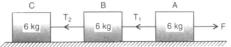
A force of FN is applied as shown in the figure. Find the tensions in the string between BC , if the friction force is negligible:
- A
$\frac{F}{4}$
- B
- C
$\frac{F}{2}$
- D
$\frac{F}{3}$
AnswerD. $\frac{F}{3}$
Explanation:
$
T_2=\frac{6}{6+6+6} F=\frac{F}{3}
$
View full question & answer→MCQ 374 Marks
A mass attached to one end of a string crosses the top-most point on a vertical circle with critical speed. Its centripetal acceleration when string becomes horizontal will be ( $g =$ gravitational acceleration)
AnswerC. 3g
Explanation:
Acceleration when string becomes horizontal, $a =3 g$
View full question & answer→MCQ 384 Marks
If $\vec{A}+\vec{B}=\vec{C}$ and $A = B = C$, then what should be the angle between $\vec{A}$ and $\vec{B}$ ?
- A
$0$
- B
$\frac{\pi}{3}$
- C
$\frac{2 \pi}{3}$
- D
$\pi$
AnswerC. $\frac{2 \pi}{3}$
Explanation:
$
\begin{array}{l}
C=\left[A^2+B^2+2 AB \cos \frac{2 \pi}{3}\right]^{1 / 2} \\
=\left[A^2+B^2+2 A^2\left(-\frac{1}{2}\right)\right]^{1 / 2}=A=B
\end{array}
$
View full question & answer→MCQ 394 Marks
The ceiling of a hall is 40 m high. For maximum horizontal distance, the angle at which the ball may be thrown with a speed of $56 ms^{-1}$ without hitting the ceiling of the hall is:
- A
$60^{\circ}$
- B
$45^{\circ}$
- C
$30^{\circ}$
- D
$25^{\circ}$
AnswerC. $30^{\circ}$
Explanation:
$
\begin{array}{l}
h=\frac{u^2 \sin ^2 \theta}{2 g}=\frac{(56)^2 \sin ^2 \theta}{19.6} \\
\sin ^2 \theta=\frac{40 \times 19.6}{(56)^2}=\frac{1}{4} \\
\sin \theta=\frac{1}{2} \text { or } \theta=30^{\circ}
\end{array}
$
View full question & answer→MCQ 404 Marks
Choose the wrong statement.
- A
Zero velocity of a particle does not necessarily mean that its acceleration is zero.
- B
If speed of a particle is constant, its acceleration must be zero.
- C
If speed of a particle is increases, its acceleration must be zero.
- D
Zero acceleration of a particle does not necessarily mean that its velocity is zero.
AnswerB. If speed of a particle is constant, its acceleration must be zero.
Explanation:
If speed, that is magnitude of velocity is constant whereas the direction of velocity changes; we cannot say that velocity is constant. Therefore, the particle has non-zero acceleration.
View full question & answer→MCQ 414 Marks
A train of 150 m length is going towards north direction at a speed of $10 ms^{-1} . A$ parrot flies at a speed of $5 ms^{-1}$ towards south direction parallel to the railway track. The time taken by the parrot to cross the train is equal to:
AnswerA. 10 s
Explanation:
As the train and parrot are moving just in opposite directions, hence relative velocity of the parrot w.r.t. the train is given by $=[10-(-5)] ms ^{-1}=15 ms^{-1}$. Hence, Time taken by the parrot to cross the train is given by $=\frac{\text { length }}{\text { relative velocity }}=\frac{150}{15}=10 sec$.
View full question & answer→MCQ 424 Marks
A metro train starts from rest and in five seconds achieves $108 km / h$. After that it moves with constant velocity and comes to rest after travelling 45 m with uniform retardation. If total distance travelled is 395 m , then total time of travelling is:
View full question & answer→MCQ 434 Marks
If $\varepsilon_0, \mu_0$ and c represent the relative permittivity of free space, the magnetic permeability of free space, and the velocity of light respectively, which of the following combinations is correct?
- A
$c =\frac{1}{\mu_0 \varepsilon_0}$
- B
$c =\sqrt{\mu_0 \varepsilon_0}$
- C
$c=\frac{1}{\sqrt{\mu_0 \varepsilon_0}}$
- D
$c =\mu_0 \varepsilon_0$
AnswerC. $c =\frac{1}{\sqrt{\mu_0 \varepsilon_0}}$
Explanation:
$
[C]=\left[LT^{-1}\right]
$
As $\mu_0=\frac{B}{n I}$ ( $n =$ number of turns per unit length)
$
\therefore\left[\mu_0\right]=\frac{[B]}{[n I]}=\frac{\left[MT^{-2} A^{-1}\right]}{\left[L^{-1} A\right]}=\left[MLT^{-2} A^{-2}\right]
$
As $F =\frac{1}{4 \pi \varepsilon_0}\left(\frac{q_1 q_2}{r^2}\right)$
$
\begin{array}{l}
{\left[\varepsilon_0\right]=\frac{\left[q_1 q_2\right]}{\left[F r^2\right]}=\frac{\left[A^2 T^2\right]}{\left[MLT^{-2} L^2\right]}=\left[M^{-1} L^{-3} T^4 A^2\right]} \\
\therefore \quad \frac{1}{\sqrt{\left[\mu_0 \varepsilon_0\right]}}=\frac{1}{\left[MLT^{-2} A^{-2} M^{-1} L^{-3} T^4 A^2\right]^{1 / 2}}=\frac{1}{\left[L^{-2} T^2\right]^{1 / 2}}=\left[L T^{-1}\right]
\end{array}
$
View full question & answer→MCQ 444 Marks
The equation $\left(P+\frac{a}{V^2}\right)(V-b)=$ constant. The units of a are:
- A
dyne $\times cm ^4$
- B
dyne $\times cm ^2$
- C
dyne $\times cm ^5$
- D
dyne $\times cm ^3$
AnswerA. dyne $\times cm ^4$
Explanation:
Unit of $a =$ unit of $P \times$ unit of $V ^2$
$
=\frac{\text { dyne }}{cm^2} \times cm^6=\text { dyne } \times cm^4 .
$
View full question & answer→MCQ 454 Marks
What are the units of $K=\frac{1}{4 \pi \varepsilon_0}$ ?
- A
- B
$Nm ^2 C ^{-2}$
- C
$C^2 N^{-1} m^{-2}$
- D
$Nm ^2 C ^2$
AnswerC. $C^2 N^{-1} m^{-2}$
Explanation :
$
\left[\frac{1}{4 \pi \varepsilon_0}\right]=\left[\frac{q^2}{F r^2}\right]=\left[\frac{\text { Coulomb }^2}{N \times m^2}\right]=\left[C^2 N^{-1} m^{-2}\right] .
$
View full question & answer→