Question
A charge is distributed uniformly over a ring of radius ‘a’. Obtain an expression for the electric intensity E at a point on the axis of the ring. Hence show that for point’s at large distances from the ring, it behaves like a point charge.

Answer

ImageConsider a point P on the axis of uniformly charged ring at a distance x from its centre O. Point P is at distance $\text{r}=\sqrt{\text{a}^2+\text{x}^2}$ from each element dl of ring. If q is total charge on ring, then, charge per metre length, $\lambda=\frac{\text{q}}{2\pi\text{a}}.$
The ring may be supposed to be formed of a large number of ring elements.
Consider an element of length dl situated at A.
The charge on element, $\text{dp}=\lambda\text{dl}$
$\therefore$ The electric field at P due to this element,
$\vec{\text{dE}}_1=\frac{1}{4\pi\epsilon_0}\frac{\text{dq}}{\text{r}^2}=\frac{1}{4\pi\epsilon_0}\frac{\lambda\text{dl}}{\text{r}^2},\ \text{along}\ \vec{\text{PC}}$
The electric field strength due to opposite symmetrical element of length dl at B is,
$\vec{\text{dE}}_2=\frac{1}{4\pi\epsilon_0}\frac{\text{dq}}{\text{r}^2}=\frac{1}{4\pi\epsilon_0}\frac{\lambda\text{dl}}{\text{r}^2},\ \text{along}\ \vec{\text{PD}}$
If we resolve $\vec{\text{dE}}_1$ and $\vec{\text{dE}}_2$ along the axis and perpendicular to axis, we note that the components perpendicular to axis are oppositely directed and so get cancelled, while those along the axis are added up. Hence, due to symmetry of the ring, the electric field strength is directed along the axis.
The electric field strength due to charge element of length dl, situated at A, along the axis will be,
$\text{dE}=\text{dE}_1\cos\theta=\frac{1}{4\pi\epsilon_0}\frac{\lambda\text{dl}}{\text{r}^2}\cos\theta$
But, $\cos\theta=\frac{\text{x}}{\text{r}}$
$\therefore\ \text{dE}=\frac{1}{4\pi\epsilon_0}\frac{\lambda\text{dl x}}{\text{r}^3}=\frac{1}{4\pi\epsilon_0}\frac{\lambda\text{x}}{\text{r}^3}\text{dl}$
The resultant electric field along the axis will be obtained by adding fields due to all elements of the ring, i.e.,
$\therefore\ \text{E}=\int\frac{1}{4\pi\epsilon_0}\frac{\lambda\text{x}}{\text{r}^3}\text{dl}$
$=\frac{1}{4\pi\epsilon_0}\frac{\lambda\text{x}}{\text{r}^3}\int\text{dl}$
But, $\int\text{dl}=$ whole length of ring $=2\pi\text{a}$ and $\text{r}=(\text{a}^2+\text{x}^2)^{1/2}$
$\therefore\ \text{E}=\frac{1}{4\pi\epsilon_0}\frac{\lambda\text{x}}{(\text{a}^2+\text{x}^2)^{3/2}}2\pi\text{a}$
As, $\lambda=\frac{\text{q}}{2\pi\text{a}},$ we have $\text{E}=\frac{1}{4\pi\epsilon_0}\frac{\big(\frac{\text{q}}{2\pi\text{a}}\big)\text{x}}{(\text{a}^2+\text{x}^2)^{3/2}}2\pi\text{}\text{a}$
$\text{E}=\frac{1}{4\pi\epsilon_0}\frac{\text{qx}}{(\text{a}^2+\text{x}^2)^{3/2}}$
or, $\text{E}=\frac{1}{4\pi\epsilon_0}\frac{\text{qx}}{(\text{a}^2+\text{x}^2)^{3/2}},$ along the axis
At large distances i.e., x >> a, $\text{E}=\frac{1}{4\pi\epsilon_0}\frac{\text{q}}{\text{x}^2}$
i.e., the electric field due to a point charge at a distance x.
For points on the axis at distances much larger than the radius of ring, the ring behaves like a point charge.

Need a full question paper?

Generate a complete, print-ready paper with questions like this in minutes — across 16+ boards, with answer keys.
Start Generating Free

Similar questions


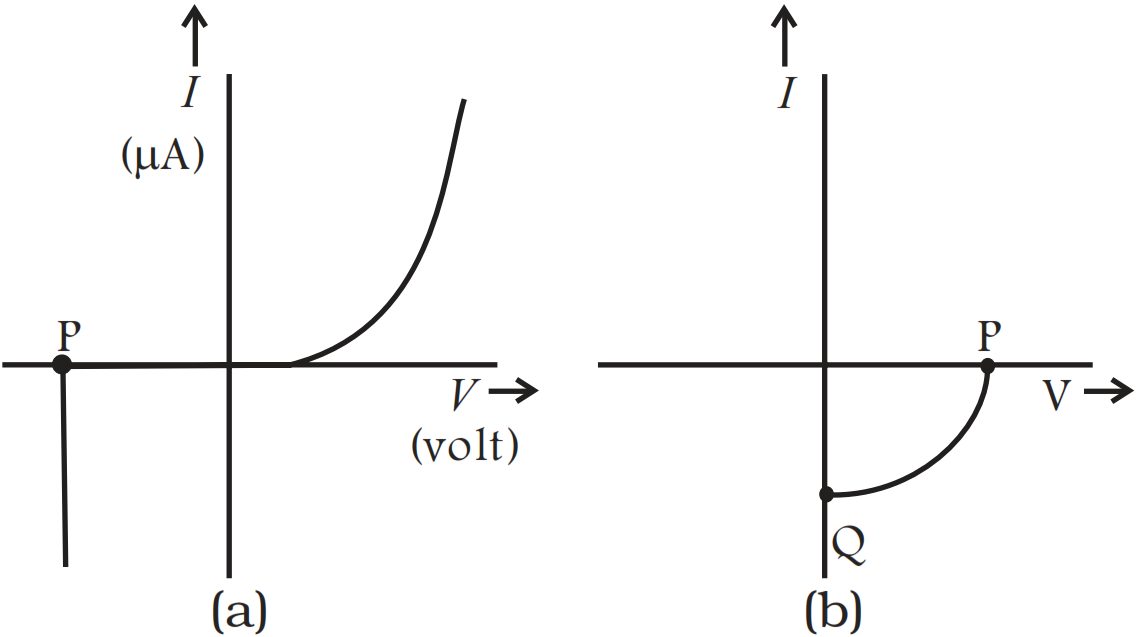
  1. Name the type of a diode whose characteristics are shown in Fig. (A) and Fig. (B).
  2. What does the point P in Fig. (A) represent?
  3. What does the points P and Q in Fig. (B) represent?
Find the maximum magnifying power of a compound Microscope having a $25$ diopter lens as the objective, a $5$ diopter lens as the eyepiece and the separation $30\ cm$ between the two lenses. The least distance for clear vision is $25\ cm.$
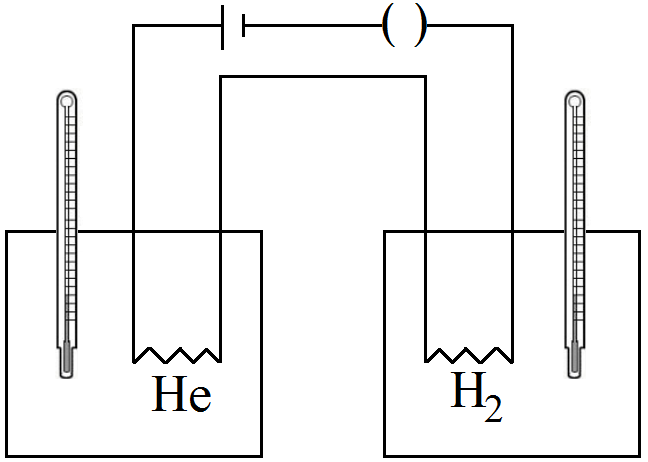
The figure shows two vessels with adiabatic walls, one containing $0.1g$ of helium $\big(\gamma=1.67,\text{M}=4\text{g-mol}^{-1}\big)$ and the other containing some amount of hydrogen $\big(\gamma=1.4,\text{M}=2\text{g-mol}^{-1}\big).$ Initially, the temperatures of the two gases are equal. The gases are electrically heated for some time during which equal amounts of heat are given to the two gases. It is found that the temperatures rise through the same amount in the two vessels. Calculate the mass of hydrogen.
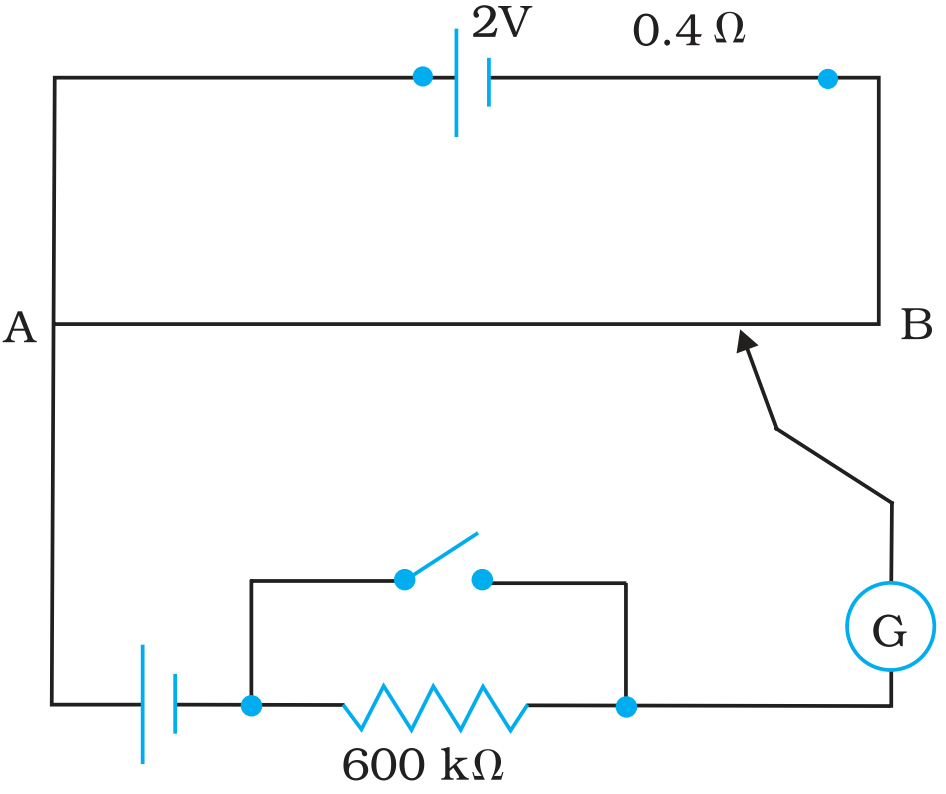
Figure shows a potentiometer with a cell of $2.0 V$ and internal resistance $0.04\ \Omega$ maintaining a potential drop across the resistor wire $AB$. A standard cell which maintains a constant emf of $1.02 V ($for very moderate currents upto a few $mA)$ gives a balance point at $67.3 \ cm$ length of the wire. To ensure very low currents drawn from the standard cell, a very high resistance of $600\ \text{k}\Omega$ is put in series with it, which is shorted close to the balance point. The standard cell is then replaced by a cell of unknown emf $\varepsilon$ and the balance point found similarly, turns out to be at $82.3 \ cm$ length of the wire.
  1. What is the value $\varepsilon?$
  2. What purpose does the high resistance of $600\ \text{k}\Omega$ have?
  3. Is the balance point affected by this high resistance?
  4. Is the balance point affected by the internal resistance of the driver cell?
  5. Would the method work in the above situation if the driver cell of the potentiometer had an emf of $1.0 V$ instead of $2.0 V$?
  6. Would the circuit work well for determining an extremely small emf, say of the order of a few $mV ($such as the typical emf of a thermo$-$couple$)$? If not, how will you modify the circuit?
It is found that yellow light does not eject photoelectrons from a metal. Is it advisable to try with orange light? With green light?
With the help of a neat and labelled diagram, explain the underlying principle and working of a moving coil galvanometer. What is the function of:
  1. Uniform radial field.
  2. Soft iron core in.
In such a device?
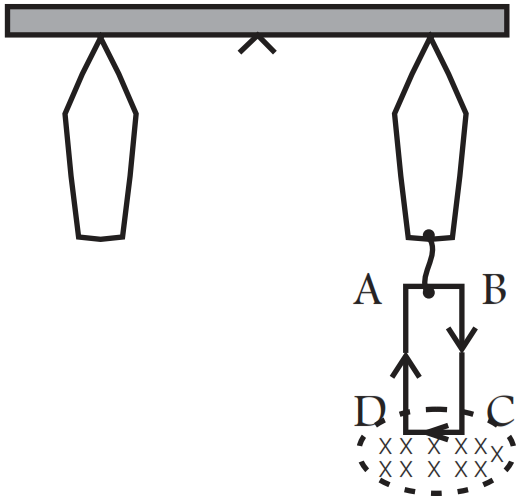
A $100$ turn rectangular coil $\text{ABCD} ($in $XY$ plane$)$ is hung from one arm of a balance $($Fig$). A$ mass $500g$ is added to the other arm to balance the weight of the coil. $A$ current $4.9A$ passes through the coil and a constant magnetic field of $0.2T$ acting inward $($in $xz$ plane$)$ is switched on such that only arm $CD$ of length $1\ cm$ lies in the field. How much additional mass $'m\ '$ must be added to regain the balance?
A long, straight wire carrying a current of $30A$ is placed in an external, uniform magnetic field of $4.0 \times 10^{-4}T$ parallel to the current. Find the magnitude of the resultant magnetic field at a point $2.0\ cm$ away from the wire.
A long solenoid with 15 turns per cm has a small loop of area 2.0 cm² placed inside the solenoid normal to its axis. If the current carried by the solenoid changes steadily from 2.0 A to 4.0 A in 0.1 s. What is the induced emf in the loop while the current is changing?
The magnetic field in a region is given by $\vec{\text{B}}=\vec{\text{k}}\frac{\text{B}_0}{\text{L}}\text{y}$ where L is a fixed length. A conductihg rod of of length lies along the Y-axis between the origin and the point (0, L, 0). If the rod moves with a velocity $\text{v}=\text{v}_0\vec{\text{i}},$ find the emf induced between the ends of the rod.