Question

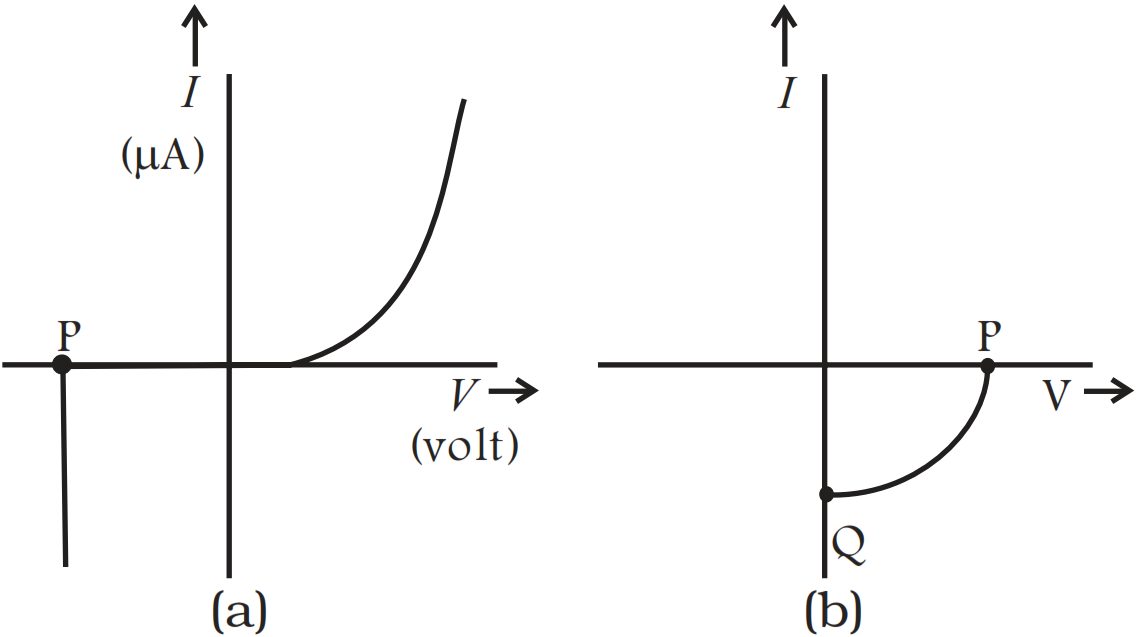
  1. Name the type of a diode whose characteristics are shown in Fig. (A) and Fig. (B).
  2. What does the point P in Fig. (A) represent?
  3. What does the points P and Q in Fig. (B) represent?

Answer

  1. Fig. (a) represents the characteristics of Zener diode and curve (b) is of solar cell.
  2. In fig. (a), point P represents Zener breakdown voltage.
  3. In fig. (b), the point Q represents zero voltage and negative current. Which means the light falling on solar cell with atleast minimum threshold frequency gives the current in opposite direction to that due to a battery connected to solar cell. But for the point Q the battery is short circuited. Hence it represents the short circuit current.
And the point Pin Fig. (b) represents some open circuit, voltage on solar cell with zero current through solar cell.
It means, there is a battery connected to a solar cell which gives rise to the equal and opposite current to that in solar cell by virtue of light falling on it.

Need a full question paper?

Generate a complete, print-ready paper with questions like this in minutes — across 16+ boards, with answer keys.
Start Generating Free

Similar questions

A parallel beam of light of wavelength $100\ nm$ passes through a sample of atomic hydrogen gas in ground state.
$(a)$ Assume that when a photon supplies some of its energy to a hydrogen atom, the rest of the energy appears as another photon. Neglecting the light emitted by the excited hydrogen atoms in the direction of the incident beam, what wavelengths may be observed in the transmitted beam?
$(b)$ A radiation detector is placed near the gas to detect radiation coming perpendicular to the incident beam. Find the wavelengths of radiation that may be detected by the detector.
A bulb with rating $250V, 100W$ is connected to a power supply of $220V$ situated $10m$ away using a copper wire of area of cross$-$section $5\ mm^2$. How much power will be consumed by the connecting wires? Resistivity of copper $1.7\times10^{-8}\Omega-\text{m}$.
When a p-n junction is reverse-biased, the current becomes almost constant at $25\mu\text{A}.$ When it is forwardbiased at 200mV, a current of $75\mu\text{A}$ is obtained. Find the magnitude of diffusion current when the diode is,
  1. Unbiased.
  2. Reverse-biased at 200mV.
  3. Forward-biased at 200mV.
A uniform magnetic field of $1.5 T$ exists in a cylindrical region of radius $10.0 \ cm,$ its direction parallel to the axis along east to west. $A$ wire carrying current of $7.0 A$ in the north to south direction passes through this region. What is the magnitude and direction of the force on the wire if,
  1. The wire intersects the axis,
  2. The wire is turned from $N-S$ to northeast-northwest direction,
  3. The wire in the $N-S$ direction is lowered from the axis by a distance of $6.0 \ cm$ ?
$a$. Derive an expression for the energy stored in a parallel plate capacitor of capacitance $C$ when charged up to voltage $V$. How is this energy stored in the capacitor?
$b.$  A capacitor of capacitance $1 \mu F$ is charged by connecting a battery of negligible internal resistance and emf $10 V$ across it. Calculate the amount of charge supplied by the battery in charging the capacitor fully.
A monoenergetic $(18$ ke $V)$ electron beam initially in the horizontal direction is subjected to a horizontal magnetic field of $0.04 G$ normal to the initial direction. Estimate the up or down deflection of the beam over a distance of $30 \ cm (m_e = 9.11 \times 10^{–19} C).$
$[$Note: Data in this exercise are so chosen that the answer will give you an idea of the effect of earth’s magnetic field on the motion of the electron beam from the electron gun to the screen in a $TV$ set.$]$
An angular magnification $($magnifying power$)$ of $30X$ is desired using an objective of focal length $1.25 \ cm$ and an eyepiece of focal length $5 \ cm$. How will you set up the compound microscope?
A parallel-plate capacitor of plate area A and plate separation d is charged to a potential difference V and then the battery is disconnected. A slab of dielectric constant K is then inserted between the plates of the capacitor so as to fill the space between the plates. Find the work done on the system in the process of inserting the slab.
1 litre of an ideal gas $(\gamma=1.5)$ at $300K$ is suddenly compressed to half its original volume.
  1. Find the ratio of the final pressure to the initial pressure.
  2. If the original pressure is $100kPa$, find the work done by the gas in the process.
  3. What is the change in internal energy?
  4. What is the final temperature?
  5. The gas is now cooled to $300K$ keeping its pressure constant. Calculate the work done during the process.
  6. The gas is now expanded isothermally to achieve its original volume of $1$ litre. Calculate the work done by the gas.
  7. Calculate the total work done in the cycle.
  1. State the principle of working of a potentiometer.
  2. In the following potentiometer circuit, AB is a uniform wire of length 1 m and resistance 10Ω. Calculate the potential gradient along the wire and balance length AO ( = l).