A charge of $1\,C$ is moving in a magnetic field of $0.5\,Tesla$ with a velocity of $10\,m/sec$ Perpendicular to the field. Force experienced is.....$N$
Easy
Download our app for free and get started
(a) $F = qBv = 1 \times 0.5 \times 10 = 5\,N$

Download our appand get started for free
Experience the future of education. Simply download our apps or reach out to us for more information. Let's shape the future of learning together!No signup needed.*
Similar Questions
- 1An electron moves with speed $2 \times {10^5}\,m/s$ along the positive $x$-direction in the presence of a magnetic induction $B = \hat i + 4\hat j - 3\hat k$ (in $Tesla$) The magnitude of the force experienced by the electron in Newton's is (charge on the electron =$1.6 \times {10^{ - 19}}C)$View Solution
- 2A long straight wire of radius a carries a steady current I. The current is uniformly distributed across its cross section. The ratio of the magnetic field at $\frac{a}{2}$ and $2$a from axis of the wire is:View Solution
- 3Two long conductors, separated by a distance $d$ carry current $I_1$ and $I_2$ in the same direction. They exert a force $F$ on each other. Now the current in one of them is increased to two times and its directions is reversed. The distance is also increased to $3d$. The new value of the force between them isView Solution
- 4View SolutionIf the direction of the initial velocity of the charged particle is neither along nor perpendicular to that of the magnetic field, then the orbit will be
- 5To Verify Ohm's law, a student is provided with a test resistor $\mathrm{R}_{\mathrm{T}}$, a high resistance $\mathrm{R}_1$, a small resistance $\mathrm{R}_2$, two identical galvanometers $\mathrm{G}_1$ and $\mathrm{G}_2$, and a variable voltage source $\mathrm{V}$. The correct circuit to carry out the experiment isView Solution
- 6A long straight wire along the $z-$ axis carries a current $I$ in the negative $z$ direction. The magnetic field vector $\vec B$ at a point having coordinates $(x, y)$ in the $z = 0$ plane isView Solution
- 7A positive charge $'q'$ of mass $'m'$ is moving along the $+ x$ axis. We wish to apply a uniform magnetic field $B$ for time $\Delta t$ so that the charge reverses its direction crossing the $y$ axis at a distance $d.$ ThenView Solution
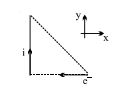
- 8View SolutionThe direction of magnetic force on the electron as shown in the diagram is along
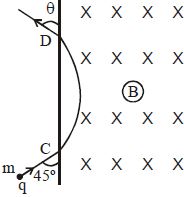
- 9A particle of mass $m = 1.67 \times 10^{-27}\, kg$ and charge $q = 1.6 \times 10^{-19} \, C$ enters a region of uniform magnetic field of strength $1$ $tesla$ along the direction shown in the figure. the radius of the circular portion of the path is :-View Solution
- 10A particle of charge $ - 16 \times {10^{ - 18}}$ $coulomb$ moving with velocity $10\,\,m{s^{ - 1}}$ along the $x$-axis enters a region where a magnetic field of induction $B$ is along the $y$-axis, and an electric field of magnitude ${10^4}\,\,V/m$ is along the negative $z$-axis. If the charged particle continues moving along the $x$-axis, the magnitude of $B$ isView Solution