An electron moves with speed $2 \times {10^5}\,m/s$ along the positive $x$-direction in the presence of a magnetic induction $B = \hat i + 4\hat j - 3\hat k$ (in $Tesla$) The magnitude of the force experienced by the electron in Newton's is (charge on the electron =$1.6 \times {10^{ - 19}}C)$
Medium


Download our appand get started for free
Experience the future of education. Simply download our apps or reach out to us for more information. Let's shape the future of learning together!No signup needed.*
Similar Questions
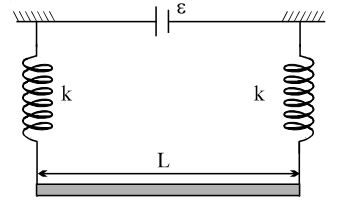
- 1A straight rod of mass $m$ and length $L$ is suspended from the identical spring as shown in the figure. The spring stretched by a distance of $x_0$ due to the weight of the wire. The circuit has total resistance $R\Omega$ . When the magnetic field perpendicular to the plane of the paper is switched on, springs are observed to extend further by the same distance. The magnetic field strength isView Solution
- 2A galvanometer coil has $500$ turns and each turn has an average area of $3 \times 10^{-4}\, m ^{2}$. If a torque of $1.5\,Nm$ is required to keep this coil parallel to magnetic field when a current of $0.5\, A$ is flowing through it, the strength of the field (in $T )$ isView Solution
- 3Two moving coil meters $M_1$ and $M_2$ having the following particulars :-View Solution
$R_1 = 10\,\Omega , N_1 = 30, A_1 = 3.6\times10^{-3}\, m^2, B_1 = 0.25\, T$
$R_2 = 14\,\Omega , N_2 = 42, A_2 = 1.8\times10^{-3}\, m^2, B_2 = 0.50\, T$
(The spring constants are identical for the two meters). Determine the ratio of voltage sensitivity of $M_2$ and $M_1$ - 4A point charge $Q\left(=3 \times 10^{-12} C \right)$ rotates uniformly in a vertical circle of radius $R(=1 \,mm )$. The axis of the circle is aligned along the magnetic axis of the earth. At what value of the angular speed $\omega$, the eff ective magnetic field at the centre of the circle .............. $rad / s$ will be reduced to zero? (Horizontal component of earth's magnetic field is $30 \,\mu T )$View Solution
- 5The maximum current that can be measured by a galvanometer of resistance $40 \,\Omega$ is $10\, mA$. It is converted into a voltmeter that can read upto $50\, V$. The resistance to be connected in series with the galvanometer is ... (in $ohm$)View Solution
- 6The resistance of an ammeter is $13\, \Omega$ and its scale is graduated for a current upto $100$ $amps$. After an additional shunt has been connected to this ammeter it becomes possible to measure currents upto $750$ $ampere$ by this meter. The value of shunt-resistance isView Solution
- 7View SolutionThe magnetic field at the centre of current carrying coil is
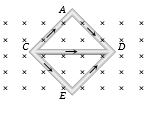
- 8Same current $i = 2A$ is flowing in a wire frame as shown in figure. The frame is a combination of two equilateral triangles $ACD$ and $CDE$ of side $1\,m$. It is placed in uniform magnetic field $B = 4T$ acting perpendicular to the plane of frame. The magnitude of magnetic force acting on the frame is.......$N$View Solution
- 9Two identical conducting wires $A$ and $B$ of same dimensions and same material are bent in the form of circular coil. Wire $A$ consists of single turn whereas wire $B$ consists of $2\, turns$. Both these wires are then suspended in a uniform magnetic field with their planes parallel to the one another and same current is passed through them. Which statement is correct ?View Solution
- 10A proton moving with a velocity, $2.5 \times {10^7}\,m/s$, enters a magnetic field of intensity $2.5\,T$ making an angle ${30^o}$ with the magnetic field. The force on the proton isView Solution