A particle of charge $ - 16 \times {10^{ - 18}}$ $coulomb$ moving with velocity $10\,\,m{s^{ - 1}}$ along the $x$-axis enters a region where a magnetic field of induction $B$ is along the $y$-axis, and an electric field of magnitude ${10^4}\,\,V/m$ is along the negative $z$-axis. If the charged particle continues moving along the $x$-axis, the magnitude of $B$ is
AIEEE 2003, Medium


Download our appand get started for free
Experience the future of education. Simply download our apps or reach out to us for more information. Let's shape the future of learning together!No signup needed.*
Similar Questions
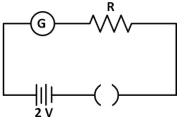
- 1A galvanometer has a $50$ $division$ scale. Battery has no internal resistance. It is found that there is deflection of $40$ $divisions$ when $R = 2400\,\Omega $. Deflection becomes $20$ $divisions$ when resistance taken from resistance box is $4900\,\Omega $ . Then we can concludeView Solution
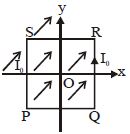
- 2A uniform, constant magnetic field $\vec B$ is directed at an angle of $45^o$ to the $x-$ axis in the $xy-$ plane, $PQRS$ is a rigid square wire frame carrying a steady current $I_0,$ with its centre at the origin $O.$ At time $t = 0,$ the frame is at rest in the position shown in the figure, with its sides parallel to the $x$ and $y$ axis. Each side of the frame is of mass $M$ and Length $L$View Solution
- 3A square loop of edge length $2 \mathrm{~m}$ carrying current of $2 \mathrm{~A}$ is placed with its edges parallel to the $\mathrm{x}-\mathrm{y}$ axis. A magnetic field is passing through the $x-y$ plane and expressed as $\vec{B}=B_0(1+4 x) \hat{k}$, where $\mathrm{B}_0=5 \mathrm{~T}$. The net magnetic force experienced by the loop is. . . . . . . $\mathrm{N}$.View Solution
- 4A $2\, MeV$ proton is moving perpendicular to a uniform magnetic field of $2.5\, tesla$. The force on the proton isView Solution
- 5Currents of a $10\, ampere$ and $2\, ampere$ are passed through two parallel thin wires $A$ and $B$ respectively in opposite directions. Wire $A$ is infinitely long and the length of the wire $B$ is $2\, m$. The force acting on the conductor $B$, which is situated at $10\, cm$ distance from $A$ will beView Solution
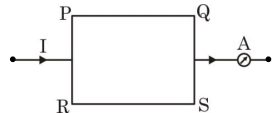
- 6A current carrying rectangular loop PQRS is made of uniform wire. The length $PR = QS =5\,cm$ and $PQ = RS =100\,cm$. If ammeter current reading changes from I to $2 I$, the ratio of magnetic forces per unit length on the wire $P Q$ due to wire RS in the two cases respectively $f_{ PQ }^{ I }: f_{ PQ }^{2 I }$ is :View Solution
- 7Two particles $\mathrm{X}$ and $\mathrm{Y}$ having equal charges are being accelerated through the same potential difference. Thereafter they enter normally in a region of uniform magnetic field and describes circular paths of radii $R_1$ and $R_2$ respectively. The mass ratio of $\mathrm{X}$ and $\mathrm{Y}$ is :View Solution
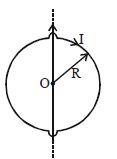
- 8A circular conducting loop of radius $R$ carries a current $I.$ Another straight infinite conductor carrying current $I$ passes through the diameter of this loop as shown in the figure. The magnitude of force exerted by the straight conductor on the loop isView Solution
- 9Two very long, straight, parallel wires carry steady currents $I$ and $-I$ respectively. The distance etween the wires is $d$. At a certain instant of time, a point charge $q$ is at a point equidistant from the two wires, in the plane of the wires. Its instantaneous velocity $v$ is perpendicular to the plane of wires. The magnitude of the force due to the magnetic field acting on the charge at this instant isView Solution
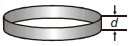
- 10Surface charge density on a ring of radius $a$ and width $d$ is $\sigma$ as shown in the figure. It rotates with frequency $f$ about its own axis. Assume that the charge is only on outer surface. The magnetic field induction at centre is(Assume that $d \ll a$ )View Solution