A charge of $2.0\,\mu C$ moves with a speed of $3.0 \times {10^6}\,m{s^{ - 1}}$ along $+ ve$ $X$ - axis $A$ magnetic field of strength $\vec B = - 0.2\,\,\hat k$ $Tesla$ exists in space. What is the magnetic force $({\overrightarrow F _m})$ on the charge
Medium
Download our app for free and get started
(c) By using ${\overrightarrow F _m} = q(\overrightarrow {v\,} \times \overrightarrow B )$
$ \Rightarrow {\overrightarrow F _m} = 2 \times {10^{ - 6}}\{ 3 \times {10^6}\hat i \times ( - 0.2)\hat k\} $ $ = - 1.2(\hat i \times \hat k) = + 1.2\hat j$
i.e., $1.2\, N$ in positive $y$ direction.
$ \Rightarrow {\overrightarrow F _m} = 2 \times {10^{ - 6}}\{ 3 \times {10^6}\hat i \times ( - 0.2)\hat k\} $ $ = - 1.2(\hat i \times \hat k) = + 1.2\hat j$
i.e., $1.2\, N$ in positive $y$ direction.

Download our appand get started for free
Experience the future of education. Simply download our apps or reach out to us for more information. Let's shape the future of learning together!No signup needed.*
Similar Questions
- 1A proton of mass $1.67\times10^{-27}\, kg$ and charge $1.6\times10^{-19}\, C$ is projected with a speed of $2\times10^6\, m/s$ at an angle of $60^o$ to the $X-$ axis. If a uniform magnetic field of $0.104\, tesla$ is applied along the $Y-$ axis, the path of the proton isView Solution
- 2An insulating rod of length $l$ carries a charge $q$ distributed uniformly on it. The rod is pivoted at an end and is rotated at a frequency $f$ about a fixed perpendicular $t$ axis. The magnetic moment of the system isView Solution
- 3A long copper tube of inner radius $R$ carries a current $i$. The magnetic field $B$ inside the tube isView Solution
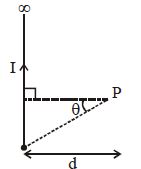
- 4Magnetic field due to semi infinite length wire at point $P$View Solution
- 5Field at the centre of a circular coil of radius $r$, through which a current $I$ flows isView Solution
- 6An electron moving in a circular orbit of radius $r$ makes $n$ rotation per second. The magnetic field produced at the centre has a magnitude ofView Solution
- 7View SolutionA loop of irregular shape carrying current is located in an external magnetic field. If wire is flexible it will take the shape of
- 8A particle of charge $q$ and mass $m$ starts moving from the origin under the action of an electric field $\vec E = {E_0}\hat i$ and $\vec B = {B_0}\hat i$ with velocity ${\rm{\vec v}} = {{\rm{v}}_0}\hat j$. The speed of the particle will become $2v_0$ after a timeView Solution
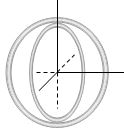
- 9View SolutionTwo insulated rings, one of slightly smaller diameter than the other are suspended along their common diameter as shown. Initially the planes of the rings are mutually perpendicular. When a steady current is set up in each of them
- 10The dimension of where $\sqrt {\frac{\mu }{ \in }} $ is permeability $\& \varepsilon$ is permittivity is same as :View Solution