Field at the centre of a circular coil of radius $r$, through which a current $I$ flows is
Easy
Download our app for free and get started
(c) Field at the centre of a circular coil of radius $r$ is $B = \frac{{{\mu _o}I}}{{2r}}$

Download our appand get started for free
Experience the future of education. Simply download our apps or reach out to us for more information. Let's shape the future of learning together!No signup needed.*
Similar Questions
- 1An electron (mass = $9.0 × $${10^{ - 31}}$ $kg$ and charge =$1.6 \times {10^{ - 19}}$ $coulomb$) is moving in a circular orbit in a magnetic field of $1.0 \times {10^{ - 4}}\,weber/{m^2}.$ Its period of revolution isView Solution
- 2A straight wire carrying a current ${i_1}\,amp$ runs along the axis of a circular current ${i_2}\,amp$. Then the force of interaction between the two current carrying conductors isView Solution
- 3View SolutionWhich of the following particle will experience maximum acceleration when projected with same speed in transverse magnetic field
- 4An ammeter of $100$ $\Omega$ resistance gives full deflection for the current of $10^{-5} \,amp$. Now the shunt resistance required to convert it into ammeter of $1\, amp$. range, will beView Solution
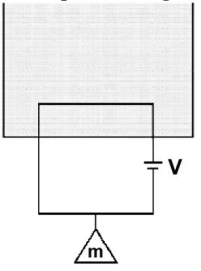
- 5A massless square loop, of wire of resistance $10\,\Omega$. supporting a mass of $1\,g$. hangs vertically with one of its sides in a uniform magnetic field of $10^3\, G$, directed outwards in the shaded region. A dc voltage $V$ is applied to the loop. For what value of V. the magnetic force will exactly balance the weight of the supporting mass of $1\,g$ ? (If sides of the loop $=10\,cm , g =10\,ms ^{-2}$ )View Solution
- 6Two long conductors, separated by a distance $d$ carry current $I_1$ and $I_2$ in the same direction. They exert a force $F$ on each other. Now the current in one of them is increased to two times and its directions is reversed. The distance is also increased to $3d$. The new value of the force between them isView Solution
- 7A proton (mass $ = 1.67 \times {10^{ - 27}}\,kg$ and charge $ = 1.6 \times {10^{ - 19}}\,C)$ enters perpendicular to a magnetic field of intensity $2$ $weber/{m^2}$ with a velocity $3.4 \times {10^7}\,m/\sec $. The acceleration of the proton should beView Solution
- 8View SolutionUnit of magnetic permeability is
- 9The magnetic induction in air at a point $1\,cm $ away from a long wire that carries a current of $1\,A$, will beView Solution
- 10A current $I$ flows in an infinitely long wire with cross-section in the form of a semicircular ring of radius $R$. The magnitude of the magnetic induction along its axis isView Solution