A charge of $2.0\,\mu C$ moves with a speed of $3.0 \times {10^6}\,m{s^{ - 1}}$ along $+ ve$ $X$ - axis $A$ magnetic field of strength $\vec B = - 0.2\,\,\hat k$ $Tesla$ exists in space. What is the magnetic force $({\overrightarrow F _m})$ on the charge
Medium


Download our appand get started for free
Experience the future of education. Simply download our apps or reach out to us for more information. Let's shape the future of learning together!No signup needed.*
Similar Questions
- 1View SolutionA moving coil sensitive galvanometer gives at once much more deflection. To control its speed of deflection
- 2View SolutionIf the direction of the initial velocity of the charged particle is neither along nor perpendicular to that of the magnetic field, then the orbit will be
- 3A charged particle enters a uniform magnetic field with velocity vector making an angle of $30^o$ with the magnetic field. The particle describes a helical trajectory of pitch $x$ . The radius of the helix isView Solution
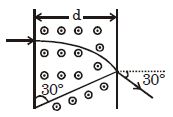
- 4A particle of charge $q$, mass $m$ enters in a region of magnetic field $B$ with velocity $V_0 \widehat i$. Find the value of $d$ if the particle emerges from the region of magnetic field at an angle $30^o$ to its ititial velocity:-View Solution
- 5The correct curve between the magnetic induction $(B)$ along the axis of a long solenoid due to current flow $i$ in it and distance $x$ from one end is :View Solution
- 6A circular coil of $20$ $turns$ and radius $10\, cm$ is placed in uniform magnetic field of $0.10\, T$ normal to the plane of the coil. If the current in coil is $5\, A$, then the torque acting on the coil will be...... $Nm$View Solution
- 7A wire of length $L$ is bent in the form of a circular coil and current $i$ is passed through it. If this coil is placed in a magnetic field then the torque acting on the coil will be maximum when the number of turns isView Solution
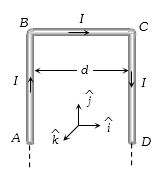
- 8$AB$ and $CD$ are long straight conductor, distance $d$ apart, carrying a current $I$. The magnetic field at the midpoint of $BC$ isView Solution
- 9A proton, a deuteron and an $\alpha-$particle with same kinetic energy enter into a uniform magnetic field at right angle to magnetic field. The ratio of the radii of their respective circular paths isView Solution
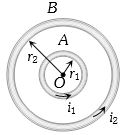
- 10$A$ and $B$ are two concentric circular conductors of centre $O$ and carrying currents ${i_1}$ and ${i_2}$ as shown in the adjacent figure. If ratio of their radii is $1 : 2$ and ratio of the flux densities at $O$ due to $A$ and $B$ is $1 : 3$, then the value of ${i_1}/{i_2}$ isView Solution