A charge of $40\,\mu \,C$ is given to a capacitor having capacitance $C = 10\,\mu \,F$. The stored energy in ergs is
Medium


Download our appand get started for free
Experience the future of education. Simply download our apps or reach out to us for more information. Let's shape the future of learning together!No signup needed.*
Similar Questions
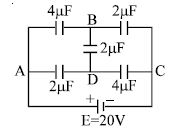
- 1View SolutionThe figure shows a diagonal symmetric arrangement of capacitors and a battery.Identify the correct statements.
- 2The capacity and the energy stored in a parallel plate condenser with air between its plates are respectively ${C_o}$ and ${W_o}$. If the air is replaced by glass (dielectric constant $= 5$ ) between the plates, the capacity of the plates and the energy stored in it will respectively beView Solution
- 3An electric dipole of moment $\vec p$ is kept in a uniform electric field $\vec E$. Angle between $\vec p$ and $\vec E$ is $30^o$. Calculate work done by field when angle is increased to $60^o.$View Solution
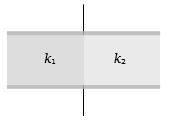
- 4A parallel plate condenser is filled with two dielectrics as shown. Area of each plate is $A\;metr{e^2}$ and the separation is $t$ $metre$. The dielectric constants are ${k_1}$ and ${k_2}$ respectively. Its capacitance in farad will beView Solution
- 5A capacitor of capacitance $C_1 = 1\ \mu F$ can with stand maximum voltage $V_1= 6\ kV$ (kilo-volt) and another capacitor of capacitance $ C_2 = 3\ \mu F$ can withstand maximum voltage $V_2 = 4\ kV$. When the two capacitors are connected in series, the combined system can withstand a maximum voltage of......$kV$View Solution
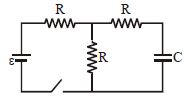
- 6View SolutionThe time constant of given circuit is
- 7View SolutionOn increasing the plate separation of a charged condenser, the energy
- 8A capacitor $C$ is charged to a potential difference $V$ and battery is disconnected. Now if the capacitor plates are brought close slowly by some distance :View Solution
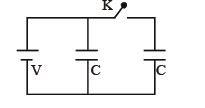
- 9Consider the arrangement shown in figure. The total energy stored is $U_1$ when key is closed. Now the key $K$ is made off (opened) and two dielectric slabs of relative permittivity ${ \in _r}$ are introduced between the plates of the two capacitors. The slab tightly fit in between the plates. The total energy stored is now $U_2$. Then the ratio of $U_1/U_2$ isView Solution
- 10Three point charges $q, q$ and $-2 q$ are placed at the corners of an equilateral triangle of side '$L$'. Calculate work done by extemal force in moving all the charges far apart without accelerationView Solution