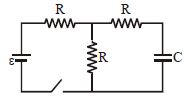
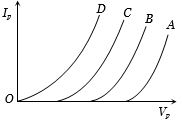
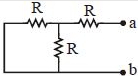
Time constant $\mathrm{T}=\mathrm{R}_{\mathrm{eq}} \mathrm{C}=\frac{3 \mathrm{RC}}{2}$
Download our app
and get started for free
Experience the future of education. Simply download our apps or reach out to us for more information. Let's shape the future of learning together!No signup needed.*
If $Q$ is the charge on the plates of a capacitor of capacitance $C, V$ the potential difference between the plates, $A$ the area of each plate and $d $ the distance between the plates, the force of attraction between the plates is
A capacitor with air as the dielectric is charged to a potential of $100\;volts$. If the space between the plates is now filled with a dielectric of dielectric constant $10$, the potential difference between the plates will be......$volts$
In a region, if electric field is defined as $\vec E = \left( {\hat i + 2\hat j + \hat k} \right)\,V/m$ , then the potential difference between two points $A (0, 0, 0)$ and $B (2, 3, 4)$ in that region, is ......$V$
An electron (charge = $1.6 \times {10^{ - 19}}$ $coulomb$) is accelerated through a potential of $1,00,000$ $volts$. The energy required by the electron is
Two insulated metallic spheres of $3\,\mu F$ and $5\,\mu F$ capacitances are charged to $300\, V$ and $500\,V$ respectively. The energy loss, when they are connected by a wire is
A charge $ + q$ is fixed at each of the points $x = {x_0},\,x = 3{x_0},\,x = 5{x_0}$..... $\infty$, on the $x - $axis and a charge $ - q$ is fixed at each of the points $x = 2{x_0},\,x = 4{x_0},x = 6{x_0}$,..... $\infty$. Here ${x_0}$ is a positive constant. Take the electric potential at a point due to a charge $Q$ at a distance $r$ from it to be $Q/(4\pi {\varepsilon _0}r)$. Then, the potential at the origin due to the above system of charges is
Two Identical capacttors $\mathrm{C}_{1}$ and $\mathrm{C}_{2}$ of equal capacitance are connected as shown in the circult. Terminals $a$ and $b$ of the key $k$ are connected to charge capacitor $\mathrm{C}_{1}$ using battery of $emf \;V\; volt$. Now disconnecting $a$ and $b$ the terminals $b$ and $c$ are connected. Due to this, what will be the percentage loss of energy?.....$\%$
A $10\, \mu F$ capacitor is fully charged to a potential difference of $50\, V$. After removing the source voltage it is connected to an uncharged capacitor in parallel. Now the potential difference across them becomes $20\, V$. The capacitance of the second capacitor is......$\mu F$