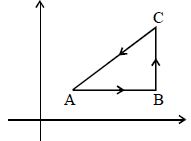
As shown in figure, on bringing a charge $Q$ from point $A$ to $B$ and from $B$ to $C$, the work done are $2\, joule$ and $-3\, joule$ respectively. The work done to bring the charge from $C$ to $A$ is
Easy


Download our appand get started for free
Experience the future of education. Simply download our apps or reach out to us for more information. Let's shape the future of learning together!No signup needed.*
Similar Questions
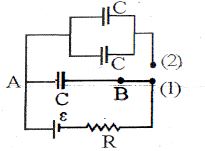
- 1If capacitor connected across $AB$ is charged to $Q$ and then switch is shifted to $2$ . The heat released after thatView Solution
- 2A capacitor of capacitance $1$ $\mu F$ withstands the maximum voltage $6$ $kV$ while a capacitor of $2$ $\mu F$ withstands the maximum voltage $4$ $kV$. What maximum voltage will the system of these two capacitor withstands if they are connected in series?......$kV$View Solution
- 3The force between the plates of a parallel plate capacitor of capacitance $C$ and distance of separation of the plates $d$ with a potential difference $V$ between the plates, isView Solution
- 4In one design of capacitor thin sheets ot metal of area $80\ mm \times 80\ mm$ sandwich between them a piece of paper whose thickness is $40\ μm$. The relative permittivity of the paper is $4.0$ and its dielectric strength is $20\ MVm^{-1}$. Calculate the maximum charge that can be put on the capacitorView Solution
[permittivity of free space $ = 9 \times 10^{-12}\ Fm^{-1}$]
- 5In a certain region of space, variation of potential with distance from origin as we move along $x$-axis is given by $V=8 x^2+2$, where $x$ is the $x$-coordinate of a point in space. The magnitude of electric field at a point $(-4,0)$ is .......... $V / m$View Solution
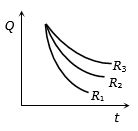
- 6Three identical capacitors are given a charge $Q$ each and they are then allowed to discharge through resistance $R_1, R_2\,$ and $\,R_3$. Their charges, as a function of time shown in the graph below. The smallest of the three resistance isView Solution
- 7Three concentric spherical shells have radii $a, b$ and $c (a < b < c)$ and have surface charge densities $\sigma ,-\;\sigma $ and $\;\sigma \;$ respectively. If $V_A,V_B$ and $V_C$ denote the potentials of the three shells, then, for $c = a +b,$ we haveView Solution
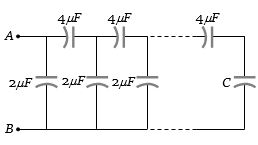
- 8A finite ladder is constructed by connecting several sections of $2\,\mu F,\;4\,\mu F$ capacitor combinations as shown in the figure. It is terminated by a capacitor of capacitance $C$. What value should be chosen for $C$ such that the equivalent capacitance of the ladder between the points $A$ and $B$ becomes independent of the number of sections in between......$\mu F$View Solution
- 9View SolutionIf the distance between parallel plates of a capacitor is halved and dielectric constant is doubled then the capacitance will become
- 10Energy per unit volume for a capacitor having area $A$ and separation $d$ kept at potential difference $V$ is given byView Solution