Three charges $q, \sqrt 2q, 2q$ are placed at the corners $A, B$ and $C$ respectively of the square $ABCD$ of side $'a'$ then potential at point $'D'$
Medium
Download our app for free and get started

Download our appand get started for free
Experience the future of education. Simply download our apps or reach out to us for more information. Let's shape the future of learning together!No signup needed.*
Similar Questions
- 1$64$ drops of mercury each charged to a potential of $10\,V$. They are combined to form one bigger drop. The potential of this drop will be.......$V$ (Assume all the drops to be spherical)View Solution
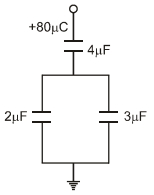
- 2In the given circuit, a charge of $+80 \ \mu C$ is given to the upper plate of the $4 \ \mu F$ capacitor. Then in the steady state, the charge on the upper plate of the $3 \ \mu F$ capacitor is :View Solution
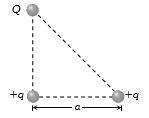
- 3Three charges $Q,\, + q$ and $ + q$ are placed at the vertices of a right-angled isosceles triangle as shown. The net electrostatic energy of the configuration is zero if $Q$ is equal toView Solution
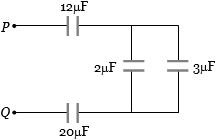
- 4In the circuit diagram shown in the adjoining figure, the resultant capacitance between $P$ and $Q$ is........$\mu F$View Solution
- 5Two identical capacitors are connected in parallel across a potenial difference $V$. After they are fully charged, the positive plate of first capacitor is connected to negative plate of second and negative plate of first is connected to positive plate of other. The loss of energy will beView Solution
- 6The capacitance of a parallel plate capacitor is $5\, \mu F$ . When a glass slab of thickness equal to the separation between the plates is introduced between the plates, the potential difference reduces to $1/8$ of the original value. The dielectric constant of glass isView Solution
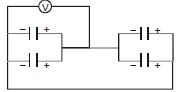
- 7The four capacitors, each of $25\,\mu \,F$ are connected as shown in fig. The $dc$ voltmeter reads $200\,V$. The charge on each plate of capacitor isView Solution
- 8The electric potential in volts due to an electric dipole of dipole moment $2 \times 10^{-8}$ coulomb-metre at a distance of $3 \,m$ on a line making an angle of $60^{\circ}$ with the axis of the dipole is ..........View Solution
- 9For a uniformly charged thin spherical shell, the electric potential $(V)$ radially away from the center $(O)$ of shell can be graphically represented asView Solution
- 10If an electron enters into a space between the plates of a parallel plate capacitor at an angle $\alpha $ with the plates and leaves at an angle $\beta $ to the plates, the ratio of its kinetic energy while entering the capacitor to that while leaving will beView Solution