A charge $q$ is released in presence of electric $(E)$ and magnetic field $(B)$ then after some time its velocity is $v$ then
Easy


Download our appand get started for free
Experience the future of education. Simply download our apps or reach out to us for more information. Let's shape the future of learning together!No signup needed.*
Similar Questions
- 1A proton and an $\alpha$ -particle, having kinetic energies $K _{ p }$ and $K _{\alpha},$ respectively, enter into $a$ magnetic field at right angles.View Solution
The ratio of the radii of trajectory of proton to that of $\alpha$ -particle is $2: 1 .$ The ratio of $K _{ p }: K _{\alpha}$ is :
- 2Two long straight wires are placed along $x$-axis and $y$-axis. They carry current $I_1$ and $I_2$ respectively. The equation of locus of zero magnetic induction in the magnetic field produced by them isView Solution
- 3A long solenoid of $50\, cm$ length having $100$ turns carries a current of $2.5$ $A.$ The magnetic field at the centre of the solenold is $...... \times 10^{-5}\;T$View Solution
$\left(\mu_{0}=4 \pi \times 10^{-7}\, T\, m\, A ^{-1}\right)$
- 4View SolutionIn a moving coil galvanometer, to make the field radial
- 5Net magnetic field at the centre of the circle $O$ due to a current carrying loop as shown in figure is $(\theta < 180^o)$View Solution
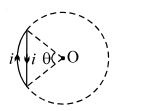
- 6The magnetic field on the axis of a circular loop of radius $100\,cm$ carrying current $I=\sqrt{2}\,A$, at point $1\,m$ away from the centre of the loop is given byView Solution
- 7View SolutionIn a current carrying long solenoid, the field produced does not depend upon
- 8For a moving coil galvanometer, the deflection in the coil is $0.05\,rad$ when a current of $10\,mA$ is passed through it. If the torsional constant of suspension wire is $4.0 \times 10^{-5}\,Nm\,rad ^{-1}$, the magnetic field is $0.01\,T$ and the number of turns in the coil is $200$,the area of each turn (in $cm ^2$ ) is :View Solution
- 9A particle of specific charge $(q/m)$ is projected from the origin of coordinates with initial velocity $[ui - vj]$. Uniform electric magnetic fields exist in the region along the $+y$ direction, of magnitude $E$ and $B.$ The particle will definitely return to the origin once ifView Solution
- 10A parallel plate capacitor of area $60\, cm^2$ and separation $3\, mm$ is charged initially to $90\, \mu C$. If the medium between the plate gets slightly conducting and the plate loses the charge initially at the rate of $2.5\times10^{-8}\, C/s$, then what is the magnetic field between the plates ?View Solution