Questions

Answer the following in Detail

Take a timed test

33 questions · self-marked practice — reveal the answer and mark yourself.

Question 14 Marks
A potential difference of $5000$ volt is applied between two parallel plates $5\ cm$ apart. A small oil drop having a charge of $9.6 \time 10-19 C$ falls between the plates. Find (i) electric field intensity between the plates and (ii) the force on the oil drop.
Answer
Given: $V = 5000 volt, d = 5 cm = 5 \times 10^{-2} m$
$q = 9.6 \times 10^{-19} C$
To find:
i. Electric field intensity (E)
ii. Force (F)
Formula:
i. $E =\frac{V}{d} \frac{q}{r}$
ii. $E =\frac{F}{q}$
Calculation: From formula (i),
$E =\frac{F}{q}=10^5 N / C$
From formula (ii)
$ F=E \times q$
$=10^5 \times 9.6 \times 10^{-19}$
$=9.6 \times 10^{-14} N $
View full question & answer
Question 24 Marks
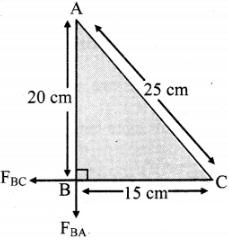
Three equal charges of $10 \times 10^{-8}\ C$ respectively, each located at the corners of a right triangle whose sides are $15\ cm, 20\ cm$ and $25\ cm$ respectively. Find the force exerted on the charge located at the $90^\circ $ angle.
Answer

Given: $q_A = q_B = q_C = 10 \times 10^{-8}$

Image
Force on B due to A,
$\overrightarrow{ F }_{ BA } =\frac{1}{4 \pi \varepsilon_0} \frac{ q _{ A } q _{ B }}{\left( r _{ AB }^2\right)}$
$=9 \times 10^9 \times \frac{\left(10 \times 10^{-8}\right)^2}{\left(20 \times 10^{-2}\right)^2}$
$=2.25 \times 10^{-3} N $
Force on $B$ due to $C$,
$\overrightarrow{ F }_{ BC }=\frac{1}{4 \pi \varepsilon_0} \frac{ q _{ C } q _{ B }}{\left( r _{ BC }^2\right)}$
$=9 \times 10^9 \times \frac{\left(10 \times 10^{-8}\right)^2}{\left(15 \times 10^{-2}\right)^2}$
$=4 \times 10^{-3} N$
$\therefore \quad \text { Resultant force on point } B ,$
$\left| F _{ B }\right|=\sqrt{ F _{ BA }^2+ F _{ BC }^2+2 F _{ BA } \cdot F _{ BC } \cos 90}$
$=\sqrt{\left(2.25 \times 10^{-3}\right)^2+\left(4 \times 10^{-3}\right)^2}$
$=4.589 \times 10^{-3} N$
View full question & answer
Question 34 Marks
A charge $+ q$ exerts a force of magnitude $– 0.2 N$ on another charge $-2q$. If they are separated by $25.0\ cm$, determine the value of $q$.
Answer
Given: $I=6 m, D =0.5 mm$,
$r=0.25 mm=0.25 \times 10^{-3} m, R=50 \Omega$
To find:
i. Resistivity ( $\rho$ )
ii. Conductivity ( $\sigma$ )
Formulae:
i. $\rho=\frac{R A}{l}=\frac{R \pi r^2}{l}$
ii. $\sigma=\frac{1}{\rho}$
Calculation:
From formula (i),
$\rho=\frac{50 \times 3.142 \times\left(0.25 \times 10^{-3}\right)^2}{6}$
$=\{\operatorname{antilog}[\log 50+\log 3.142+21 \log 0.25-\log 6]\} \times 10^{-6}$
$=\{\operatorname{antilog}[1.6990+0.4972+2(1.3979)-0.7782]\} \times 10^{-6}$
$=\{\text { antilog }[2.1962+2.7958-0.7782]\} \times 10^{-6}$
$=\{\text { antilog }[0.9920-0.7782]\} \times 10^{-6}$
$=\{\text { antilog }[0.2138]\} \times 10^{-6}$
$=1.636 \times 10^{-6} \Omega / m$
From formula (ii),
$\sigma=\frac{1}{1.636 \times 10^{-6}}$
$=0.6157 \times 10^6$
$\cdots(\text { Using reciprocal from \log table })$
$=6.157 \times 10^5 m / \Omega$
View full question & answer
Question 44 Marks
Two small spheres $18\ cm$ apart have equal negative charges and repel each other with the force of $6 \times 10^{-8} N$. Find the total charge on both spheres.
Answer
Given: $F = 6 \times 10^{-8} N, r = 18 cm = 18 \times 10^{-2} m$
To find: Total charge $(q_1 + q_2)$
Formula: $F =\frac{1}{4 \pi \varepsilon_0} \frac{q_1 q_2}{r^2}$
Calculation: From formula,
$F =\frac{1}{4 \pi \varepsilon_0} \frac{ q ^2}{ r ^2}$
$\ldots\left(\right.$ Given: $\left.q _1- q _2- q \right)$
$\therefore \quad q ^2=\frac{4 \pi \varepsilon_0}{1} \times Fr ^2$
$= \frac{6 \times 10^{-8} \times\left(18 \times 10^{-2}\right)^2}{9 \times 10^9}$
$\ldots\left(\because \frac{1}{4 \pi \varepsilon_0}=9 \times 10^9 \text { SI units }\right)$
Taking square roots from log table,
$\therefore q = -4.648 \times 10^{-10} C$
….($\because $ the charges are negative)
Total charge $= q_1 + q_2 = 2q$
$= 2 \times (-4.648) \times 10^{-10}$
$= -9.296 \times 10^{-10} C$
View full question & answer
Question 54 Marks
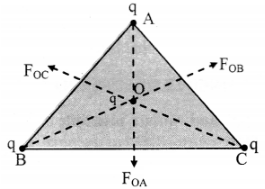
Three charges, q each, are placed at the vertices of an equilateral triangle. What will be the resultant force on charge q placed at the centroid of the triangle?
Answer

Image
Since AD. BE and CF meets at O, as centroid of an equilateral triangle.
∴ OA = OB = OC
∴ Let, r = OA = OB = OC
Force acting on point O due to charge on point A,
$\overrightarrow{ F }_{ OA }=\frac{1}{4 \pi \varepsilon_0} \frac{ q ^2}{ r _i^2} \hat{ r }_{ AO }$
Force acting on point $O$ due to charge on point $B$, $\overrightarrow{ F }_{O B }=\frac{1}{4 \pi \varepsilon_0} \frac{ q ^2}{ r ^2} \hat{ r }_{ BO }$
Force acting on point $O$ due to charge on point $C$, $\overrightarrow{ F }_{ OC }=\frac{1}{4 \pi \varepsilon_0} \frac{ q ^2}{ r ^2} \hat{ r } CO$
$\therefore$ Resultant force acting on point $O$,
$F =\vec{F}_{ OA }+\vec{F}_{ OB }+\vec{F}_{ OC }$
On resolving $\vec{F}_{O B}$ and $\vec{F}_{O C}$, we get $-\vec{F}_{O A}$
i.e., $\vec{F}_{O B}+\vec{F}_{O C}=-\vec{F}_{O A}$
$\therefore \vec{F}=\vec{F}_{ OA }-\vec{F}_{ OA }=0$
Hence, the resultant force on the charge placed at the centroid of the equilateral triangle is zero.
View full question & answer
Question 64 Marks
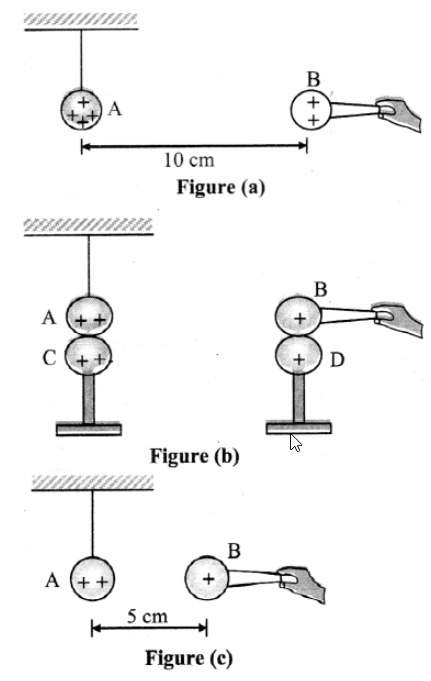
A charged metallic sphere A is suspended by a nylon thread. Another charged metallic sphere B held by an insulating handle is brought close to A such that the distance between their centres is 10 cm, as shown in figure (a). The resulting repulsion of A is noted (for example, by shining a beam of light and measuring the deflection of its shadow on a screen.) Spheres A and B are touched by uncharged spheres C and D respectively, as shown in figure (b). C and D are then removed and B is brought closer to A to a distance of 5.0 cm between their centres, as shown in figure (c). What is the expected repulsion of A on the basis of Coulomb’s law? Spheres A and C and spheres B and D have identical sizes. Ignore the sizes of A and B comparison to the separation between their centres.
Image
Answer
 Let the original charge on sphere A be q and that on B be q’. At a distance r between their centres, the magnitude of the electrostatic force on each is given by

$F =\frac{1}{4 \pi \varepsilon_0} \frac{ qq ^{\prime}}{ r ^2}$
Neglecting the sizes of spheres, A and B in comparison to r. When an identical but uncharged sphere C touches A, the charges redistribute on A and C and, by symmetry, each sphere carries a charge q/2. Similarly, after D touches B, the redistributed charge on each is q’/2. Now, if the separation between A and B is halved, the magnitude of the electrostatic force on each is

$F ^{\prime}=\frac{1}{4 \pi \varepsilon_0} \frac{( q / 2)\left( q ^{\prime} / 2\right)}{( r / 2)^2}=\frac{1}{4 \pi \varepsilon_0} \frac{\left( qq ^{\prime}\right)}{ r ^2}= F$
Thus, the electrostatic force on A, due to B, remains unaltered.
View full question & answer
Question 74 Marks
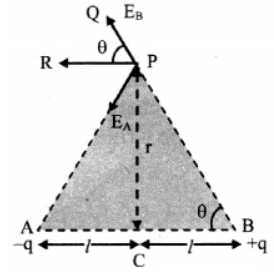
Drive expression for electric intensity at a point on the equator of an electric dipole.
Answer
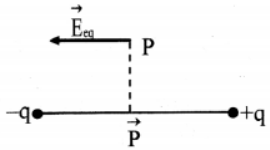
$i.$ Electric field at point $P$ due to charge $- q$ at $A$ is $\vec{E}_{ A }=\frac{1}{4 \pi \varepsilon_0} \frac{(- q )}{( AP )^2} \hat{ u }_{ PA }$
where, $\hat{u}_{P A}$ is a unit vector directed along $\overrightarrow{P A}$
Image
$ii.$ Similarly, electric field at $P$ due to charge $+q$ at $B$ is
$\vec{E}_{ A }=\frac{1}{4 \pi \varepsilon_0} \frac{ q }{( BP )^2} \hat{ u }_{ BP }$
where $\hat{u}_{B P}$ is a unit vector directed along $\overrightarrow{B P}$
$iii.$ Electric field at $P$ is the sum of $E_A$ and $E_B$
$\therefore \vec{E}_{ eq }=\vec{E}_{ A }+\vec{E}_{ B }$
$iv.$ Consider $\triangle ACP$
$(A P)^2=(P C)^2+(A C)^2=r^2+1^2=(B P)^2$
$\therefore \quad\left|\overrightarrow{ E }_{ A }\right|=\frac{1}{4 \pi \varepsilon_0} \frac{ q }{\left( r ^2+l^2\right)} .......(1)$
$\left|\overrightarrow{ E }_{ B }\right|=\frac{1}{4 \pi \varepsilon_0} \frac{ q }{\left( r ^2+l^2\right)} ........(2)$
$\therefore \quad\left|\overrightarrow{ E }_{ A }\right|=\left|\overrightarrow{ E }_{ B }\right| .........(3)$
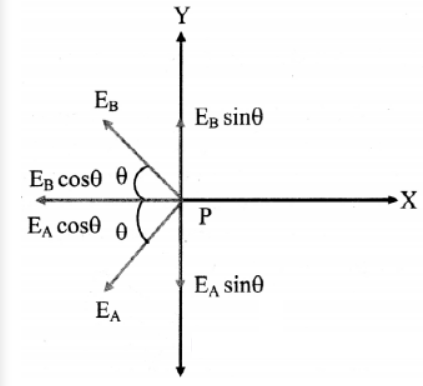
$v.$ The resultant of fields $\vec{E}_{ A }$ and $\vec{E}_{ B }$ acting at point $P$ can be calculated by resolving these vectors $E \vec{E}_{ A }$ and $E \vec{E}_{ B }$ along the equatorial line and along a direction perpendicular to it.Image
$vi.$ Let the $Y-$axis coincide with the equator of the dipole $X-$axis will be parallel to dipole axis and the origin is at point $P$ as shown.
$vii.$ The $Y-$components of $E_A$ and $E_B$ are $E_Asin \theta$ and $E_B \sin \theta$ respectively. They are equal in magnitude but opposite in direction and cancel each other. There is no contribution from them towards the resultant.
$viii.$ The $X-$components of $E_A$ and $E_B$ are $E_Acos \theta$ and $E_Bcos \theta$ respectively. They are of equal magnitude and are in the same direction.
$\therefore\left|\vec{E}_{\text {eq }}\right|= E _{ A } \cos \theta+ E _{ B } \cos \theta$  From equation $(3),$
$\left|\vec{E}_{\text {eq }}\right|=2 E _{ A } \cos \theta$
$=2\left(\frac{ q }{4 \pi \varepsilon_0\left( r ^2+l^2\right)}\right) \frac{l}{\sqrt{ r ^2+l^2}}$
$.....\left(\because \cos \theta=\frac{l}{\sqrt{ r ^2+l^2}}\right)$
$=\frac{2 q l}{4 \pi \varepsilon_0\left( r ^2+l^2\right)^{\frac{3}{2}}}=\frac{1}{4 \pi \varepsilon_0} \times \frac{ p }{\left( r ^2+l^2\right)^{3 / 2}}$
$ix.$ If $r>l$ then $l^2$ is very small compared to $r^2$
$\left|\overrightarrow{ E }_{ qq }\right|=\frac{1}{4 \pi \varepsilon_0} \frac{ p }{\left( r ^2\right)^{\frac{3}{2}}}=\frac{1}{4 \pi \varepsilon_0} \frac{ p }{ r ^3}$
$x.$ The direction of this field is along $-\vec{P}$ (anti$-$parallel to $\vec{P}$ ).
Image
View full question & answer
Question 84 Marks
Derive expression for electric intensity at a point on the axis of an electric dipole.
Answer
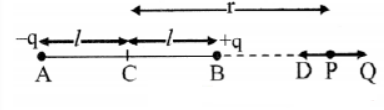
i. Consider an electric dipole consisting of two charges -q and +q separated by a distance 2lImage
ii. Let P be a point at a distance r from the centre C of the dipole.
iii. The electric intensity $\vec{E}_{ a }$ at P due to the dipole is the vector sum of the field due to the charge $-q$ at $A$ and $+q$ at $B$.
iv. Electric field intensity at P due to the charge - q at $A =\vec{E}_{ A }=\frac{1}{4 \pi \varepsilon_0} \frac{(-q)}{(r+l)^2} \hat{ u }_{ pD }$,
where, $\hat{u}_{ PD }$ is unit vector directed along $\overrightarrow{P D}$
v. Electric intensity at $P$ due to charge $+q$ at $B$
$\vec{E}_{ B }=\frac{1}{4 \pi \varepsilon_0} \frac{ q }{( r -l)^2} \hat{ u }_{ PQ }$
where, $\hat{u}_{ PQ }$ is a unit vector directed along $\overrightarrow{P Q}$
The magnitude of $\vec{E}_{ B }$ is greater than that of $\vec{E}_{ A }$ since $BP < AP$
vi. Resultant field $\vec{E}_{ a }$ at P on the axis, due to the dipole is
$\vec{E}_{ a }=\vec{E}_{ B }+ E \vec{E}_{ A }$
vii. The magnitude of $\vec{E}_{ a }$ is given by
$\left|\overrightarrow{ E }_{ a }\right|=\frac{1}{4 \pi \varepsilon_0}\left[\frac{ q }{( r -l)^2}-\frac{ q }{( r +l)^2}\right]$
$\left|\overrightarrow{ E }_{ a }\right|=\frac{ q }{4 \pi \varepsilon_0}\left[\frac{ r ^2+l^2+2 l r - r ^2+2 l r -l^2}{\left( r ^2-l^2\right)^2}\right]$
$\left|\overrightarrow{ E }_{ a }\right|=\frac{2(2 l q ) r ^{ }}{4 \pi \varepsilon_0\left( r ^2-l^2\right)^2}$
viii. But $2 lq = p$, the dipole moment
$\left|\overrightarrow{ E }_{ a }\right|=\frac{1}{4 \pi \varepsilon_0} \frac{2 pr }{\left( r ^2-l^2\right)^2}$
ix. $\left|\vec{E}_{ a }\right|$ is directed along PQ, which is the direction of the dipole moment $\vec{p}$ i.e., from the negative to the positive charge, parallel to the axis.
x. If $r>>\mid, I^2$ can be neglected compared to $r^2$,
$\left|\vec{E}_{\text {a }}\right|=\frac{1}{4 \pi \varepsilon_0} \frac{2 p}{r^3}$
The field will be along the direction of the dipole moment $\vec{p}$.
View full question & answer
Question 94 Marks
Derive expression for couple acting on an electric dipole in a uniform electric field.
Answer
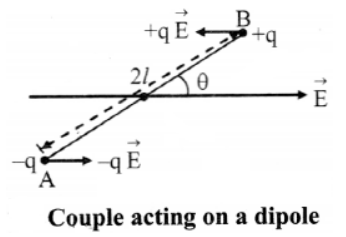
$i.$ Consider an electric dipole placed in a uniform electric field $E$. The axis of electric dipole makes an angle $\theta $ with the direction of electric field.
Image
$ii.$ The force acting on charge $- q$ at A is $\vec{F}_{ A }=- q \vec{E}$ in the direction of $\vec{E}$ and the force acting on charge $+ q$ at $B$ is $\vec{F}_{ B }=+ q \vec{E}$ in the direction opposite to $\vec{E}$.
$iii.$ Since $\vec{F}_{ A }=-\vec{F}_{ B }$, the two equal and opposite forces separated by a distance form a couple.
$iv.$ Moment of the couple is called torque and is defined by $\vec{\tau}=\vec{d} \times \vec{F}$ where, $d$ is the perpendicular distance between the two equal and opposite forces.
$v.$ Magnitude of Torque $=$ Magnitude of force $\times $ Perpendicular distance
$\therefore \text { Torque on the dipole }(\vec{\tau})=\overrightarrow{B A} \times q \vec{E}$
$=2 lqE \sin \theta$
$\text { but } p = q 2 l$
$\therefore \tau= pE \sin \theta$
$\therefore \text { In vector form } \vec{\tau}=\vec{d} \times \vec{E}$
$vi.$ If $\theta = 90^\circ \sin \theta = 1,$ then $τ = pE$
When the axis of electric dipole is perpendicular to uniform electric field, torque of the couple acting on the electric dipole is maximum, i.e., $τ = pE.$
$vii.$ If $\theta = 0$ then $τ = 0$, this is the minimum torque on the dipole. Torque tends to align its axis along the direction of electric field.
View full question & answer
Question 104 Marks
Define the following terms with the help of a diagram.
i. Electric dipole
ii. Dipole axis
iii. Axial line
iv. Equatorial line
Answer
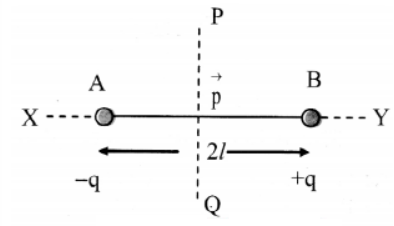
i. Electric dipole: A pair of equal and opposite charges separated by a finite distance is called an electric dipole.
ii. Dipole axis: Line joining the two charges is called the dipole axis.
iii. Axial line: A line passing through the dipole axis is called axial line.
iv. Equatorial line: A line passing through the centre of the dipole and perpendicular to the axial line is called the equatorial line.
Image
AB : Electric dipole Line joining
AB: Dipole axis
X-Y : Axial line
P-Q : Equatorial line
View full question & answer
Question 114 Marks
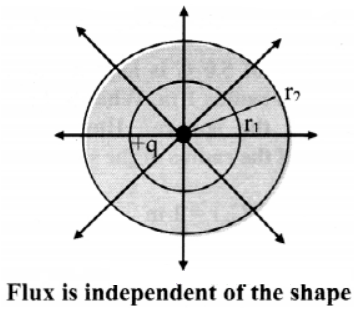
Explain: Electric flux is independent of shape and size of closed surface.
Answer
i. The net flux crossing an enclosed surface is equal to $\frac{q}{\varepsilon_0}$ where q is the net charge inside the closed surface.
ii. Consider a charge +q at the centre of concentric circles as shown in figure below
Image
As the charge inside the sphere is unchanged, the flux passing through a sphere of any radius is the same.
iii. Thus, if the radius of the sphere is increased by a factor of 2, the flux passing through is surface remains unchanged.
iv. As shown in figure same number of lines of force cross both the surfaces.
Hence, total flux is independent of shape of the closed surface radius of the sphere and size of closed surface.
View full question & answer
Question 124 Marks
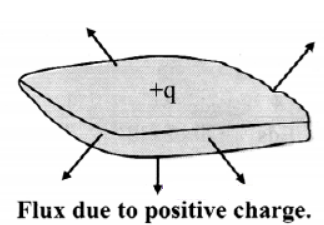
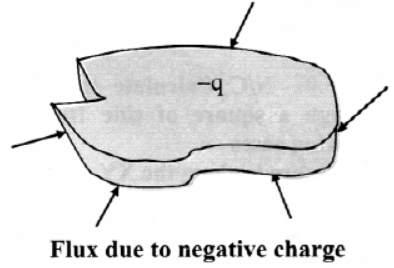
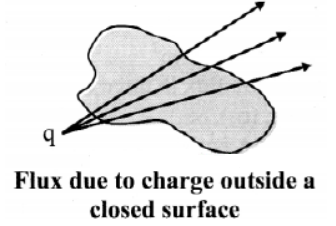
With a help of diagram, state the direction of flux due to positive charge, negative charge and charge outside a closed surface.
Answer
i
Image
Positive sign indicates that the flux is directed outwards, away from the charge.
ii
Image
If the charge is negative, the flux will be is directed inwards.
Image
If a charge is outside the closed surface, the net flux through it will be zero.
View full question & answer
Question 134 Marks
State and prove Gauss’ law of electrostatics.
Answer
Statement:
The flux of the net electric field through a closed surface equals the net charge enclosed by the surface divided by $E$.
$\int \vec{E} \cdot \overrightarrow{ dS }=\frac{ Q }{\varepsilon_0}$
where $Q$ is the total charge within the surface.
Proof:
$i$. Consider a closed surface of any shape which encloses number of positive electric charges.
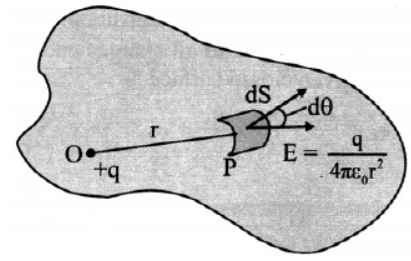
$ii$. Imagine a small charge $+q$ present at a point $O$ inside closed surface. Imagine an infinitesimal area $dS$ of the given irregular closed surface.
Image
$iii.$ The magnitude of electric field intensity at point $P$ on $dS$ due to charge $+q$ at point $O$ is, $E =\frac{1}{4 \pi \varepsilon_0}\left(\frac{ q }{ r ^2}\right) ..............(1)$
$iv$. The direction of $E$ is away from point $O$.
Let $\theta$ be the angle subtended by normal drawn to area $dS$ and the direction of $E$
$v$. Electric flux passing through area $(d$ varnothing $)$
$= E \cos\theta \ dS$
$=\frac{ q }{4 \pi \varepsilon_0 r ^2} \cos \theta dS ..............($from $1)$
$=\left(\frac{ q }{4 \pi \varepsilon_0}\right)\left(\frac{ dS \cos \theta}{ r ^2}\right)$
$\text { But, } d \omega=\frac{d S \cos \theta}{r^2}$
where, $dc$ is the solid angle subtended by area $dS$ at a point $O$.
$\therefore d \varnothing=\left(\frac{ q }{4 \pi \varepsilon_0}\right) d \omega .............(2)$
$vi$. Total electric flux crossing the given closed surface can be obtained by integrating equation $(2)$ over the total area.
$\phi_{ E }=\int_{ s } d \phi=\int_{ s } \overrightarrow{ E } \cdot \overrightarrow{ dS }$
$=\int \frac{ q }{4 \pi \varepsilon_0} d \omega=\frac{ q }{4 \pi \varepsilon_0} \int d \omega$
$vii$. But $\int d \omega=4 \pi=$ solid angle subtended by entire closed surface at point $O$.
Total Flux $=\frac{q}{4 \pi \varepsilon_0}(4 \pi)$
$\therefore \varnothing_{ E }=\int_{ s } \overrightarrow{ E } \cdot \overrightarrow{ dS }=\frac{+ q }{\varepsilon_0}$
$viii$. This is true for every electric charge enclosed by a given closed surface.
Total flux due to charge $q _1$, over the given closed surface $=+\frac{q_1}{\varepsilon_0}$
Total flux due to charge $q _2$, over the given closed surface $=+\frac{q_2}{\varepsilon_0}$
Total flux due to charge $q _n$, over the given closed surface $=+\frac{q_n}{\varepsilon_0}$
$ix$. According to the superposition principle, the total flux $c|>$ due to all charges enclosed within the given closed surface is
$\phi_{ E }=\frac{ q _1}{\varepsilon_0}+\frac{ q _2}{\varepsilon_0}+\frac{ q _3}{\varepsilon_0}+\ldots+\frac{ q _{ n }}{\varepsilon_0}=\sum_{ i =1}^{ i = n } \frac{ q _{ i }}{\varepsilon_0}=\frac{ Q }{\varepsilon_0}$
View full question & answer
Question 144 Marks
Explain the term: Electric flux
Answer
$i.$ The number of lines of force per unit area is the intensity of the electric field $\vec{E}$
$\therefore E=\frac{\text { Number of lines of force }}{\text { Area enclosing the lines of force }}$
$\therefore \quad$ Number of lines of force $=(E) \times($ Area $)$
Image
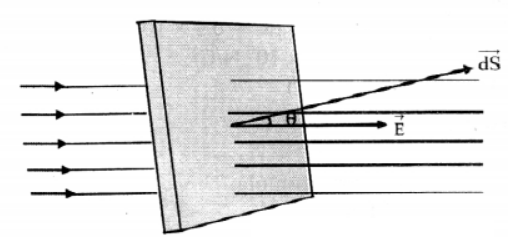
$ii.$ When the area is inclined at an angle $\theta$ with the direction of electric field, the electric flux can be calculated as follows.
Let the angle between electric field $\vec{E}$, and area vector $\overrightarrow{d S}$ be $\theta$, then the electric flux passing through are $dS$ is given by
$d \varnothing=(\text { component of } dS \text { along } \vec{E}) \times(\text { area of } \overrightarrow{d S})$
$d \varnothing= EdS \cos \theta$
$d \varnothing=\vec{E} \cdot \overrightarrow{d S}$
Total flux through the entire surface .
$\varnothing=\int d \varnothing=\int_S \vec{E} \cdot d \vec{S}=\vec{E} \cdot \vec{S}$
$iii.$ The $SI$ unit of electric flux can be calculated using,
$\varnothing=\vec{E} \cdot \vec{S}=( V / m ) m ^2= Vm$
$[$Note: Area vector is a vector whose magnitude is equal to area and is directed normal to its surface$]$
View full question & answer
Question 154 Marks
A simplified model of hydrogen atom consists of an electron revolving about a proton at a distance of $5.3 \times 10^{-11} m.$ The charge on a proton is $+1.6 \times 10^{-19} C.$ Calculate the intensity of the electric field due to proton at this distance. Also find the force between electron and proton.
Answer
Given: $r = 5.3 \times 10^{-11} m$
$q = 1.6 \times 10^{-19} C$
To Find :  $i.$ Intensity of electric field $(E)$
$ii.$ Force $(F)$
Formula : $i. E =\frac{1}{4 \pi \varepsilon_0} \times \frac{ q }{ r ^2}$
$ii. E =\frac{F}{q}$
Calculation from formula $(i)$
$E=9 \times 10^9 \times \frac{1.6 \times 10^{-19}}{\left(5.3 \times 10^{-11}\right)^2}$
$= 5.126 \times 10^{11} \ N/C$
Force between electron and proton,
$F = E \times q_e ….[$From formula $(ii)]$
$= 5.126 \times 10^{-11} \times -1.6 \times 10^{-19}$
$= -8.201 \times 10^8 N$
View full question & answer
Question 164 Marks
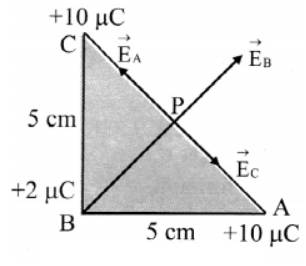
Three point charges are placed at the vertices of a right angled isosceles triangle as shown in the given figure. What is the magnitude and direction of the resultant electric field at point $P$ which is the mid point of its hypotenuseImage
Answer
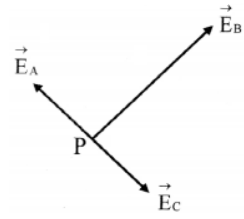
Electric field at $P$ due to the charges at $A, B$ and $C$ are shown in the figure.
Image
Let $\vec{E}_{ A }$ be the field at $P$ due to charge at $A$ and $\vec{E}_{ c }$ be the field at $P$ due to charge at $C.$
Since $P$ is the midpoint of $AC$ and the fields at $A$ and $C$ are equal in magnitudes and are opposite in direction, $E_A = – E_C.$
i.e., $\vec{E}_{ A }+\vec{E}_{ C }=0$.
Thus, the field at $P$ is only to the charge at $B$ and is given by,
$\overrightarrow{ E }_{ P }=\overrightarrow{ E }_{ B }=\frac{ q }{4 \pi \varepsilon_0 r ^2}=\frac{2 \times 10^{-6}}{4 \pi \varepsilon_0( BP )^2}$
$ \angle BCA =45^{\circ}$
$\therefore \sin 45^{\circ}=\frac{ BP }{ BC }$
$\therefore BP = BC \sin 45^{\circ}$
$=5 \times \frac{1}{\sqrt{2}} \ cm$
$=\frac{5}{\sqrt{2}} \times 10^{-2} m$
$\vec{E}_P=\frac{2 \times 10^{-6} \times 9 \times 10^9}{\left(\frac{5}{\sqrt{2}} \times 10^{-2}\right)^2}$
$=\frac{2 \times 9 \times 10^3 \times 2}{25 \times 10^{-4}}$
$=\frac{36}{25} \times 10^7$
$=1.44 \times 10^7 N C ^{-1}$ along $\overrightarrow{ BP }$
View full question & answer
Question 174 Marks
State the characteristics of electric lines of force.
Answer
  1. The lines of force originate from a positively charged object and end on a negatively charged object.
  2. The lines of force neither intersect nor meet each other, as it will mean that electric field has two directions at a single point.
  3. The lines of force leave or terminate on a conductor normally.
  4. The lines of force do not pass through conductor i.e., electric field inside a conductor is always zero, but they pass through insulators.
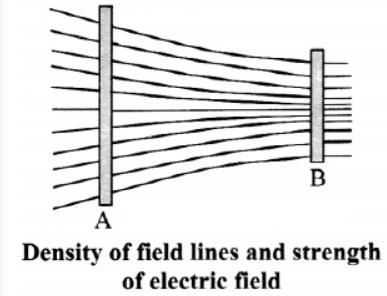
  5. Magnitude of the electric field intensity is proportional to the number of lines of force per unit area of the surface held perpendicular to the field.
  6. Electric lines of force are crowded in a region where electric intensity is large.
  7. Electric lines of force are widely separated from each other in a region where electric intensity is small
  8. The lines of force of an uniform electric field are parallel to each other and are equally spaced.
View full question & answer
Question 184 Marks
What are electric lines of force?
Answer
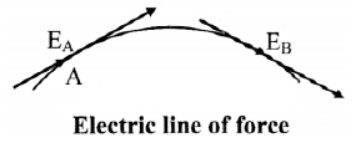
i. An electric line of force is an imaginary curve drawn in such a way that the tangent at any given point on this curve gives the direction of the electric field at that point.
ii. If a test charge is placed in an electric field it would be acted upon by a force at every point in the field and will move along a path.
iii. The path along which the unit positive charge moves is called a line of force
Image
iv. A line of force is defined as a curve such that the tangent at any point to this curve gives the direction of the electric field at that point.
v. The density of field lines indicates the strength of electric fields at the given point in space.
Image
View full question & answer
Question 194 Marks
Derive relation between electric field $(E)$ and electric potential $(V).$
Answer
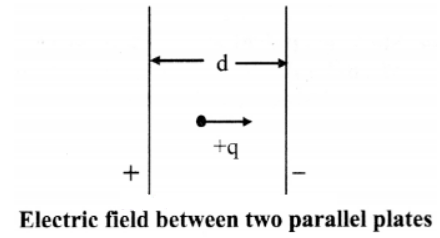
$i.$ A pair of parallel plates is connected as shown in the figure. The electric field between them is uniformImage
$ii.$ A potential difference $V$ is applied between two parallel plates separated by a distance $‘d \ ’.$
$iii.$ The electric field between them is directed from plate $A$ to plate $B.$
$iv.$ A charge $+q$ placed between the plates experiences a force $F$ due to the electric field.
$v.$ If the charge is moved against the direction of field, i.e., towards the positive plate, some amount of work is done on it.
$vi.$ If the charge is moved $+q$ from the negative plate $B$ to the positive plate $A,$ then the work done against the field is $W = Fd;$ where $‘d \ ’$ is the separation between the plates.
$vii.$ The potential difference $V$ between the two plates is given by $W = V_q,$
but $W = Fd$
$\therefore Vq = Fd$
$\therefore \frac{F}{q}=\frac{V}{d}= E$
$\therefore$ Electric field can be defined as $E = V/d.$
View full question & answer
Question 204 Marks
Derive expression for electric field intensity due to a point charge in a material medium.
Answer
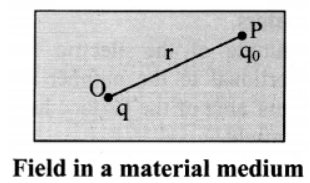
i. Consider a point charge q placed at point O in a medium of dielectric constant K as shown in figureImage
ii. Consider the point P in the electric field of point charge at distance r from q. A test charge q0 placed at the point P will experience a force which is given by the Coulomb’s law,
$\vec{F}=\frac{1}{4 \pi \varepsilon_0 K} \frac{ qq _0}{ r ^2} \hat{ r }$
where $\hat{r}$ is the unit vector in the direction of force i.e., along $O P$.
iii. By the definition of electric field intensity,
$\vec{F}=\frac{F}{ q _0}=\frac{1}{4 \pi \varepsilon_0 K} \frac{ q }{ r ^2} \hat{ r }$
The direction of $\vec{E}$ will be along OP when $q$ is positive and along PO when q is negative.
iv. The magnitude of electric field intensity in a medium is given by, $E=\frac{1}{4 \pi \varepsilon_0 K} \frac{q}{r^2}$
v. For air or vacuum, K = 1 then
$E =\frac{1}{4 \pi \varepsilon_0} \frac{ q }{ r ^2}$
View full question & answer
Question 214 Marks
Explain the concept of electric field.
Answer
  1. The space around a charge gets modified when a test charge is brought in that region, it experiences a coulomb force. The region around a charged object in which coulomb force is experienced by another charge is called electric field.
  2. Mathematically, electric field is defined as the force experienced per unit charge.
  3. The coulomb force acts across an empty space (vacuum) and does not need any intervening medium for its transmission.
  4. The electric field exists around a charge irrespective of the presence of other charges.
  5. Since the coulomb force is a vector, the electric field of a charge is also a vector and is directed along the direction of the coulomb force, experienced by a test charge.
View full question & answer
Question 224 Marks
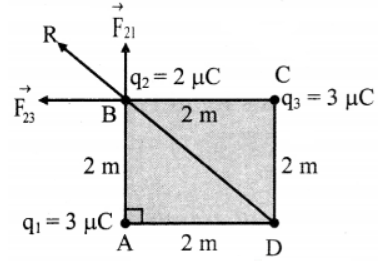
There are three charges of magnitude $3 \ pC, 2 \ pC$ and $3 \ pC$ located at three corners $A, B$ and $C$ of a square $\text{ABCD}$ of each side measuring $2 m.$ Determine the net force on $2 \ pC$ charge.
Answer
Given $: q_1 = 3 µC, q_2 = 2 µC, q_3 = 3 µC, r = 2 m$
To find: Net force on $q_2 (R)$
Formula: $F =\frac{1}{4 \pi \varepsilon_0} \frac{q_1 q_2}{r^2}$
Calculation:
Image
From the formula,
Force on $q_2$ because of $q_1$
$=\vec{F}_{21}=\frac{1}{4 \pi \varepsilon_0} \frac{ q _1 q _2}{ r ^2}=\frac{9 \times 10^9 \times 3 \times 10^{-6} \times 2 \times 10^{-6}}{2^2}$
$=1.35 \times 10^{-2} N$
Force on $q_2$ because of $q_3$
$=\overrightarrow{ F _{23}}=\frac{1}{4 \pi \varepsilon_0} \frac{ q _2 q _3}{ r ^2}=\frac{9 \times 10^9 \times 2 \times 10^{-6} \times 3 \times 10^{-6}}{2^2}$
$=1.35 \times 10^{-2} N$
Net force on $q _2$ is the resultant force of $\vec{F}_{21}$ and $\vec{F}_{23}$ which is given by,
$R =\sqrt{ F _{21}^2+ F _{23}^2}$
$=\sqrt{\left(1.35 \times 10^{-2}\right)^2+\left(1.35 \times 10^{-2}\right)^2}$
$\therefore R = 1.91 \times 10^{-2} N$
View full question & answer
Question 234 Marks
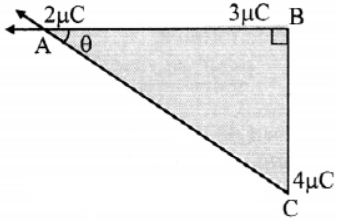
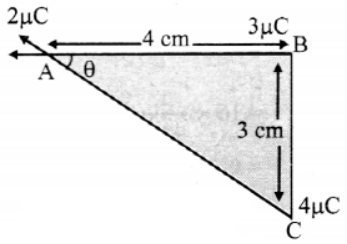
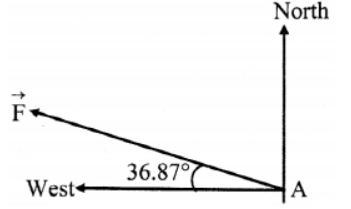
Three charges of $2 \mu C, 3\mu C$ and $4 \mu C$ are placed at points $A, B$ and $C$ respectively, as shown in the figure. Determine the force on $A$ due to other charges.
$($Given: $AB = 4 \ cm, BC = 3 \ cm)$
Image
Answer
Image
Using pythagoras theorem
$ AC =\sqrt{A B^2+B C^2}$
$=\sqrt{4^2+3^2}$
$AC = 5 \ cm$
Magnitude of force $\vec{F}_{A B}$ on $A$ due to $B$ is,
$\overrightarrow{ F }_{ AB }=\frac{1}{4 \pi \varepsilon_0} \frac{ q _{ A } q _{ B }}{ r _{ AB }{ }^2}$
$=9 \times 10^9 \times \frac{2 \times 10^{-6} \times 3 \times 10^{-6}}{\left(4 \times 10^{-2}\right)^2}=33.75 N$
Magnitude of force $\vec{F}_{A C}$ on $A$ due to $C$ is,
$\overrightarrow{ F }_{ AC }=\frac{1}{4 \pi \varepsilon_0} \frac{ q _{ A } q _{ C }}{ r _{ AC }^2}$
$=9 \times 10^9 \times \frac{2 \times 10^6 \times 4 \times 10^6}{\left(5 \times 10^{-2}\right)^2}$
$=28.8 N$
$\text { In } \triangle A B C \ 4$
$\cos \theta=\frac{4}{5}$
$\theta=\cos ^{-1}\left(\frac{4}{5}\right)=36.87^{\circ}$
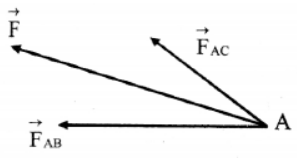
Forces acting points $A$ are
Image
Magnitude of resultant force,
$\vec{F}=\vec{F}_{A B}+\vec{F}_{A C}$
$\therefore |\overrightarrow{ F }|=\sqrt{ F _{A B}{ }^2+ F _{ AC }{ }^2+2 F_{ AB } \times F _{ AC } \cos \theta}$
$=\sqrt{33.75^2+28.8^2+2 \times 33.75 \times 28.8 \times \cos 36.87^{\circ}}$
$= 59.36 N$
Direction of resultant force is $36.87^\circ ($north of west$)$
Image
$[$Note: The question given above is modified considering minimum requirement of data needed to solve the problem.$]$
View full question & answer
Question 244 Marks
State and explain principle of superposition.
Answer
  Statement: When a number of charges are interacting, the resultant force on a particular charge is given by the vector sum of the forces exerted by individual charges.
Explanation:
i. Consider a number of point charges q1, q2, q3 ……………… kept at points A1, A2, A3 ………….. as shown in figure
https://pg-data.sgp1.digitaloceanspaces.com/chapter_wise/16082/K3.png" alt="Image" width="200" height="">
ii. The force exerted on the charge $q _1$ by $q _2$ is $\vec{F}_{12}$ The value of $\vec{F}_{12}$ is calculated by ignoring the presence of other charges. Similarly, force $\vec{F}_{13}, \vec{F}_{14}$ can be found, using the Coulomb's law.
iii. Total force $\vec{F}_1$ on charge qi is the vector sum of all such forces.
$\vec{F}_1=\vec{F}_{12}+\vec{F}_{13}+\vec{F}_{14}+$ .............
$=\frac{1}{4 \pi \varepsilon_0}\left[\frac{ q _1 q _2}{\left| r _{21}\right|^2} \times \hat{ r }_{21}+\frac{ q _1 q _3}{\left| r _{31}\right|^2} \times \hat{ r }_{31}+\ldots\right]$
where $\hat{r}_{21}, \hat{r}_{31}$ are unit vectors directed to $q _1$ from $q _2, q_3$ respectively and $r_{21}, r_{31}, r_{41}$ are the distances from $q_1$ to $q_2, q_3$ respectively.
iv. If $q_1, q_2, q_3 \ldots . . . ., q_n$ are the point charges then the force $\vec{F}$ exerted by these charges on a test charge $q _0$ is given by,
$\vec{F}_{\text {test }}=\vec{F}_1=\vec{F}_2+\vec{F}_3+\ldots+\vec{F}_{ n }$
$=\sum_{ n =1}^{ n } F _{ n }=\frac{1}{4 \pi \varepsilon_0} \sum_{ n =1}^{ n } \frac{ q _0 q _{ n }}{ r _{ n }^2} \hat{ r }_{ n }$
Where, $\hat{r}_n$ is a unit vector directed from the nth charge to the test charge $q_0$ and $r_2$ is the separation between them, $\vec{r}_{ n }= r _{ n } \hat{r}_{ n }$
View full question & answer
Question 254 Marks
Calculate and compare the electrostatic and gravitational forces between two protons which are $10^{-15} m$ apart. Value of $G = 6.674 \times 10^{-11} m^3 \ kg^{-1} s^{-2}$ and mass of the porton is $1.67 \times 10^{-27} \ kg.$
Answer
Given $: G = 6.674 \times 10^{-11} m^3 \ kg^{-1} s^{-2}$
$m_p = 1.67 \times 10^{-27} \ kg.$
$q_p = 1.67 \times 10^{-19} C, r = 10^{-15}$
To find:
$i.$ Electrostatic Force $(F_E)$
$ii.$ Gravitational Force $(F_G)$
Formula: $i. F _{ E }=\frac{1}{4 \pi \varepsilon_0} \frac{q_1 q_2}{r^2}$
$ii. F _{ E }=\frac{G m_1 m_2}{r^2}$
Calculation:
From formula $(i),$
$F _{ E }=9 \times 10^9 \times \frac{1.6 \times 10^{-19} \times 1.6 \times 10^{-19}}{\left(10^{-15}\right)^2}$
$= 9 \times 1.6 \times 1.6 \times 10$
$= 90 \times 1.6 \times 1.6$
$= \text {antilog} [\log 90 + \log 1.6 + \log 1.6]$
$= \text {antilog} [1.9542 + 0.2041 + 0.2041]$
$= \text {antilog} [2.3624]$
$= 2.303 \times 10^2 N$
From formula $(ii),$
$F _{ G }=6.674 \times 10^{-11} \times \frac{1.67 \times 10^{-27} \times 1.67 \times 10^{-27}}{\left(10^{-15}\right)^2}$
$= 6.674 \times 1.67 \times 1.67 \times 10^{-35}$
$= {\text {antilog} [\log 6.674 + \log 1.67 + \log 1.67]} \times 10^{-35}$
$= {\text {antilog} [0.8244 + 0.2227 + 0.2227]} \times 10^{-35}$
$= {\text {antilog} [1.2698]} \times 10^{-35}$
$= 1.861 \times 10^1 \times 10^{-35}$
$= 1.861 \times 10^{-34} N$
Now,
$\frac{ F _{ E }}{ F _{ G }}=\frac{2.303 \times 10^2}{1.861 \times 10^{-34}}$
$= {\text {antilog} [\log 2.303 – \log 1.861]} \times 10^{36}$
$= {\text {antilog} [0.3623 – 0.2697]} \times 10^{36}$
$= {\text {antilog} [0.0926]}$
$= 1.238 \times 10^{36}$
$\therefore F_E ≈ 10^{36} \times F_G$
View full question & answer
Question 264 Marks
$i.$ Two insulated charged copper spheres $A$ and $B$ have their centres separated by a distance of $50 \ cm.$ What is the mutual force of electrostatic repulsion, if the charge on each is $6.5 \times 10^{-7} C$? The radii of $A$ and $B$ are negligible compared to the distance of separation,
$ii.$ What is the force of repulsion if each sphere is charged double the above amount and the distance between them is halved?
Answer
Given $: q_1 = 6.5 \times 10^{-7} C q_2 = 6.5 \times 10^{-7} C$
$r = 50 \ cm = 0.50 m$
To find: Force of repulsion $(F)$
Formula: $F =\frac{1}{4 \pi \varepsilon_0} \frac{q_1 q_2}{r^2}$
Calculation:
From formula,
$F=\frac{9 \times 10^9 \times 6.5 \times 10^{-7} \times 6.5 \times 10^{-7}}{(0.50)^2}$
$F=1.52 \times 10^{-2} N$
$ii.$ When each charge is doubled and the distance between them is reduced to half, then
$F =\frac{1}{4 \pi \varepsilon_0} \frac{\left(2 q_1\right)\left(2 q_2\right)}{(r / 2)^2}$
$=16 \times \frac{1}{4 \pi \varepsilon_0} \frac{q_1 q_2}{r^2}=16 \times 1.52 \times 10^{-2}$
$\therefore F = 0.24 N$
View full question & answer
Question 274 Marks
Explain Coulomb’s law in vector form.
Answer
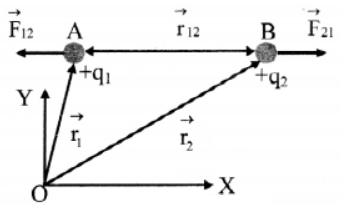
$i.$ Let $q_1$ and $q_2$ be the two similar point charges situated at points $A$ and $B$ and let $\vec{r}_{12}$ be the distance of separation between them.
$ii.$ The force $\vec{F}_{21}$ exerted on $q _2$ by $q _1$ is given by,
$\overrightarrow{ F }_{21}=\frac{1}{4 \pi \varepsilon_0} \frac{ q _1 q _2}{\left| r _{12}\right|^2} \times \hat{ r }_{12}$
where, $\hat{r}_{12}$ is the unit vector from $A$ to $B$.
$\vec{F}_{21}$ acts on $q _2$ at $B$ and is directed along $BA$ , away from $B$.
Image
$iii.$ Similarly, the force $\vec{F}_{12}$ exerted on $q _1$ by $q _2$ is given by, $\vec{F}_{12}=\frac{1}{4 \pi \varepsilon_0} \frac{ q _1 q _2}{\left| r _{12}\right|^2} \times \hat{ r _{21}}$
where, $\hat{r}_{21}$ is the unit vector from $B$ to $A . \vec{F}_{12}$ acts on $q _1$ at $A$ and is directed along $BA ,$ away from $A$.
$iv.$ The unit vectors $\hat{r}_{12}$ and $\hat{r}_{21}$ are oppositely directed i.e., $\hat{r}_{12}=-\hat{r}_{21}$ Hence, $\vec{F}_{21}=-\vec{F}_{12}$
Thus, the two charges experience force of equal magnitude and opposite in direction.
$v.$ These two forces form an action$-$reaction pair.
$vi.$ As $\vec{F}_{21}$ and $\vec{F}_{12}$ act along the line joining the two charges, the electrostatic force is a central force.
View full question & answer
Question 284 Marks
If relative permittivity of water is $80$ then derive the relation between $F _{\text {water }}$ and $F _{\text {vacuum }}$. What can be concluded from it?
Answer
$i.$ The force between two point charges $q_1$ and $q_2$ placed at a distance $r$ in a medium of relative permittivity $ε_r$ is given by
$F _{\text {med }}=\frac{1}{4 \pi \varepsilon_0 \varepsilon_r} \frac{ q _1 q _2}{ r ^2} ..............(1)$
If the medium is vacuum,
$F _{\text {vac }}=\frac{1}{4 \pi \varepsilon_0} \frac{ q _1 q _2}{ r ^2} .................(2)$
$ii.$ Dividing equation $(2)$ by equation $(1),$
$\frac{ F _{ vac }}{ F _{ med }}=\varepsilon_{ r }$
For water, $ε_r = 80 ……….. ($given$)$
$\therefore F_{\text {water }}=\frac{F_{\text {vac }}}{80}$
$iii.$ This means that when two point charges are placed some distance apart in water, the force between them is reduced to $\left(\frac{1}{80}\right)^{\text {th }}$ of the force between the same two charges placed at the same distance in vacuum.
$iv.$ Thus, it is concluded that a material medium reduces the force between charges by a factor of $er$, its relative permittivity.
View full question & answer
Question 294 Marks
Prove that relative permittivity is the ratio of the force between two point charges placed a certain distance apart in free space or vacuum to the force between the same two point charges when placed at the same distance in the given medium.
Answer
i. The force between the two charges placed in a medium is given by,
$F _{ med }=\frac{1}{4 \pi \varepsilon}\left(\frac{q_1 q_2}{r^2}\right)$ ...............(1)
where, $\varepsilon$ is called the absolute permittivity of the medium.
ii. The force between the same two charges placed in free space or vacuum at distance r is given by,
$F _{ vac }=\frac{1}{4 \pi \varepsilon_0}\left(\frac{q_1 q_2}{r^2}\right)$ ..............(1)
Dividing equation (2) by equation (1),
$\frac{ F _{ vac }}{ F _{ med }}=\frac{\frac{1}{4 \pi \varepsilon_0}\left(\frac{ q _1 q _2}{ r ^2}\right)}{\frac{1}{4 \pi \varepsilon}\left(\frac{ q _1 q _2}{ r ^2}\right)}$
$=\frac{\varepsilon}{\varepsilon_0}$
But $\varepsilon_{ r }=\frac{\varepsilon}{\varepsilon_0}$
$\therefore \quad \varepsilon_{ r }=\frac{ F _{ vac }^{ M }}{ F _{ med }}$
Hence, relative permittivity is the ratio of the force between two point charges placed a certain distance apart in free space or vacuum to the force between the same two point charges when placed at the same distance in the given medium.
View full question & answer
Question 304 Marks
State and explain Coulomb’s law of electric charge in scalar form.
Answer
Coulomb’s law:The force of attraction or repulsion between two point charges at rest is directly proportional to the product of the magnitude of the charges and inversely proportional to the square of the distance between them. This force acts along the line joining the two charges.
$i$. Let $q_1$ and $q_2$ be the two point charges at rest with each other and separated by a distance $r. $
$F$ is the magnitude of electrostatic force of attraction or repulsion between them.
$ii$. According to Coulomb’s law. $ F \propto \frac{q_1 q_2}{r^2}$
$\therefore F = K \frac{q_1 q_2}{r^2}$
where, $K$ is the constant of proportionality which depends upon the units of $F, q_1, q_2, r$ and medium in which charges are placed.
View full question & answer
Question 314 Marks
How much positive and negative charge is present in $1 g$ of water? How many electrons are present in it?
$($Given: molecular mass of water is $18.0 g)$
Answer
Molecular mass of water is $18$ gram, that means the number of molecules in $18$ gram of water is $6.02 \times 1023$
$\therefore$ Number of molecules in $I \ gm$ of water $=\frac{6.02 \times 10^{23}}{18}$
one molecule of water $(H_2O)$ contains two hydrogen atoms and one oxygen atom. Thus, the number of electrons in $\text{ILO}$ is sum of the number of electrons in $H2$ and oxygen. There are $2$ electrons in $H_2$ and $8$ electrons in oxygen.
$\therefore$ Number of electrons in $H2O = 2 + 8 = 10$
Total number of protons / electrons in one gram of water
$=\frac{6.02 \times 10^{23}}{18} \times 10=3.344 \times 10^{23}$
Total positive charge
$=3.344 \times 10^{23} \times$ charge on a proton
$=3.344 \times 10^{23} \times 1.6 \times 10^{-19} C$
$=5.35 \times 10^4 C$
This positive charge is balanced by equal amount of negative charge so that the water molecule is electrically neutral.
$\therefore$ Total negative charge $= 5.35 \times 104C$
View full question & answer
Question 324 Marks
Explain the concept of additive nature of charge.
Answer
  1. Electric charge is additive, similar to mass. The total electric charge on an object is equal to the algebraic sum of all the electric charges distributed on different parts of the object.
  2. It may be pointed out that while taking the algebraic sum, the sign (positive or negative) of the electric charges must be taken into account.
  3. Thus, if two bodies have equal and opposite charges, the net charge on the system of the two bodies is zero.
  4. This is similar to that in case of atoms where the nucleus is positively charged and this charge is equal to the negative charge of the electrons making the atoms electrically neutral.
View full question & answer
Question 334 Marks
Explain concept of charging by induction.
Answer
  1. If an uncharged conductor is brought near a charged body, (not in physical contact) the nearer side of the conductor develops opposite charge to that on the charged body and the far side of the conductor develops charge similar to that on the charged body. This is called induction.
  2. This happens because the electrons in a conductor are free and can move easily in presence of charged body.
  3. A charged body attracts or repels electrons in a conductor depending on whether the charge on the body is positive or negative respectively.
  4. Positive and negative charges are redistributed and are accumulated at the ends of the conductor near and away from the charged body.
  5. In induction, there is no transfer of charges between the charged body and the conductor. So when the charged body is moved away from the conductor, the charges in the conductor are free again.
View full question & answer