Question
A charged metallic sphere A is suspended by a nylon thread. Another charged metallic sphere B held by an insulating
Image
handle is brought close to A such that the distance between their centres is 10 cm, as shown in Fig. 1.4(a). The resulting repulsion of A is noted (for example, by shining a beam of light and measuring the deflection of its shadow on a screen). Spheres A and B are touched by uncharged spheres C and D respectively, as shown in Fig. 1.4(b). C and D are then removed and B is brought closer to A to a distance of 5.0 cm between their centres, as shown in Fig. 1.4(c). What is the expected repulsion of A on the basis of Coulomb’s law? Spheres A and C and spheres B and D have identical sizes. Ignore the sizes of A and B in comparison to the separation between their centres.
Answer

Let the original charge on sphere A be $q$ and that on B be $q^{\prime}$. At a distance $r$ between their centres, the magnitude of the electrostatic force on each is given by
$
F=\frac{1}{4 \pi \varepsilon_0} \frac{q q^{\prime}}{r^2}
$
neglecting the sizes of spheres A and B in comparison to $r$. When an identical but uncharged sphere $C$ touches $A$, the charges redistribute on A and $C$ and, by symmetry, each sphere carries a charge q/2. Similarly, after D touches B, the redistributed charge on each is $q^{\prime} / 2$. Now, if the separation between A and B is halved, the magnitude of the electrostatic force on each is
$
F^{\prime}=\frac{1}{4 \pi \varepsilon_0} \frac{(q / 2)\left(q^{\prime} / 2\right)}{(r / 2)^2}=\frac{1}{4 \pi \varepsilon_0} \frac{\left(q q^{\prime}\right)}{r^2}=F
$
Thus the electrostatic force on A, due to B, remains unaltered.

Need a full question paper?

Generate a complete, print-ready paper with questions like this in minutes — across 16+ boards, with answer keys.

Start Generating Free

Similar questions

A large conducting plane has a surface charge density $1.0\times10^{-4}\text{Cm}^{-2}.$ Find the electrostatic energy stored in a cubical volume of edge 1.0cm in front of the plane.
Why are alloys used for making standard resistance coils?
A magnetic flux of $8 \times 10^{-4}$ weber is linked with each turn of a $200-$turn coil when there is an electric current of $4A$ in it. Calculate the self$-$inductance of the coil.
A $p-n$ photodiode is fabricated from a semiconductor with band gap of $2.8\ eV$. Can it detect a wavelength of $6000\ nm$?
Calculate the energy released by $1g$ of natural uranium assuming $200\ MeV$ is released in each fission event and that the fissionable isotope $^{235}U$ has an abundance of $0.7\%$ by weight in natural uranium.
For a $CE-$transistor amplifier, the audio signal voltage across the collected resistance of $2k \Omega$ is $2 V$. Suppose the current amplification factor of the transistor is $100,$ find the input signal voltage and base current, if the base resistance is $1k \Omega$ .
  1. Explain with the help of a diagram formation of depletion region and barrier potential in a $pn$ junction.
  2. Draw the circuit diagram of a half wave rectifier and explain its working.
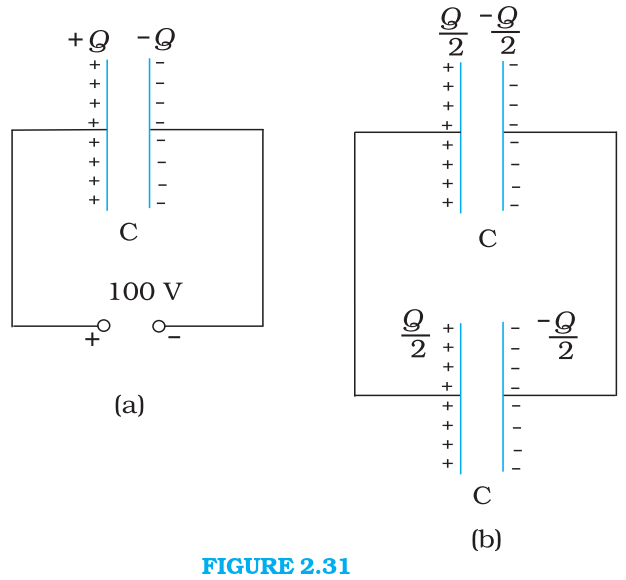
(a) A $900 pF$ capacitor is charged by $100 V$ battery [Fig. 2.31(a)]. How much electrostatic energy is stored by the capacitor? (b) The capacitor is disconnected from the battery and connected to another $900 pF$ capacitor [Fig. 2.31(b)]. What is the electrostatic energy stored by the system?
Image
A particle goes in a circle of radius 2.0cm. A concave mirror of focal length 20cm is placed with its principal axis passing through the centre of the circle and perpendicular to its plane. The distance between the pole of the mirror and the centre of the circle is 30cm. Calculate the radius of the circle formed by the image.
Explain the difference between conductor, insulator and semiconductor on the basis of energy band in solids.