MCQ
A charged object is launched inside a time varying electric field. Its motion is recorded by a video camera on a video tape. When it is at a certain moment $A$ , its position vector $\vec r$, velocity $\vec v$ and acceleration $\vec a$ are measured. A student watches the video at a later time but mistakenly plays the tape in the reverse direction. What is the position, velocity, and acceleration of the object, at moment $A$ observed by the student respectively?
  • A
    $\vec r,\vec v,\vec a$
  • B
    $- \vec r, -\vec v, -\vec a$
  • $\vec r,- \vec v,\vec a$
  • D
    $\vec r,\vec v,- \vec a$

Answer

Correct option: C.
$\vec r,- \vec v,\vec a$
c

Need a full question paper?

Generate a complete, print-ready paper with questions like this in minutes — across 16+ boards, with answer keys.

Start Generating Free

Similar questions

If $|\overrightarrow A \times \overrightarrow B |\, = \,|\overrightarrow A \,.\,\overrightarrow B |,$ then angle between $\overrightarrow A $ and $\overrightarrow B $ will be ........ $^o$
Dispersion of light is due to
A cylindrical rod having temperature ${T_1}$ and ${T_2}$ at its ends. The rate of flow of heat is ${Q_1}$ $cal/sec$. If all the linear dimensions are doubled keeping temperature constant then rate of flow of heat ${Q_2}$ will be
A simple harmonic progressive wave is represented by the equation : $y = 8\sin 2\pi (0.1x - 2t)$ where $x$ and $y$ are in $cm$ and $t$ is in seconds. At any instant the phase difference between two particles separated by $2.0 \,cm$ in the $x-$direction is ..... $^o$
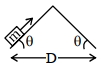
An object of mass $'m'$ is being moved with a constant velocity under the action of an applied force of $2\, {N}$ along a frictionless surface with following surface profile.

The correct applied force vs distance graph will be:

An unpolarized light passes through three polarizing sheets whose polariging directions make an angle of $30^o$ , $60^o$ and $30^o$ with $y$ axis in same sense. What fraction of initial intensity is transmitted by the system ?
A body cools in $7$ minutes from ${60^o}C$ to ${40^o}C$ What time (in minutes) does it take to cool from ${40^o}C$ to ${28^o}C$ if the surrounding temperature is ${10^o}C$? Assume Newton’s Law of cooling holds
The equation of progressive wave is $y = a\sin (200\,t - x)$. where $x$ is in meter and $t$ is in second. The velocity of wave is  ..... $m/sec$
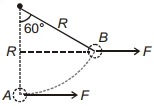
A block of mass $m$ is pulled along a circular arc by means of a constant horizontal force $F$ as shown. Work done by this force in pulling the block from $A$ to $B$ is ............ 
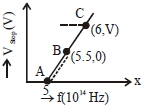
Given figure shows few data points in a photo electric effect experiment for a certain metal. The minimum energy for ejection of electron from its surfface is$.......eV$

(Plancks constant $\left. h =6.62 \times 10^{-34}\, J . s \right)$