The equation of progressive wave is $y = a\sin (200\,t - x)$. where $x$ is in meter and $t$ is in second. The velocity of wave is ..... $m/sec$
Easy
Download our app for free and get started
(a) comparing the given equation with $y = a\sin \left( {\omega t - kx} \right)$
$\omega = 200\,,\;\,k = 1$ so $v = \frac{\omega }{k} = 200\,m/s$
$\omega = 200\,,\;\,k = 1$ so $v = \frac{\omega }{k} = 200\,m/s$

Download our appand get started for free
Experience the future of education. Simply download our apps or reach out to us for more information. Let's shape the future of learning together!No signup needed.*
Similar Questions
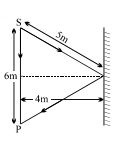
- 1A person standing at a distance of $6\,\, m$ from a source of sound receives sound wave in two ways, one directly from the source and other after reflection from a rigid boundary as shown in the figure. The maximum wavelength for which, the person will receive maximum sound intensity, is .... $m$View Solution
- 2Two waves represented by the following equations are travelling in the same medium ${y_1} = 5\sin 2\pi (75t - 0.25x)$, ${y_2} = 10\sin 2\pi (150t - 0.50x)$ The intensity ratio ${I_1}/{I_2}$ of the two waves isView Solution
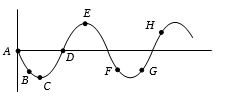
- 3View SolutionThe diagram below shows the propagation of a wave. Which points are in same phase
- 4A tuning fork of frequency $340\, Hz$ is sounded above an organ pipe of length $120\, cm$. Water is now slowly poured in it. The minimum height of water column required for resonance is .... $cm$ (speed of sound in air $= 340 \,m/s$)View Solution
- 5If the ratio of amplitude of wave is $2 : 1$, then the ratio of maximum and minimum intensity isView Solution
- 6An organ pipe is closed at one end has fundamental frequency of $1500 Hz$. The maximum number of overtones generated by this pipe which a normal person can hear is :View Solution
- 7A closed organ pipe has a fundamental frequency of $1.5\, kHz$. The number of overtones that can be distinctly heard by a person with this organ pipe will be : (Assume that the highest frequency a person can hear is $20,000\, Hz$)View Solution
- 8A tuning fork of unknown frequency makes $3\,beats/sec$ with a standard fork of frequency $384\,Hz$ . The beat frequency decreases when a small piece of wax is put on the prong of the first. The frequency of the fork is .... $Hz$View Solution
- 9Two opens organ pipes of length $50\, cm$ and $50.5\, cm$ produce three beats. Then, the velocity of sound is ..... $m/s$View Solution
- 10A tuning fork resonates with a sonometer wire of length $1 \mathrm{~m}$ stretched with a tension of $6 \mathrm{~N}$. When the tension in the wire is changed to $54 \mathrm{~N}$, the same tuning fork produces $12$ beats per second with it. The frequency of the tuning fork is $\mathrm{Hz}$.View Solution