A charged particle going around in a circle can be considered to be a current loop. A particle of mass $m$ carrying charge $q$ is moving in a plane with speed $v$ under the influence of magnetic field $\overrightarrow{ B }$. The magnetic moment of this moving particle
JEE MAIN 2020, Diffcult
Download our app for free and get started
Magnetic moment
$M=i A$
$M=\left(\frac{q}{T}\right) \times \pi r^{2}=\frac{q \pi r^{2}}{\left(\frac{2 \pi r}{v}\right)}=\frac{q v r}{2}$
$M=\frac{q v}{2} \times \frac{v m}{q B}$
$M =\frac{ mv ^{2}}{2 B }$
As we can see from the figure, direction of magnetic moment $(M)$ is opposite to magnetic field.
$\overrightarrow{ M }=-\frac{ mv ^{2}}{2 B } \hat{ B }$
$=-\frac{m v^{2}}{2 B^{2}} \vec{B}$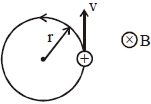

Download our appand get started for free
Experience the future of education. Simply download our apps or reach out to us for more information. Let's shape the future of learning together!No signup needed.*
Similar Questions
- 1A charged particle of mass $m$ and charge $q$ travels on a circular path of radius $r$ that is perpendicular to a magnetic field $B$. The time taken by the particle to complete one revolution isView Solution
- 2A proton (mass $m$ and charge $+e$) and an $\alpha - $particle (mass $4m$ and charge $+2e$) are projected with the same kinetic energy at right angles to the uniform magnetic field. Which one of the following statements will be trueView Solution
- 3A steady current $I$ flows along an infinitely long hollow cylindrical conductor of radius $R$. This cylinder is placed coaxially inside an infinite solenoid of radius $2 \ R$. The solenoid has $n$ turns per unit length and carries a steady current $I$. Consider a point $P$ at a distance $r$ from the common axis. The correct statement$(s)$ is (are) :View Solution
$(A)$ In the region $0 < r < R$, the magnetic field is non-zero.
$(B)$ In the region $R < r < 2 R$, the magnetic field is along the common axis.
$(C)$ In the region $R < r < 2 R$, the magnetic field is tangential to the circle of radius $r$, centered on the axis.
$(D)$ In the region $r > 2 R$, the magnetic field is non-zero.
- 4A uniform magnetic field $B$ and a uniform electric field $E$ act in a common region. An electron is entering this region of space. The correct arrangement for it to escape undeviated isView Solution
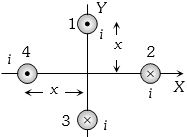
- 5What will be the resultant magnetic field at origin due to four infinite length wires. If each wire produces magnetic field '$B$' at originView Solution
- 6A particle is projected with a velocity ( $10\ m/s$ ) along $y-$ axis from point $(2, 3)$ . Magnetic field of $\left( {3\hat i + 4\hat j} \right)$ Tesla exist uniformly in the space. Its speed when particle passes through $y-$ axis for the third time is : (neglect gravity)View Solution
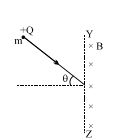
- 7A particle with charge $+Q$ and mass m enters a magnetic field of magnitude $B,$ existing only to the right of the boundary $YZ$. The direction of the motion of the $m$ particle is perpendicular to the direction of $B.$ Let $T = 2\pi\frac{m}{{QB}}$ . The time spent by the particle in the field will beView Solution
- 8Given below are two statements: One is labelled as Assertion $(A)$ and the other is labelled as Reason $(R).$View Solution
Assertion $(A)$ : In an uniform magnetic field, speed and energy remains the same for a moving charged particle.
Reason $(R)$ : Moving charged particle experiences magnetic force perpendicular to its direction of motion.
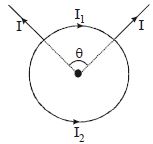
- 9Assertion : The magnetic field at the centre of the circular coil in the following figure due to the currents $I_1$ and $I_2$ is zero.View Solution
Reason : $I_1 = I_2$ implies that the fields due to the current $I_1$ and $I_2$ will be balanced.
- 10View SolutionWhich particles will have minimum frequency of revolution when projected with the same velocity perpendicular to a magnetic field