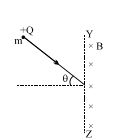
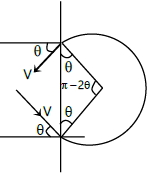
A particle with charge $+Q$ and mass m enters a magnetic field of magnitude $B,$ existing only to the right of the boundary $YZ$. The direction of the motion of the $m$ particle is perpendicular to the direction of $B.$ Let $T = 2\pi\frac{m}{{QB}}$ . The time spent by the particle in the field will be
Advanced


Download our appand get started for free
Experience the future of education. Simply download our apps or reach out to us for more information. Let's shape the future of learning together!No signup needed.*
Similar Questions
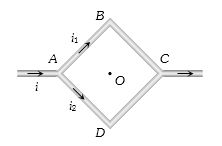
- 1Figure shows a square loop $ABCD$ with edge length $a$. The resistance of the wire $ABC$ is $r$ and that of $ADC$ is $2r$. The value of magnetic field at the centre of the loop assuming uniform wire isView Solution
- 2A galvanometer, having a resistance of $50 \,\Omega$ gives a full scale deflection for a current of $0.05\, A$. The length in meter of a resistance wire of area of cross-section $2.97× 10^{-2} \,cm^2$ that can be used to convert the galvanometer into an ammeter which can read a maximum of $5\, A$ current is (Specific resistance of the wire = $5 × {10^{ - 7}}\,\Omega m$)View Solution
- 3View SolutionConsider the magnetic field produced by a finitely long current carrying wire.
- 4An electron with energy $0.1\,ke\,V$ moves at right angle to the earth's magnetic field of $1 \times 10^{-4}\,Wbm ^{-2}$. The frequency of revolution of the electron will be. (Take mass of electron $=9.0 \times 10^{-31}\,kg$ )View Solution
- 5View SolutionWhich of the following particle will experience maximum acceleration when projected with same speed in transverse magnetic field
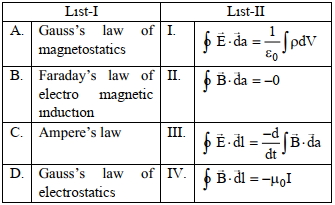
- 6Match List $I$ with List $II$View Solution
Choose the correct answer from the options given below:
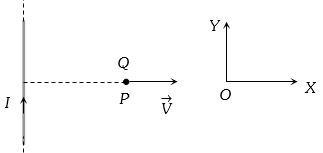
- 7A very long straight wire carries a current $I$. At the instant when a charge $ + Q$ at point $P$ has velocity $\overrightarrow V $, as shown, the force on the charge isView Solution
- 8A straight conductor carries a current of $5A$. An electron travelling with a speed of $5 \times {10^6}\,m{s^{ - 1}}$ parallel to the wire at a distance of $0.1\,m$ from the conductor, experiences a force ofView Solution
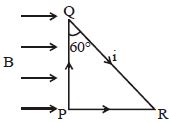
- 9For the circuit shown in figure, the direction and magnitude of the force on $PQR$ is :-View Solution
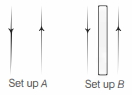
- 10In an experiment, set up $A$ consists of two parallel wires which carry currents in opposite directions as shown in the figure. $A$ second set up $B$ is identical to set up $A$, except that there is a metal plate between the wires. Let $F_A$ and $F_B$ be the magnitude of the force between the two wires in setup $A$ and setup $B$, respectively.View Solution