A charged particle initially at rest at $O$,when released follows a trajectory as shown alongside. Such a trajectory is possible in the presence of

KVPY 2014, Medium


Download our appand get started for free
Experience the future of education. Simply download our apps or reach out to us for more information. Let's shape the future of learning together!No signup needed.*
Similar Questions
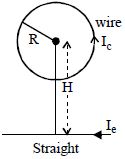
- 1Circular loop of a wire and a long straight wire carry currents $I_c$ and $I_e$, respectively as shown in figure. Assuming that these are placed in the same plane, the magnetic fields will be zero at the centre of the loop when the separation $H$ isView Solution
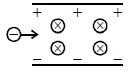
- 2An electron enters the space between the plates of a charged capacitor as shown. The charge density on the plate is $\sigma $. Electric intensity in the space between the plates is $E$. A uniform magnetic field $B$ also exists in that space perpendicular to the direction of $E$. The electron moves perpendicular to both $\vec E$ and $\vec B$ without any change in direction. The time taken by the electron to travel a distance $\ell $ is the space isView Solution
- 3View SolutionIf the current is doubled, the deflection is also doubled in
- 4In an experiment, electrons are accelerated, from rest, by applying, a voltage of $500 \,V.$ Calculate the radius of the path if a magnetic field $100\,mT$ is then applied. [Charge of the electron $= 1.6 \times 10^{-19}\,C$ Mass of the electron $= 9.1 \times 10^{-31}\,kg$ ]View Solution
- 5View SolutionA small cylindrical soft iron piece is kept in a galvanometer so that
- 6In an ammeter, $5 \%$ of the main current passes through the galvanometer. If resistance of the galvanometer is G, the resistance of ammeter will be :View Solution
- 7The radius of a circular ring of wire is $R$ and it carries a current of $I\,ampere$. At its centre a smaller ring of radius $r$ with current $i$ and $N\, turns$ is placed. Assuming that the planes of two rings are perpendicular to each other and the magnetic induction produced at the centre of bigger ring is constant, then the torque acting on smaller ring will beView Solution
- 8Consider a galvanometer shunted with $5\, \Omega$ resistance and $2\, \%$ of current passes through it.View Solution
What is the resistance of the given galvanometer? (In $\Omega$)
- 9In a moving coil galvanometer, the deflection of the coil $\theta $ is related to the electrical current $i$ by the relationView Solution
- 10View SolutionElectrons moving with different speeds enter a uniform magnetic field in a direction perpendicular to the field., time periods of rotation will be :