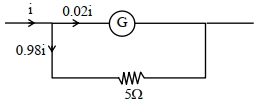
Consider a galvanometer shunted with $5\, \Omega$ resistance and $2\, \%$ of current passes through it.
What is the resistance of the given galvanometer? (In $\Omega$)
JEE MAIN 2021, Medium


Download our appand get started for free
Experience the future of education. Simply download our apps or reach out to us for more information. Let's shape the future of learning together!No signup needed.*
Similar Questions
- 1View SolutionIn a cyclotron experiment, if we assume that maximum radius attained by any charged particle is equal to radius of dees, then minimum kinetic energy gained by the particles will be for
- 2In an experiment, electrons are accelerated, from rest, by applying, a voltage of $500 \,V.$ Calculate the radius of the path if a magnetic field $100\,mT$ is then applied. [Charge of the electron $= 1.6 \times 10^{-19}\,C$ Mass of the electron $= 9.1 \times 10^{-31}\,kg$ ]View Solution
- 3View SolutionAn electron is moving in the north direction. It experiences a force in vertically upward direction. The magnetic field at the position of the electron is in the direction of
- 4A electron $(q = 1.6 \times 10^{-19}\, C)$ is moving at right angle to the uniform magnetic field $3.534 \times 10^{-5}\, T$. The time taken by the electron to complete a circular orbit is......$µs$View Solution
- 5When a certain length of wire is turned into one circular loop, the magnetic induction at the centre of coil due to some current flowing is ${B_1}$ If the same wire is turned into three loops to make a circular coil, the magnetic induction at the center of this coil for the same current will beView Solution
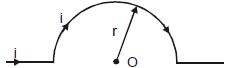
- 6A portion of a conductive wire is bent in the form of a semicircle of radius $r$ as shown below in fig. At the centre of semicircle, the magnetic induction will beView Solution
- 7A charged particle is moving in a circular orbit of radius $6\, cm$ with a uniform speed of $3 \times 10^6\, m/s$ under the action of a uniform magnetic field $2 \times 10^{-4}\, Wb/m^2$ which is at right angles to the plane of the orbit. The charge to mass ratio of the particle isView Solution
- 8An electron (charge $q$ $coulomb$) enters a magnetic field of $H$ $weber/{m^2}$ with a velocity of $v\,m/s$ in the same direction as that of the field the force on the electron isView Solution
- 9A charged particle enters a magnetic field $H$ with its initial velocity making an angle of $45^\circ $ with $H$. The path of the particle will beView Solution
- 10At a distance of $10\, cm $ from a long straight wire carrying current, the magnetic field is $0.04\, T$. At the distance of $40\, cm$, the magnetic field will be....$T$View Solution