A charged particle moves through a magnetic field perpendicular to its direction. Then
AIEEE 2007, Medium


Download our appand get started for free
Experience the future of education. Simply download our apps or reach out to us for more information. Let's shape the future of learning together!No signup needed.*
Similar Questions
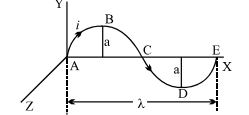
- 1A conductor $ABCDE$, shaped as shown, carries a current i. It is placed in the $xy$ plane with the ends $A$ and $E$ on the $x$-axis. $A$ uniform magnetic field of magnitude $B$ exists in the region. The force acting on it will beView Solution
- 2An electron is moving along the positive $x$-axis. If the uniform magnetic field is applied parallel to the negative $z$-axis. thenView Solution
$A.$ The electron will experience magnetic force along positive $y$-axis
$B.$ The electron will experience magnetic force along negative $y$-axis
$C.$ The electron will not experience any force in magnetic field
$D.$ The electron will continue to move along the positive $x$-axis
$E.$ The electron will move along circular path in magnetic field
Choose the correct answer from the options given below:
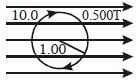
- 3A single circular loop of radius $1.00\, m$ carries a current of $10.0\, mA$. It is placed in $a$ uniform magnetic field of magnitude $0.500\, T$ that is directed parallel to the plane of the loop as suggested in the figure. The magnitude of the torque exerted on the loop by the magnetic field is.View Solution
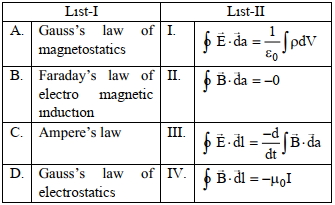
- 4Match List $I$ with List $II$View Solution
Choose the correct answer from the options given below:
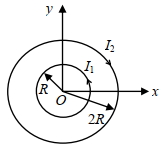
- 5Two concentric circular loops, one of radius $R$ and the other of radius $2 R$, lie in the $x y$-plane with the origin as their common center, as shown in the figure. The smaller loop carries current $I_1$ in the anti-clockwise direction and the larger loop carries current $I_2$ in the clockwise direction, with $I_2>2 I_1 . \vec{B}(x, y)$ denotes the magnetic field at a point $(x, y)$ in the $x y$-plane. Which of the following statement($s$) is(are) current?View Solution
$(A)$ $\vec{B}(x, y)$ is perpendicular to the $x y$-plane at any point in the plane
$(B)$ $|\vec{B}(x, y)|$ depends on $x$ and $y$ only through the radial distance $r=\sqrt{x^2+y^2}$
$(C)$ $|\vec{B}(x, y)|$ is non-zero at all points for $r$
$(D)$ $\vec{B}(x, y)$ points normally outward from the $x y$-plane for all the points between the two loops
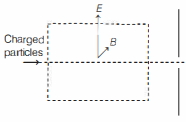
- 6View SolutionA stream of charged particles enter into a region with crossed electric and magnetic fields as shown in the figure below. On the other side is a screen with a hole that is right on the original path of the particles. Then,
- 7A coil in the shape of an equilateral triangle of side $l$ is suspended between the pole pieces of a permanent magnet such that $\vec {B}$ is in plane of the coil. If due to a current $i$ in the triangle a torque $\tau$ acts on it, the side $l$ of the triangle isView Solution
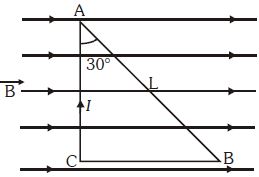
- 8Consider the inferences given below in respect of the following current loop of wire kept is a magnetic field $\vec B$View Solution
$A.$ The force on the element $AC$ of the wire is $\frac{{\sqrt 3 }}{2}\,ILB$ directed into the page
$B.$ The force on the element $AB$ of the wire is $\frac{{\sqrt 3 }}{2}\,ILB$ directed into the page
$C.$ The total force on the loop $ABCA$ is zero.
Which of the above is /are not true ?
- 9A current of $1\,A$ is flowing on the sides of an equilateral triangle of side $4.5\times10^{-2}\,m$ . The magnetic field at the centre of the triangle will beView Solution
- 10View SolutionAn electron and a proton enter a magnetic field perpendicularly. Both have same kinetic energy. Which of the following is true