Two concentric circular loops, one of radius $R$ and the other of radius $2 R$, lie in the $x y$-plane with the origin as their common center, as shown in the figure. The smaller loop carries current $I_1$ in the anti-clockwise direction and the larger loop carries current $I_2$ in the clockwise direction, with $I_2>2 I_1 . \vec{B}(x, y)$ denotes the magnetic field at a point $(x, y)$ in the $x y$-plane. Which of the following statement($s$) is(are) current?
$(A)$ $\vec{B}(x, y)$ is perpendicular to the $x y$-plane at any point in the plane
$(B)$ $|\vec{B}(x, y)|$ depends on $x$ and $y$ only through the radial distance $r=\sqrt{x^2+y^2}$
$(C)$ $|\vec{B}(x, y)|$ is non-zero at all points for $r$
$(D)$ $\vec{B}(x, y)$ points normally outward from the $x y$-plane for all the points between the two loops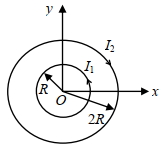
IIT 2021, Advanced
Download our app for free and get started
$(A)$ $d \overrightarrow{ B }=\frac{\mu_0 1 \overrightarrow{ d \ell} \times \overrightarrow{ r }}{4 \pi I ^5}$
$\overrightarrow{ d \ell}$ is in xy plane & $\overrightarrow{ r }$ is also in xy plane
so $d \overrightarrow{ B }$ is perpendicular to xy plane
$(B)$ Due to symmetry it depends only on $r=\sqrt{x^2+y^2}$
$(C)$ At centre $B_1=\frac{\mu_0 I_1}{2 R} ; B_2=\frac{\mu_0 I_2}{4 R} \Rightarrow B_2>B_1$
bu as we approach towards first loop $B_1$ increases to infinity hence $B_1$ dominates.
So it would be zero at some point between inner loops and centre.
Ans. $(A,B)$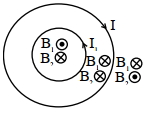

Download our appand get started for free
Experience the future of education. Simply download our apps or reach out to us for more information. Let's shape the future of learning together!No signup needed.*
Similar Questions
- 1An $\alpha $ particle and a proton travel with same velocity in a magnetic field perpendicular to the direction of their velocities, find the ratio of the radii of their circular pathView Solution
- 2View SolutionThe phosphor bronze strip is used in a moving coil galvanometer because
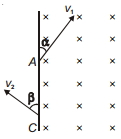
- 3A particle of charge $-q$ and mass $m$ enters a uniform magnetic field $\vec{B}$ at $A$ with speed $v_1$ at an angle $\alpha$ and leaves the field at $C$ with speed $v_2$ at an angle $\beta$ as shown. ThenView Solution
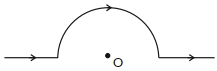
- 4A straight wire carrying a current of $14\,A$ is bent into a semicircular are of radius $2.2\,cm$ as shown in the figure. The magnetic field produced by the current at the centre $(O)$ of the arc. is $.........\,\times 10^{-4}\, T$View Solution
- 5Two long parallel wires carrying currents $8\,A$ and $15\,A$ in opposite directions are placed at a distance of $7\,cm$ from each other. A point $P$ is at equidistant from both the wires such that the lines joining the point $P$ to the wires are perpendicular to each other. The magnitude of magnetic field at $P$ is $............\times 10^{-6}\,T$. (Given : $\left.\sqrt{2}=1.4\right)$View Solution
- 6The dipole moment of a circular loop carrying a current $I$, is $m$ and the magnetic field at the centre of the loop is $B_1$ . When the dipole moment is doubled by keeping the current constant, the magnetic field at the centre of the loop is $B_2$ . The ratio $\frac{{{B_1}}}{{{B_2}}}$ isView Solution
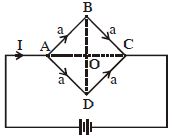
- 7Magnetic field at the centre $O$ of a square loop of side $'a'$ carrying current $I$ as shown in the figure isView Solution
- 8View SolutionOne Tesla is equal to
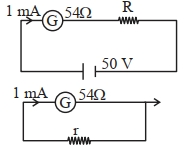
- 9For designing a voltmeter of range $50\,V$ and an ammeter of range $10\,mA$ using a galvanometer which has a coil of resistance $54\,\Omega$ showing a full scale deflection for $1\,mA$ as in figure.View Solution
$(A)$ for voltmeter $R \approx 50\,k\Omega$
$(B)$ for ammeter $r \approx 0.2\,\Omega$
$(C)$ for ammeter $r \approx 6\,\Omega$
$(D)$ for voltmeter $R \approx 5\,k \Omega$
$(E)$ for voltmeter $R \approx 500 \Omega$
Choose the correct answer from the options given below
- 10The magnetic field at the centre of an equilateral triangular loop of side $2\,L$ and carrying a current $i$ isView Solution