A charged particle moves with velocity $v$ in a uniform magnetic field $\overrightarrow B $. The magnetic force experienced by the particle is
Easy


Download our appand get started for free
Experience the future of education. Simply download our apps or reach out to us for more information. Let's shape the future of learning together!No signup needed.*
Similar Questions
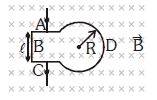
- 1The figure shows a conducting loop $ABCDA$ placed in a uniform magnetic field perpendicular to its plane. The part $ABC$ is the $(3/4)^{th}$ portion of the square of side length $l$ . The part $ADC$ is a circular arc of radius $R$ . The points $A$ and $C$ are connected to a battery which supply a current $I$ to the circuit. The magnetic force on the loop due to the field $B$ isView Solution
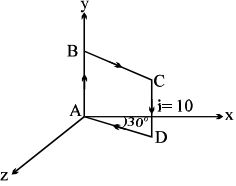
- 2Figure shows a square current carrying loop $ABCD$ of side $10\,\, cm$ and current $i = 10\,A$. The magnetic moment $\vec M$ of the loop isView Solution
- 3A particle carrying a charge equal to $100$ times the charge on an electron is rotating per second in a circular path of radius $0.8$ $metre$. The value of the magnetic field produced at the centre will be $({\mu _0} = $ permeability for vacuum)View Solution
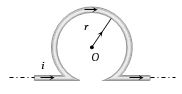
- 4An infinitely long straight conductor is bent into the shape as shown in the figure. It carries a current of $i$ $ampere$ and the radius of the circular loop is $r$ $metre$. Then the magnetic induction at its centre will beView Solution
- 5A coil having $N$ turns is wound tightly in the form of a spiral with inner and outer radii $a$ and $b$ respectively. When a current $i$ passes through the coil, the magnetic field at the centre isView Solution
- 6A galvanometer is used in laboratory for the null point in electrical experiments. If, on passing a current of $6 \,m A$ it produces a deflection of $2^{\circ},$ its figure of merit is close to :View Solution
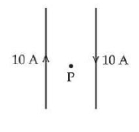
- 7Two long, straight wires carry equal currents in opposite directions as shown in figure. The separation between the wires is $5.0 \mathrm{~cm}$. The magnitude of the magnetic field at a point $P$ midway between the wires is __________$\mu \mathrm{T}$ (Given : $\mu_0=4 \pi \times 10^{-7} \mathrm{TmA}^{-1}$ )View Solution
- 8A electron experiences a force $\left( {4.0\,\hat i + 3.0\,\hat j} \right)\times 10^{-13} N$ in a uniform magnetic field when its velocity is $2.5\,\hat k \times \,{10^7} ms^{-1}$. When the velocity is redirected and becomes $\left( {1.5\,\hat i - 2.0\,\hat j} \right) \times {10^7}$, the magnetic force of the electron is zero. The magnetic field $\vec B$ is :View Solution
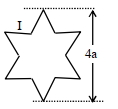
- 9A symmetric star conducting wire loop is carrying a steady state current $\mathrm{I}$ as shown in figure. The distance between the diametrically opposite vertices of the star is $4 a$. The magnitude of the magnetic field at the center of the loop isView Solution
- 10A beam of neutrons performs circular motion of radius, $r=1 \,m$. Under the influence of an inhomogeneous magnetic field with inhomogeneity extending over $\Delta r=0.01 \,m$. The speed of the neutrons is $54 \,m / s$. The mass and magnetic moment of the neutrons respectively are $1.67 \times 10^{-27} \,kg$ and $9.67 \times 10^{-27} \,J / T$. The average variation of the magnetic field over $\Delta r$ is approximately ....... $T$View Solution