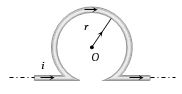
An infinitely long straight conductor is bent into the shape as shown in the figure. It carries a current of $i$ $ampere$ and the radius of the circular loop is $r$ $metre$. Then the magnetic induction at its centre will be
Medium


Download our appand get started for free
Experience the future of education. Simply download our apps or reach out to us for more information. Let's shape the future of learning together!No signup needed.*
Similar Questions
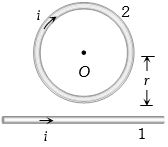
- 1Three long straight wires are connected parallel to each other across a battery of negligible internal resistance. The ratio of their resistances are $3 : 4 : 5$. What is the ratio of distances of middle wire from the others if the net force experienced by it is zeroView Solution
- 2A circular loop is kept in that vertical plane which contains the north-south direction. It carries a current that is towards south at the topmost point. Let $A$ be a point on axis of the circle to the east of it and $B$ a point on this axis to the west of it. The magnetic field due to the loop :-View Solution
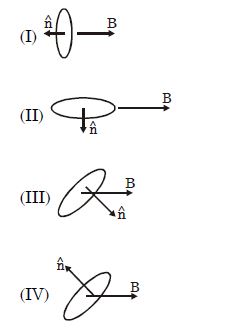
- 3A current carrying loop is placed in a uniform magnetic field in four different orientations; $I,\, II,\, III$ and $IV,$ arrange them in the decreasing order of potential energyView Solution
- 4Two protons move parallel to each other, keeping distance $r$ between them, both moving with same velocity $\vec V\,$. Then the ratio of the electric and magnetic force of interaction between them isView Solution
- 5View SolutionTesla is the unit of
- 6A galvanometer having a coil resistance $100 \;\Omega$ gives a full scale deflection when a current of $1 \;\mathrm{mA}$ is passed through it. What is the value of the resistance which can convert this galvanometer into a voltmeter giving full scale deflection for a potential difference of $10\; \mathrm{V} ?$......$k\Omega$View Solution
- 7A proton and a deutron ( $\mathrm{q}=+\mathrm{e}, m=2.0 \mathrm{u})$ having same kinetic energies enter a region of uniform magnetic field $\vec{B}$, moving perpendicular to $\vec{B}$. The ratio of the radius $r_d$ of deutron path to the radius $r_p$ of the proton path is:View Solution
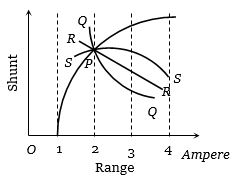
- 8The ammeter has range $1\, ampere$ without shunt. the range can be varied by using different shunt resistances. The graph between shunt resistance and range will have the natureView Solution
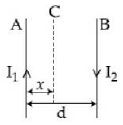
- 9Two wires $A$ and $B$ are carrying currents $I_1$ and $I_2$ as shown in the figure. The separation between them is $d$. A third wire $C$ carrying a current $I$ is to be kept parallel to them at a distance $x$ from $A$ such that the net force acting on it is zero. The possible values of $x$ areView Solution
- 10Two charged particles traverse identical helical paths in a completely opposite sense in a uniform magnetic field $B$ = $B_0\hat{k}$View Solution