Question
In one of the exercises to strengthen the wrist and fingers, a person squeezes and releases a soft rubber ball. Is the work done on the ball positive, negative or zero during compression? During expansion?

Answer

  1. During compression, the work done on the ball is positive as the direction of the force applied by the fingers is along the compression of the ball.
  2. During expansion, the work done is negative as expansion takes place against the force applied by the fingers on the ball.

Need a full question paper?

Generate a complete, print-ready paper with questions like this in minutes — across 16+ boards, with answer keys.
Start Generating Free

Similar questions

Read the passage given below and answer the following questions from 1 to 5. Power is defined as the time rate at which work is done or energy is transferred. The average power of a force is defined as the ratio of the work, W, to the total time t taken $P_{av}= W/t$ The instantaneous power is defined as the limiting value of the average power as time interval approaches zero. P = dw/dt The work dW done by a force F for a displacement dr is dW = F.dr. The instantaneous power can also be expressed as P = F.dr/dt P = F.v Where v is the instantaneous velocity when the force is F. Power, like work and energy, is a scalar quantity. Its dimensions are $[ML^2 T^{-3}]$. In the SI, its unit is called a watt (W). The watt is $1 J s^{-1}$. The unit of power is named after James Watt, one of the innovators of the steam engine in the eighteenth century. There is another unit of power, namely the horse-power (hp) 1 hp = 746W This unit is still used to describe the output of automobiles, motorbikes.
  1. The time rate at which work is done or energy is transferred is called as:
  1. Energy
  2. Force
  3. Power
  4. None of these
  1. Limiting value of power as time interval approaches zero is called as:
  1. Average power
  2. Instantaneous power
  3. Both a and b
  4. None of these
  1. Power is directly proportional to:
  1. Force
  2. Velocity
  3. Both
  4. None of these
  1. Define instantaneous power. Give its SI unit and dimensions.
  1. 1 horse power is equal to how many watt?
Read the passage given below and answer the following questions from (i) to (v). Kelvin-Planck statement: No process is possible whose sole result is the absorption of heat from a reservoir and the complete conversion of the heat into work. Clausius statement: No process is possible whose sole result is the transfer of heat from a colder object to a hotter object. It can be proved that the two statements above are completely equivalent. A thermodynamic process is reversible if the process can be turned back such that both the system and the surroundings return to their original states, with no other change anywhere else in the universe. a reversible process is an idealized motion. A process is reversible only if it is quasi-static (system in equilibrium with the surroundings at every stage) and there are no dissipative effects. For example, a quasi-static isothermal expansion of an ideal gas in a cylinder fitted with a frictionless movable piston is a reversible process. The free expansion of a gas is irreversible. The combustion reaction of a mixture of petrol and air ignited by a spark cannot be reversed. Cooking gas leaking from a gas cylinder in the kitchen diffuses to the entire room. The diffusion process will not spontaneously reverse and bring the gas back to the cylinder. The stirring of a liquid in thermal contact with a reservoir will convert the work done into heat, increasing the internal energy of the reservoir. The process cannot be reversed exactly; otherwise it would amount to conversion of heat entirely into work, violating the Second Law of Thermodynamics. Irreversibility is a rule rather an exception in nature.
  1. The diffusion process is:
  1. Reversible process
  2. Irreversible process
  1. A quasi-static isothermal expansion of an ideal gas in a cylinder fitted with a frictionless movable piston is
  1. Reversible process
  2. Irreversible process
  1. State Kelvin Planck statement.
  2. State Clausius statement.
  3. Define reversible processes and irreversible processes of thermodynamics.
The plate current in a diode is 20mA when the plate voltage is 50V or 60V. What will be the current if the plate voltage is 70V?
Read the passage given below and answer the following questions from $1$ to $5$. When an object moves along a straight line with uniform acceleration, it is possible to relate its velocity, acceleration during motion and the distance covered by it in a certain time interval by a set of equations known as the equations of motion. For convenience, a set of three such equations are given below: $v = u + at $$\text{s}=\text{ut}+\frac{1}{2}\text{at}^2$ $2a s = v^2 – u^2$ Where u is the initial velocity of the object which moves with uniform acceleration a for Time $t, v$ is the final velocity and s is the distance travelled by the object in time.
  1. equation of motions are applicable to motion with
  1. uniform acceleration
  2. non uniform acceleration
  3. constant velocity
  4. none of these
  1. There are $4$ equation of motion. True or false?
  1. True
  2. False
  1. The brakes applied to a car produce an acceleration of $10\ m/s^2$​​​​​​​ in the opposite direction to the motion. If the car takes $1\ s$ to stop after the application of brakes, calculate the distance traveled during this time by car.
  1. An object is dropped from a tower falls with a constant acceleration of $10\ m/s2$. Find its speed $10\ s$ after it was dropped.
  1. A bullet hits a Sand box with a velocity of $10\ m/s$ and penetrates it up to a distance of $5\ cm$. Find the deceleration of the bullet in the sand box
Read the passage given below and answer the following questions from 1 to 5. Momentum of a body is defined to be the product of its mass m and velocity v, and is denoted By p: p = m v Momentum is clearly a vector quantity. SI unit is kg m/s. The following common experiences indicate the importance of this quantity for considering the effect of force on motion. Suppose a light-weight vehicle (say a small car) and a heavy weight vehicle (say a loaded truck) is parked on a horizontal road. We all know that a much greater force is needed to push the truck than the car to bring them to the same speed in same time. Similarly, a greater opposing force is needed to stop a heavy body than a light body in the same time, if they are moving with the same speed.
  • If two stones, one light and the other heavy, are dropped from the top of a building, a person on the ground will find it easier to catch the light stone than the heavy stone. The mass of a body is thus an important parameter that determines the effect of force on its motion.
  • Speed is another important parameter to consider. A bullet fired by a gun can easily pierce human tissue before it stops, resulting in casualty. The same bullet fired with moderate speed will not cause much damage. Thus for a given mass, the greater the speed, the greater is the opposing force needed to stop the body in a certain time. Taken together, the product of mass and velocity, that is momentum, is evidently a relevant variable of motion. The greater the change in the momentum in a given time, the greater is the force that needs to be applied.
  1. SI unit of momentum is:
  1. Kgm/s
  2. Kgm/s2
  3. m/s2
  4. None of these
  1. Momentum is:
  1. Scalar quantity
  2. Vector quantity
  1. Define momentum. Give its SI unit.
  1. Explain with example how mass of body is important for determining effect of force on its motion?
  1. Explain with example how speed is important for determining effect of force on its motion?
Read the passage given below and answer the following questions from 1 to 3. Bernoulli's Theorem It states that for the streamline flow of an ideal liquid through a tube, the total energy (the sum of pressure energy, the potential energy and kinetic energy) per unit volume remains constant at every cross-section throughout the tube.$\text{P}+\text{pgh}+\frac{1}{2}\text{pv}^2$ = constant
or $\frac{\text{P}}{\text{pg}}+\text{h}+\frac{1}{2}\frac{\text{v}^2}{\text{g}}$ = another constant Here, $\frac{\text{P}}{\text{pg}}$ = pressure head; h = potential head and $\frac{1}{2}\frac{\text{v}^2}{\text{g}}$ velocity head. If the liquid is flowing through a horizontal tube, then h is constant, then according to Bernoulli’s theorem,$\frac{\text{P}}{\text{pg}}+\frac{1}{2}\frac{\text{v}^2}{\text{g}}$ constant
Bernoulli’s theorem is based on law of conser - vation of energy.
  1. Bernoulli’s equation for steady, non-viscous, incompressible flow expresses the:
  1. Conservation of linear momentum
  2. Conservation of angular momentum
  3. Conservation of energy
  4. Conservation of mass
  1. Applications of Bernoulli’s theorem can be seen in:
  1. Dynamic lift of aeroplane
  2. Hydraulic press
  3. Helicopter
  4. None of these
  1. A tank filled with fresh water has a hole in its bottom and water is flowing out of it. If the size of the hole is increased, then:
  1. The volume of water flowing out per second will decrease.
  2. The velocity of outflow of water remains unchanged.
  3. The volume of water flowing out per second remains zero.
  4. Both (b) and (c)
A simple pendulum of length I is suspended from the ceiling of a car moving with a speed v on a circular horizontal road of radius r.
  1. Find the tension in the string when it is at rest with respect to the car.
  2. Find the time period of small oscillation.
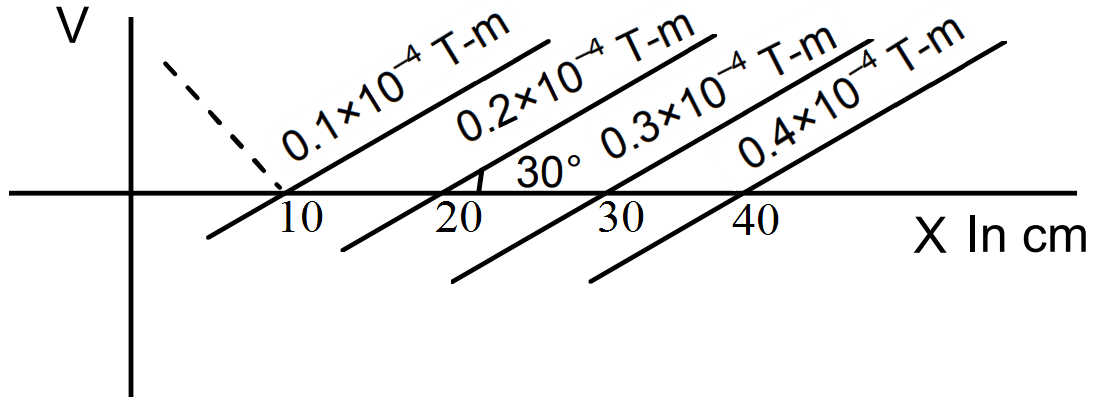
Figure shows some of the quipotential surfaces of the magnetic scalar potential. Fmd the magnetic field B at a point in the region.
If the earth's magnetic field has a magnitude $3.4 \times 10^{-5} T$ at the magnetic equator of the earth what would be its value at the earth's geomagnetic poles?