Question
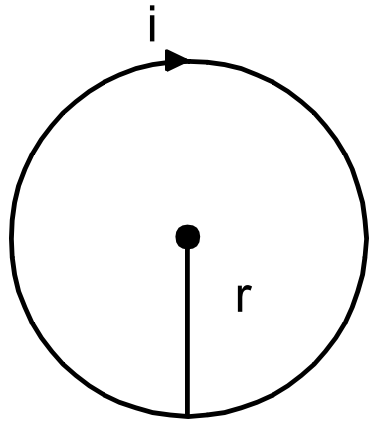
A circular loop of radius r carries a current i. How should a long, straight wire carrying a current 4i be placed in the plane of the circle so that the magnetic field at the centre becomes zero?
Answer


$\overrightarrow{\text{B}}$ due to loop $\frac{\mu_0\text{i}}{2\text{r}}$
Let the straight current carrying wire be kept at a distance R from centre. Given I = 4i
$\overrightarrow{\text{B}}$ due to wire $\frac{\mu_0\text{i}}{2\pi\text{R}}=\frac{\mu_0\times4\text{i}}{2\pi\text{R}}$
Now, the $\overrightarrow{\text{B}}$ due to both will balance each other
Hence $\frac{\mu_0\text{i}}{2\text{r}}=\frac{\mu_04\text{i}}{2\pi\text{R}}\Rightarrow\text{R}=\frac{4\text{r}}{\pi}$
Hence the straight wire should be kept at a distance $\frac{4\pi}{\text{r}}$ from centre in such a way that the direction of current in it is opposite to that in the nearest part of circular wire. As a result the direction will $\overrightarrow{\text{B}}$ will be oppose.

Need a full question paper?

Generate a complete, print-ready paper with questions like this in minutes — across 16+ boards, with answer keys.
Start Generating Free

Similar questions

A charged particle having a charge of $-2.0 \times 10^{-6} \mathrm{C}$ is placed close to a nonconducting plate having a surface charge density $4.0 \times 10^{-5} \mathrm{Cm}^{-2}$. Find the force of attraction between the particle and the plate.
By using the method of dimension, check the accuracy of the following $\text{T}=\frac{\text{rh } \rho\text{g}}{2\cos\theta}$ where T is the surface tension, h is the height of the liquid in a capillary tube, $\rho$ is the density of the liquid, g is the acceleration due to gravity, $\theta$ is the angle of contact, and r is the radius of the capillary tube.
The number of electrons in an insulator is of the same order as the number of electrons in a conductor. What is then the basic difference between a conductor and an insulator?
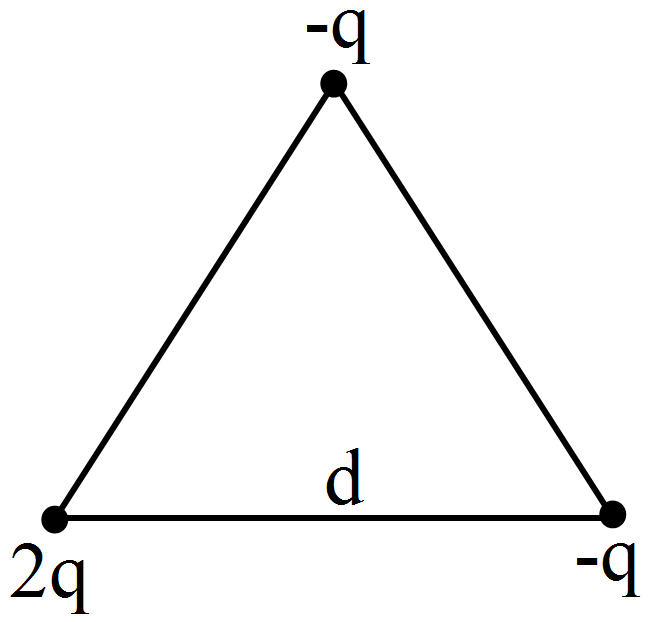
Three charges are arranged on the vertices of an equilateral triangle as shown in figure. Find the dipole moment of the combination.
A block is kept on the floor of an elevator at rest. The elevator starts descending with an acceleration of $12m/s^2$. Find the displacement of the block during the first $0.2s$ after the start. Take $g = 10m/s^2$.
Two strings of the same material and length under the same tension may vibrate with different fundamental frequency. Why?
A person aims a gun at a bird from a point at a horizontal distance of $100m$. If the gun can impart a speed of $500ms^{-1}$ to the bullet, at what height above the bird must he aim his gun in order to hit it?
State the laws of limiting friction. Hence define coefficient of friction.
One kilogram molecule of a gas at $400 \ k$ expands isothermally until its volume is doubled. Find the amount of work done and heat produced.
Describe Camot's cycle.