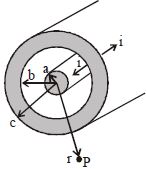
A coaxial cable having radii $a, b$ and $c$ carries equal and opposite currents of magnitude $i$ the inner and outer conductors. What is the magnitude of the magnetic induction at point $P$ outside of the cable at a distance $r$ from the axis?
Medium


Download our appand get started for free
Experience the future of education. Simply download our apps or reach out to us for more information. Let's shape the future of learning together!No signup needed.*
Similar Questions
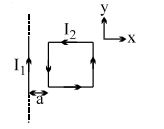
- 1A square loop of side $\lambda $ is placed in the neighbourhood of an infinitely long straight wire carrying a current $I_1.$ The loop carries a current $I_2$ as shown in figureView Solution
- 2An electron has mass $9 \times {10^{ - 31}}\,kg$ and charge $1.6 \times {10^{ - 19}}C$ is moving with a velocity of ${10^6}\,m/s$, enters a region where magnetic field exists. If it describes a circle of radius $0.10\, m$, the intensity of magnetic field must beView Solution
- 3A galvanometer having a coil resistance of $30\,\Omega $ shows full scale deflection when a current of $2\,A$ passes through it. It can be converted into an ammeter to read currents upto $10\,A$ byView Solution
- 4A moving coil galvanometer, having a resistance $G$, produces full scale deflection when a current $I_g$ flows through it. This galvanometer can be converted into $(i)$ an ammeter of range $0$ to $I_0 (I_0 > I_g)$ by connecting a shunt resistance $R_A$ to it and $(ii)$ into a voltmeter of range $0$ to $V(V = GI_0)$ by connecting a series resistance $R_V$ to it. Then,View Solution
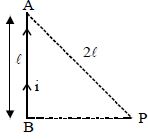
- 5The magnetic field at point, point $P$ will be :-View Solution
- 6View SolutionAn electron enters a magnetic field whose direction is perpendicular to the velocity of the electron. Then
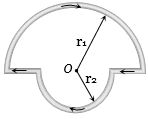
- 7In the figure shown there are two semicircles of radii ${r_1}$ and ${r_2}$ in which a current $i$ is flowing. The magnetic induction at the centre $O$ will beView Solution
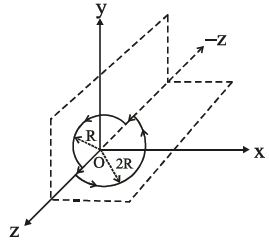
- 8In given diagram, two current carrying circular loop of radius $R$ and $2R$ are arranged in $YZ-$ plane and $XZ-$ plane respectively. Common centre of both are at origin $O$. Then what will be angle of resultant magnetic field from $X-$ axis.View Solution
- 9A proton of velocity $\left( {3\hat i + 2\hat j} \right)\,ms^{-1}$ enters a magnetic field of $(2\hat j + 3\hat k)\, tesla$. The acceleration produced in the proton is (charge to mass ratio of proton $= 0.96 \times10^8\,Ckg^{-1}$)View Solution
- 10A non conducting ring (of mass $m,$ radius $r,$ having charge $Q$) is placed on a rough horizontal surface (in a region with transverse magnetic field). The field is increasing with time at the rate $R$ and coefficient of friction between the surface and the ring is $\mu .$ For ring to remain in equilibrium $\mu$ should be greater thanView Solution