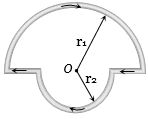
In the figure shown there are two semicircles of radii ${r_1}$ and ${r_2}$ in which a current $i$ is flowing. The magnetic induction at the centre $O$ will be
Medium


Download our appand get started for free
Experience the future of education. Simply download our apps or reach out to us for more information. Let's shape the future of learning together!No signup needed.*
Similar Questions
- 1An electron in a hydrogen atom revolves around its nucleus with a speed of $6.76 \times 10^6\,ms ^{-1}$ in an orbit of radius $0.52\,\mathring A$. The magnetic field produced at the nucleus of the hydrogen atom is $......T$.View Solution
- 2View SolutionA charged particle moving in a magnetic field experiences a resultant force
- 3A galvanmeter has a coil of resistance $200 \Omega$ with a full scale deflection at $20 \mu \mathrm{A}$. The value of resistance to be added to use it as an ammeter of range $(0-20) \mathrm{mA}$ is:View Solution
- 4The figure shows the cross section of a long cylindrical conductor through which an axial hole of radius $r$ is drilled with its centre at point $A$ . $O$ is the centre of the conductor. If an identical hole were to be drilled centred at point $B$ while maintaining the same current density the magnitude of magnetic field at $O$View Solution
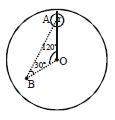
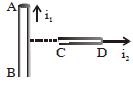
- 5An infinitely long straight conductor $AB$ is fixed and a current is passed through it. Another movable straight wire $CD$ of finite length and carrying current is held perpendicular to it and released. Neglect weight of the wireView Solution
- 6The resistance of a galvanometer is $50\,\Omega $ and current required to give full scale deflection is $100\,μA$ in order to convert it into an ammeter for reading upto $10\,A$. It is necessary to put an resistance ofView Solution
- 7A galvanometer gives full scale deflection with $0.006$ A current. By connecting it to a $4990 \ \Omega$ resistance, it can be converted into a voltmeter of range $0-30 \ V$. If connected to a $\frac{2 n }{249} \Omega$ resistance, it becomes an ammeter of range $0-1.5 \ A$. The value of $n$ is:View Solution
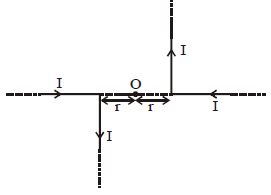
- 8Two infinite wires bent in the form of $L$ shape carries current $I$ as shown. What is magnetic field at $O$ ?View Solution
- 9A long solenoid carrying a current produces a magnetic field $B$ along its axis. If the current is doubled and the number of turns per cm is halved, the new value of the magnetic field isView Solution
- 10A ring of radius $R$, made of an insulating material carries a charge $Q$ uniformly distributed on it. If the ring rotates about the axis passing through its centre and normal to plane of the ring with constant angular speed $\omega $, then the magnitude of the magnetic moment of the ring isView Solution