A coil of $50\, turns$ and $4\,cm$ radius carries $2\,A$ current then magnetic field at its centre is......$mT$
Easy
Download our app for free and get started
$\overrightarrow{\mathrm{B}}=\mathrm{N}\left[\frac{\mu_{0} \mathrm{i}}{2 \mathrm{r}}\right]=\frac{50 \times 4 \pi \times 10^{-7} \times 2}{2 \times 4 \times 10^{-2}}=1.57 \times 10^{-3} \mathrm{T}$

Download our appand get started for free
Experience the future of education. Simply download our apps or reach out to us for more information. Let's shape the future of learning together!No signup needed.*
Similar Questions
- 1The flux density obtained at the centre of a circular coil of radius $R$ which carries a current $i$, is $B_0$. At a distance $‘pR’$ from the centre on the axis, the flux density will beView Solution
- 2A circular loop of radius $R$ carries a current $I$. Another circular loop of radius $r(< < R) $ carries a current $i$ and is placed at the centre of the larger loop. The planes of the two circles are at right angle to each other. Find the torque acting on the smaller loop.View Solution
- 3A straight wire of length $({\pi ^2})$ $metre$ is carrying a current of $2\,A$ and the magnetic field due to it is measured at a point distant $1\, cm$ from it. If the wire is to be bent into a circle and is to carry the same current as before, the ratio of the magnetic field at its centre to that obtained in the first case would beView Solution
- 4Two long and parallel straight wires $A$ and $B$ carrying currents of $8.0\, A$ and $5.0\, A$ in the same direction are separated by a distance of $4.0\, cm$. Estimate the force on a $10\, cm$ section of wire $A$View Solution
- 5${H^ + },\,H{e^ + }$ and ${O^{ + + }}$ ions having same kinetic energy pass through a region of space filled with uniform magnetic field $B$ directed perpendicular to the velocity of ions. The masses of the ions ${H^ + },\,H{e^ + }$and ${O^{ + + }}$ are respectively in the ratio $1:4:16$. As a resultView Solution
- 6View SolutionThe magnetic force between wires as shown in figure is :-
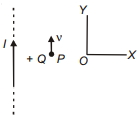
- 7A charge $Q$ moves parallel to a very long straight wire carrying a current $l$ as shown. The force on the charge isView Solution
- 8Two parallel wires in free space are $10\, cm$ apart and each carries a current of $10\, A$ in the same direction. The force one wire exerts on the other per metre of length isView Solution
- 9View SolutionThe radius of circular path of an electron when subjected to a perpendicular magnetic field is
- 10A plastic disc of radius $R$ has a charge $q$ uniformly distributed over its surface. If the disc is rotated at an angular frequency $\omega$ about it axis, the induction at the center of the disc is :-View Solution