The flux density obtained at the centre of a circular coil of radius $R$ which carries a current $i$, is $B_0$. At a distance $‘pR’$ from the centre on the axis, the flux density will be
Diffcult


Download our appand get started for free
Experience the future of education. Simply download our apps or reach out to us for more information. Let's shape the future of learning together!No signup needed.*
Similar Questions
- 1A milli voltmeter of $25$ $milli$ $volt$ range is to be converted into an ammeter of $25$ $ampere$ range. The value (in $ohm$) of necessary shunt will beView Solution
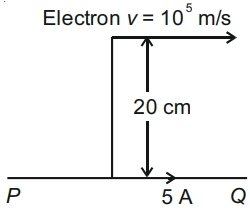
- 2An infinitely long straight conductor carries a current of $5 \,\mathrm{~A}$ as shown. An electron is moving with a speed of $10^{5} \, \mathrm{~m} / \mathrm{s}$ parallel to the conductor. The perpendicular distance between the electron and the conductor is $20 \, \mathrm{~cm}$ at an instant. Calculate the magnitude of the force experienced by the electron at that instant in $\times 10^{-20} \,N$View Solution
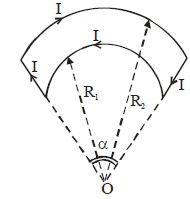
- 3The magnetic induction at the centre $O$ of the current carrying bent wire shown in the adjoining figure isView Solution
- 4An electron moves through a uniform magnetic field $\vec{B}=B_0 \hat{i}+2 B_0 \hat{j} T$. At a particular instant of time, the velocity of electron is $\overrightarrow{\mathrm{u}}=3 \hat{i}+5 \hat{j} \mathrm{~m} / \mathrm{s}$. If the magnetic force acting on electron is $\overrightarrow{\mathrm{F}}=5 \mathrm{ekN}$, where $e$ is the charge of electron, then the value of $\mathrm{B}_0$ is ____$\mathrm{T}$.View Solution
- 5A closely wound flat circular coil of $25$ $turns$ of wire has diameter of $10\, cm$ and carries a current of $4\, ampere$. Determine the flux density at the centre of a coilView Solution
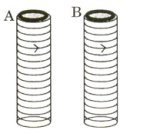
- 6Two metallic rings $\mathrm{A}$ and $\mathrm{B}$, identical in shape and size but having different resistivities $\rho_A$ and $\rho_B$, are kept on top of two identical solenoids as shown in the figure. When current $I$ is switched on in both the solenoids in identical manner, the rings $\mathrm{A}$ and $\mathrm{B}$ jump to heights $h_A$ and $h_B$, respectively, with $h_A>h_B$. The possible relation$(s)$ between their resistivities and their masses $m_A$ and $m_B$ is(are)View Solution
$(A)$ $\rho_A>\rho_B$ and $m_A=m_B$
$(B)$ $\rho_A<\rho_B$ and $m_A=m_B$
$(C)$ $\rho_A>\rho_B$ and $m_A > m_B$
$(D)$ $\rho_A<\rho_B$ and $m_A < m_B$
- 7View SolutionIf the direction of the initial velocity of the charged particle is neither along nor perpendicular to that of the magnetic field, then the orbit will be
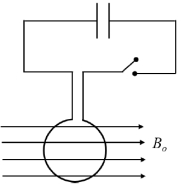
- 8A circular coil of radius $R$ and $N$ turns has negligible resistance. As shown in the schematic figure, its two ends are connected to two wires and it is hanging by those wires with its plane being vertical. The wires are connected to a capacitor with charge $Q$ through a switch. The coil is in a horizontal uniform magnetic field $B_0$ parallel to the plane of the coil. When the switch is closed, the capacitor gets discharged through the coil in a very short time. By the time the capacitor is discharged fully, magnitude of the angular momentum gained by the coil will be (assume that the discharge time is so short that the coil has hardly rotated during this time)-View Solution
- 9The magnetic field at the centre of a circular current carrying-conductor of radius $r$ is $B_c$. The magnetic field on its axis at a distance $r$ from the centre is $B_a$. The value of $B_c$ : $B_a$ will beView Solution
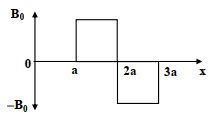
- 10A magnetic field $\overrightarrow{\mathrm{B}}=\mathrm{B}_0 \hat{\mathrm{j}}$ exists in the region $\mathrm{a} < \mathrm{x} < 2 \mathrm{a}$ and $\vec{B}=-B_0 \hat{j}$, in the region $2 \mathrm{a} < \mathrm{x} < 3 \mathrm{a}$, where $\mathrm{B}_0$ is a positive constant. $\mathrm{A}$ positive point charge moving with a velocity $\overrightarrow{\mathrm{v}}=\mathrm{v}_0 \hat{\dot{i}}$, where $v_0$ is a positive constant, enters the magnetic field at $x=a$. The trajectory of the charge in this region can be like,View Solution