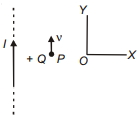
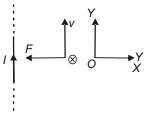
A charge $Q$ moves parallel to a very long straight wire carrying a current $l$ as shown. The force on the charge is
Easy


Download our appand get started for free
Experience the future of education. Simply download our apps or reach out to us for more information. Let's shape the future of learning together!No signup needed.*
Similar Questions
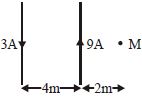
- 1Magnetic field at point $'M'$ of given current distributionView Solution
- 2An electron in a hydrogen atom revolves around its nucleus with a speed of $6.76 \times 10^6\,ms ^{-1}$ in an orbit of radius $0.52\,\mathring A$. The magnetic field produced at the nucleus of the hydrogen atom is $......T$.View Solution
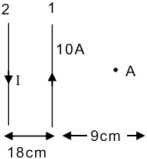
- 3In figure two parallel infinitely long current carrying wires are shown. If resultant magnetic field at point $A$ is zero. Then determine current $I.$ (in $A$)View Solution
- 4A charge $q$ is released in presence of electric $(E)$ and magnetic field $(B)$ then after some time its velocity is $v$ thenView Solution
- 5View SolutionA magnetic field
- 6Suppose an isolated north pole is kept at the centre of a circular loop carrying a electric current $i$. The magnetic field due to the north pole at a point on the periphery of the wire is $B$. The radius of the loop is $a$. The force on the wire isView Solution
- 7View SolutionIf an electron and a proton having same momenta enter perpendicular to a magnetic field, then
- 8When a galvanometer is shunted with a $4\,\Omega$ resistance, the deflection is reduced to one-fifth. If the galvanometer is further shunted with $2\,\Omega$ wire, the further reduction in the deflection will be (the main current remains same)View Solution
- 9A long straight wire in the horizontal plane carries a current of $50\, A$ in north to south direction. Give the magnitude and direction of $B$ at a point $2.5\,m$ east of the wireView Solution
- 10View SolutionA negative charge is coming towards the observer. The direction of the magnetic field produced by it will be (as seen by observer)