A coil takes $15\,\min$ to boil a certain amount of water, another coil takes $20\,\min$ for the same process. Time taken to boil the same amount of water when both coil are connected in series ........... $min$
Easy
Download our app for free and get started
(c) Time ${t_S} = {t_1} + {t_2} = 35\,\,\min .$

Download our appand get started for free
Experience the future of education. Simply download our apps or reach out to us for more information. Let's shape the future of learning together!No signup needed.*
Similar Questions
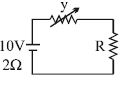
- 1In the figure shown the power generated in $y$ is maximum when $y = 5\,\Omega $. Then $R$ isView Solution
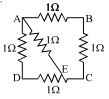
- 2$ABCD$ is a square where each side is a uniform wire of resistance $1\,\Omega$ . $A$ point $E$ lies on $CD$ such that if a uniform wire of resistance $1\,\Omega$ is connected across $AE$ and constant potential difference is applied across $A$ and $C$ then $B$ and $E$ are equipotential.View Solution
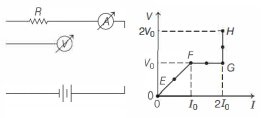
- 3In the circuit shown below (on the left) the resistance and the emf source are both variable. The graph of seven readings of the voltmeter and the ammeter ( $V$ and $I$, respectively) for different settings of resistance and the emf, taken at equal intervals of time $\Delta t$, are shown below (on the right) by the dots connected by the curve $E F G H$. Consider the internal resistance of the battery to be negligible and the voltmeter an ammeter to be ideal devices. (Take, $R_0 \equiv \frac{V_0}{I_0}$ ).View Solution
Then, the plot of the resistance as a function of time corresponding to the curve $E F G H$ is given by
- 4A wire of resistance $4 \,\Omega$ is stretched to twice its original length. The resistance of stretched wire would be ........... $\Omega$View Solution
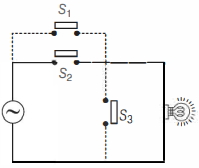
- 5View SolutionConsider the following circuit given below. The bulb will light up, if
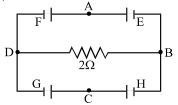
- 6In the circuit shown $E, F, G$ and $H$ are cells of $\mathrm{e.m.f.}$ $2\,V, 1\,V, 3\,V$ and $1\,V$ respectively and their internal resistances are $2\,\Omega , 1\,\Omega , 3\,\Omega$ and $1\,\Omega$ respectively.View Solution
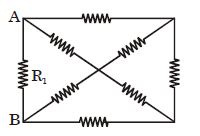
- 7As shown, the circuit is made of $8$ different resistors. It is found that when $R_1 = 4\,\,\Omega,$ the resistance between $A$ and $B$ is $2\,\,\Omega.$ Now replace $R_1$ by a $6\,\,\Omega$ resistor, what is the resistance between $A$ and $B$?View Solution
- 8An electric bulb is designed to draw power $P_0$ at voltage $V_0$. If the voltage is $V$ it draws a power $P$. ThenView Solution
- 9View SolutionAll of the following statements are true except
- 10If $400\; \Omega$ of resistance is made by adding four $100\; \Omega$ resistance of tolerance $5 \%$ then the tolerance of the combination is .....$\%$View Solution