All of the following statements are true except
Easy
Download our app for free and get started
(c) Ohm’s Law is not obeyed by semiconductors.

Download our appand get started for free
Experience the future of education. Simply download our apps or reach out to us for more information. Let's shape the future of learning together!No signup needed.*
Similar Questions
- 1In india electricity is supplied for domestic use at $220\,\,V$. It is supplied at $110\,\, V$ in $USA$. If resistance of $60\,\, W$ bulb for use in India is $R$, then the resistance of $60\,\, W$ bulb for use in $USA$ will beView Solution
- 2A house is served by $220\, V$ supply line in a circuit protected by a $9\, ampere$ fuse. The maximum number of $60\, W$ lamps in parallel that can be turned on, isView Solution
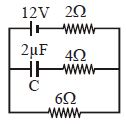
- 3Find the charge on the capacitor $C$ in the following circuit ............ $\mu C$View Solution
- 4The resistance of a wire of iron is $10\, ohms$ and temp. coefficient of resistivity is $5 \times {10^{ - 3}}\,^oC$. At $20\,^oC$ it carries $30$ milliamperes of current. Keeping constant potential difference between its ends, the temperature of the wire is raised to $120\,^oC$. The current in milliamperes that flows in the wire isView Solution
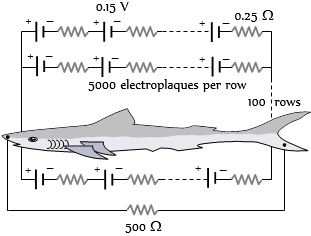
- 5Eels are able to generate current with biological cells called electroplaques. The electroplaques in an eel are arranged in $100$ rows, each row stretching horizontally along the body of the fish containing $5000$ electroplaques. The arrangement is suggestively shown below. Each electroplaques has an emf of $0.15\, V$ and internal resistance of $0.25 \,\Omega$ The water surrounding the eel completes a circuit between the head and its tail. If the water surrounding it has a resistance of $500 \,\Omega$, the current an eel can produce in water is about .............. $A$View Solution
- 6Assume a hypothetical wire in which free electron density changes with temperature in proportionality $n\ \alpha \ T$ assuming $\tau $(Relaxation time of collision) and dimensions of wire remain unchanged with increasing temperature. Which one of the resistance $v/s$ temperature graph is trueView Solution
- 7Consider a metallic cube of edge length $L$. Its resistance, $R$, measured across its opposite faces is $R =\frac{ m _{ e } v }{ ne ^2 L ^2}$, where $n$ is the number density and $v$ is the drift speed of electrons in the cube, and $e$ and $m _{ e }$ are the charge and mass of an electron respectively. Assuming the de-Broglie wavelength of the electron to be $L$, the maximum resistance of the sample is closest to ............. $\,\Omega$ $\left(e=1.60 \times 10^{-19} \,C ; m _{ e }=9.11 \times 10^{-31} \,kg\right.$; Planck's constant, $h=6.63 \times 10^{-34} \,Js$ )View Solution
- 8A rod of a certain metal is $1.0\, m$ long and $0.6\, cm$ in diameter. Its resistance is $3.0 × {10^{ - 3}}\, ohm$. Another disc made of the same metal is $2.0\, cm$ in diameter and $1.0\, mm$ thick. What is the resistance between the round faces of the discView Solution
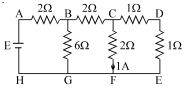
- 9The figure shows a network of resistors and $a$ battery. If $1\,A$ current flowsthrough the branch $CF$, then answer the following questions The current throughView Solution
- 10Two bulbs consume same power when operated at $200\, V$ and $300\, V$ respectively. When these bulbs are connected in series across a $D.C$. source of $500\, V$, thenView Solution