An electric bulb is designed to draw power $P_0$ at voltage $V_0$. If the voltage is $V$ it draws a power $P$. Then
Easy


Download our appand get started for free
Experience the future of education. Simply download our apps or reach out to us for more information. Let's shape the future of learning together!No signup needed.*
Similar Questions
- 1In a hydrogen discharge tube it is observed that through a given cross-section $3.13 \times {10^{15}}$ electrons are moving from right to left and $3.12 \times {10^{15}}$ protons are moving from left to right. What is the electric current in the discharge tube and what is its directionView Solution
- 2A letter $A$ is constructed of a uniform wire with resistance $1.0\,\Omega \,per\,cm$. The sides of the letter are $20\, cm$ and the cross piece in the middle is $10\, cm$ long. The apex angle is $60^o$. The resistance between the ends is .............. $\Omega$View Solution
- 3The resistance of a wire is $5 \Omega$. It's new resistance in ohm if stretched to $5$ times of it's original length will be :View Solution
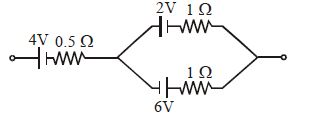
- 4Find the net emf of the three batteries shown in figure ................ $\mathrm{V}$View Solution
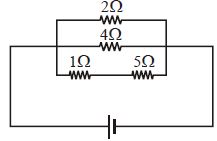
- 5A current of $3\,amp$ flows through the $2\,\Omega $ resistor shown in the circuit. The power dissipated in the $5\,\Omega $ resistor is ................. $watt$View Solution
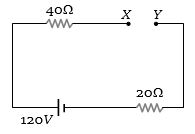
- 6Potential difference across the $40\,\Omega $ resistance will be ............ $V$View Solution
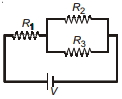
- 7Three identical resistors $R_1=R_2=R_3$ are connected as shown to a battery of constant e.m.f. The power dissipated is ...........View Solution
- 8In order to quadruple the resistance of a uniform wire, a part of its length was uniformly stretched till the final length of the entire wire was $1.5$ times the original length, the part of the wire was fraction equal toView Solution
- 9If the length of the filament of a heater is reduced by $10\%$, the power of the heater willView Solution
- 10A $10\, m$ long wire of $20\,\Omega$ resistance is connected with a battery of $3\, volt$ $e.m.f.$ (negligible internal resistance) and a $10 \,\Omega$ resistance is joined to it is series. Potential gradient along wire in volt per meter isView Solution