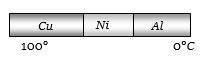
A composite metal bar of uniform section is made up of length $25 cm$ of copper, $10 cm$ of nickel and $15 cm$ of aluminium. Each part being in perfect thermal contact with the adjoining part. The copper end of the composite rod is maintained at ${100^o}C$ and the aluminium end at ${0^o}C$. The whole rod is covered with belt so that there is no heat loss occurs at the sides. If ${K_{{\rm{Cu}}}} = 2{K_{Al}}$ and ${K_{Al}} = 3{K_{{\rm{Ni}}}}$, then what will be the temperatures of $Cu - Ni$ and $Ni - Al$ junctions respectively
Diffcult
Download our app for free and get started
(b) If suppose ${K_{Ni}} = K \Rightarrow {K_{Al}} = 3K$ and ${K_{Cu}} = 6K.$
Since all metal bars are connected in series
Since all metal bars are connected in series
So ${\left( {\frac{Q}{t}} \right)_{Combination}} = {\left( {\frac{Q}{t}} \right)_{Cu}} = {\left( {\frac{Q}{t}} \right)_{Al}} = {\left( {\frac{Q}{t}} \right)_{Ni}}$
and $\frac{3}{{{K_{eq}}}} = \frac{1}{{{K_{Cu}}}} + \frac{1}{{{K_{Al}}}} + \frac{1}{{{K_{Ni}}}} = \frac{1}{{6K}} + \frac{1}{{3K}} + \frac{1}{K} = \frac{9}{{6K}}$
==> ${K_{eq}} = 2K$
Hence, if ${\left( {\frac{Q}{t}} \right)_{Combination}} = {\left( {\frac{Q}{t}} \right)_{Cu}}$
==> $\frac{{{K_{eq}}\,A(100 - 0)}}{{{l_{Combination}}}} = \frac{{{K_{Cu}}A(100 - {\theta _1})}}{{{l_{Cu}}}}$
==> $\frac{{2K\,A\,(100 - 0)}}{{(25 + 10 + 15)}} = \frac{{6K\,A\,(100 - {\theta _1})}}{{25}}$
==> ${\theta _1} = 83.33^\circ C$
Similar if ${\left( {\frac{Q}{t}} \right)_{Combination}} = {\left( {\frac{Q}{t}} \right)_{Al}}$
==> $\frac{{2K\,A(100 - 0)}}{{50}} = \frac{{3K\,A({\theta _2} - 0)}}{{15}}$
==> ${\theta _2} = {20^o}C$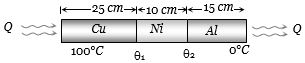

Download our appand get started for free
Experience the future of education. Simply download our apps or reach out to us for more information. Let's shape the future of learning together!No signup needed.*
Similar Questions
- 1View SolutionIn Searle's method for finding conductivity of metals, the temperature gradient along the bar
- 2View SolutionWe consider the radiation emitted by the human body. Which of the following statements is true
- 3Two bodies $A$and $B$ have thermal emissivities of $0.01$ and $0.81$ respectively. The outer surface areas of the two bodies are the same. The two bodies emit total radiant power at the same rate. The wavelength ${\lambda _B}$ corresponding to maximum spectral radiancy in the radiation from $B$ is shifted from the wavelength corresponding to maximum spectral radiancy in the radiation from $A$, by $1.00\mu m$. If the temperature of $A$ is $5802\;K$View Solution
- 4A body takes $4\, {min}$. to cool from $61^{\circ} {C}$ to $59^{\circ} {C}$. If the temperature of the surroundings is $30^{\circ} {C}$, the time taken by the body to cool from $51^{\circ} {C}$ to $49^{\circ} {C}$ is $....\,min$View Solution
- 5Three very large plates of same area are kept parallel and close to each other. They are considered as ideal black surfaces and have very high thermal conductivity. The first and third plates are maintained at temperatures $2T$ and $3T$ respectively. The temperature of the middle (i.e. second) plate under steady state condition isView Solution
- 6A long metallic bar is carrying heat from one of its ends to the other end under steady-state. The variation of temperature $\theta$ along the length $x$ of the bar from its hot end is best described by which of the following figures?View Solution
- 7A body of length 1m having cross sectional area $0.75\;m^2$ has heat flow through it at the rate of $ 6000\; Joule/sec$ . Then find the temperature difference if $K = 200\;J{m^{ - 1}}{K^{ - 1}}$ ...... $^oC$View Solution
- 8A slab of stone of area $0.36\;m ^2$ and thickness $0.1 \;m$ is exposed on the lower surface to steam at $100^{\circ} C$. A block of ice at $0^{\circ} C$ rests on the upper surface of the slab. In one hour $4.8\; kg$ of ice is melted. The thermal conductivity of slab is .......... $J / m / s /{ }^{\circ} C$ (Given latent heat of fusion of ice $=3.36 \times 10^5\; J kg ^{-1}$)View Solution
- 9View SolutionWhen two ends of a rod wrapped with cotton are maintained at different temperatures and after some time every point of the rod attains a constant temperature, then
- 10In a steady state, the temperature at the end $A$ and $B$ of $20\,cm$ long rod $AB$ are $100\,^oC$ and $0\,^oC$ respectively. The temperature of a point $9\,cm$ from $A$ is....... $^oC$View Solution