Question
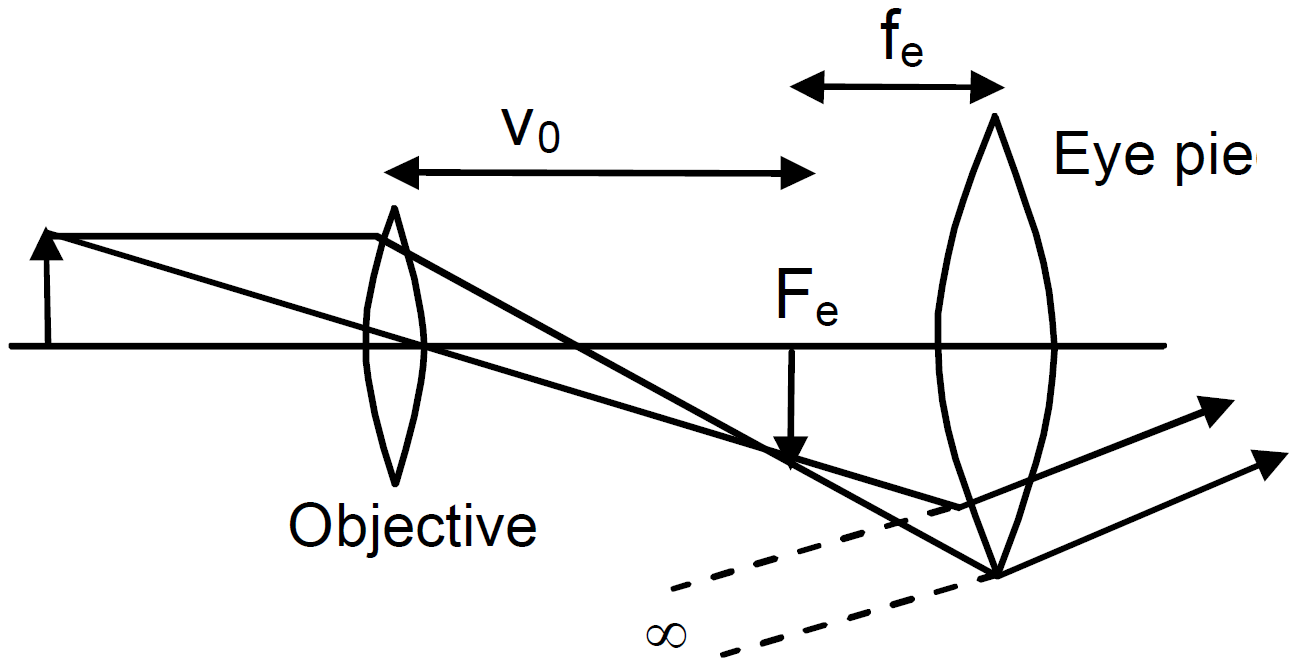
A compound microscope has a magnifying power of $100$ when the image is formed at infinity. The objective has a focal length of $0.5\ cm$ and the tube length is $6.5\ cm$. Find the focal length of the eyepiece.
Answer

For the give compound microscope$, f_0 = 0.5\ cm,$ tube length $= 6.5\ cm$ magnifying power $= 100\ ($normal adjustment$)$
Since, the image is formed at infinity, the real image produced by the objective lens should lie on the focus of the eye piece.
So$, v_o + f_e = 6.5\ cm ...(1)$
Again, magnifying power $\text{m}=\frac{\text{v}_0}{\text{u}_0}\times\frac{\text{D}}{\text{f}_\text{e}}\ [$for normal adjustment$]$
$\Rightarrow\text{m}=\Big[1-\frac{\text{V}_0}{\text{f}_0}\Big]\frac{\text{D}}{\text{f}_\text{e}}$
$\Rightarrow100=-\Big[1-\frac{\text{V}_0}{0.5}\Big]\times\frac{25}{\text{f}_\text{e}}\ [$Taking $D = 25\ cm]$
$\Rightarrow100\text{f}_\text{e}=-(1-2\text{v}_0)\times25$
$\Rightarrow2\text{v}_0-4\text{f}_\text{e}=1 ...(2)$
Solving equation $(1)$ and $(2)$ we can get,
$V_0 = 4.5\ cm$ and $f_e = 2\ cm$
So, the focal length of the eye piece is $2\ cm.$

Need a full question paper?

Generate a complete, print-ready paper with questions like this in minutes — across 16+ boards, with answer keys.

Start Generating Free

Similar questions

A gas is enclosed in a cylindrical can fitted with a piston. The walls of the can and the piston are adiabatic. The initial pressure, volume and temperature of the gas are $100kPa, 400\ cm^3$ and $300K,$ respectively. The ratio of the specific heat capacities of the gas is $\frac{\text{C}_\text{P}}{\text{C}_\text{V}}=1.5.$ Find the pressure and the temperature of the gas if it is,
  1. Suddenly compressed.
  2. Slowly compressed to $100\ cm^3.$
What is capacitance of a conductor? What is its unit? Find the formula for capacitance of an isolated spherical conductor. Draw a graph between capacitance and radius. If a spherical conductor is placed in dielectric constant $\epsilon_r$, then what will be the effect on the value of capacitance?###If the area of each conducting plate of a parallel plate capacitor is A and the separation between them is $d$, then express the formula for its capacitance.
Explain the laws of refraction of light waves on the basis of Huygen's theory of secondary wavelets.
Two capacitors of capacitances $20.0\ pF$ and $50.0\ pF$ are connected in series with a $6.00V$ battery. Find:
$a.$ The potential difference across each capacitor.
$b.$ The energy stored in each capacitor.
Three coplanar parallel wires, each carrying a current of 10A along the same direction, are placed with a separation 5.0cm between the consecutive ones. Find the matnitude ol the magnetic force per unit lenght acting on the wires.
A simple pendulum is constructed by hanging a heavy ball by a $5.0m$ long string. It undergoes small oscillations.
  1. How many oscillations does it make per second?
  2. What will be the frequency if the system is taken on the moon where acceleration due to gravitation of the moon is $1.67\ m/s^2.$
A wire of resistance $15.0\Omega$ is bent to form a regular hexagon ABCDEFA. Find the equivalent resistance of the loop between the points (a) A and B (b) A and C and (c) A and D.
Two long, straight wires, each carrying a current of $5A,$ are placed along the $X$ and $Y-$ axes respectively. The currents point along the positive directions of the axes. Find the magnetic fields at the points $(a) (1m, 1m), (b) (-1m, 1m), (c) (-1m,-1m)$ and $(d) (1m, -1m),$
A particle of mass m and charge $q$ is thrown at a speed u against a uniform electric field $E$. How much distance will it travel before coming to momentary rest?
A rectangular wire loop of sides 8 cm and 2 cm having a small cut is moving out of a region of uniform magnetic field of magnitude 0.3 T directed normal to the loop. What is the emf developed across the cut if the velocity of the loop is $1 cm s ^{-1}$ in a direction normal to the (a) longer side (b) shorter side of the loop? For how long does the induced voltage last in each case?