Question
A simple pendulum is constructed by hanging a heavy ball by a $5.0m$ long string. It undergoes small oscillations.
  1. How many oscillations does it make per second?
  2. What will be the frequency if the system is taken on the moon where acceleration due to gravitation of the moon is $1.67\ m/s^2.$
Answer

$\text{L}=5\text{m}$
  1. $\text{T}=2\pi\sqrt{\frac{\ell}{\text{g}}}=2\pi\sqrt{0.5}=2\pi(0.7)$
$\therefore$ in $2\pi(0.7)\sec$ the body completes $1$ oscillation,
In $1$ second, the body will complete $\frac{1}{2\pi(0.7)}$ oscillation
$\therefore\text{f}=\frac{1}{2\pi(0.7)}=\frac{10}{14\pi}=\frac{0.70}{\pi}$ Times
  1. When it is taken to the moon
$\text{T}=2\pi\sqrt{\frac{\ell}{\text{g'}}}$
where $g\ ' \rightarrow$ Acceleration in the moon.
$=2\pi\sqrt{\frac{5}{1.67}}$
$\therefore\text{f}=\frac{1}{\text{T}}=\frac{1}{2\pi}\sqrt{\frac{1.67}{5}}=\frac{1}{2\pi}(0.577)=\frac{1}{2\pi\sqrt{3}}$ times.

Need a full question paper?

Generate a complete, print-ready paper with questions like this in minutes — across 16+ boards, with answer keys.

Start Generating Free

Similar questions

An operator sitting in his base camp sends a sound signal of frequency 400Hz. The signal is reflected back from a car moving towards him. The frequency of the reflected sound is found to be 410Hz. Find the speed of the car. Speed of sound in air = 324m/s.
What is Wheatstone bridge ? Explain its use in detail.
A turn of radius 20m is banked for the vehicles going at a speed of 36 km/h. If the coefficient of static friction between the road and the tyre is 0.4, what are the possible speeds of a vehicle so that it neither slips down nor skids up?
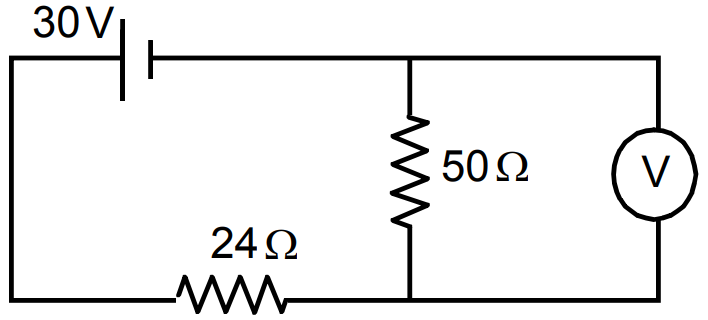
The voltmeter shown in the figure. reads 18V across the $50\Omega$ resistor. Find the resistance of the voltmeter.
A neutron moving with a speed υ strikes a hydrogen atom in ground state moving towards it with the same speed. Find the minimum speed of the neutron for which inelastic $($completely or partially$)$ collision may take place. The mass of neutron $=$ mass of hydrogen $= 1.67 \times 10^{-27}kg.$
Define resonance. Explain resonant frequency and write characteristics of resonant circuit.
A suitcase kept on a shop's rack is measured 50cm × 25cm × 10cm by the shop's owner. A traveller takes this suitcase in a train moving with velocity 0.6c.
If the suitcase is placed with its length along the train's velocity, find the dimensions measured by:
  1. The traveller and.
  2. A ground observer.
A $U-$tube having unequal arm$-$lengths has water in it. A tuning fork of frequency $440\ Hz$ can set up the air in the shorter arm in its fundamental mode of vibration and the same tuning fork can set up the air in the longer arm in its first overtone vibration. Find the length of the air columns. Neglect any end effect and assume that the speed of sound in air $= 330\ m/s.$
A parallel$-$plate capacitor has plate area $100\ cm^2$ and plate separation $1.0\ cm.$ A glass plate $($dielectric constant $6.0)$ of thickness $6.0\ mm$ and an ebonite plate $($dielectric constant $4.0)$ are inserted one over the other to fill the space between the plates of the capacitor. Find the new capacitance.
Two friends $A$ and $B \ ($each weighing $40\ kg)$ are sitting on a frictionless platform some distance $d$ apart. A rolls a ball of mass $4\ kg$ on the platform towards $B$ which $B$ catches. Then $B$ rolls the ball towards $A$ and $A$ catches it. The ball keeps on moving back and forth between $A$ and $B$. The ball has a fixed speed of $5m/s$ on the platform.
  1. Find the speed of $A$ after he rolls the ball for the first time.
  2. Find the speed of $A$ after he catches the ball for the first time.
  3. Find the speeds of $A$ and $B$ after the ball has made $5$ round trips and is held by $A$.
  4. How many times can $A$ roll the ball?
  5. Where is the centre of mass of the system $''A + B \ +$ ball'' at the end of the $n^{th}$ trip?