Question
A compound microscope is an optical instrument used for observing highly magnified images of tiny objects. Magnifying power of a compound microscope is defined as the ratio of the angle subtended at the eye by the final image to the angle subtended at the eye by the object, when both the final image and the object are situated at the least distance of distinct vision from the eye. It can be given that: m = me × m0, where me is magnification produced by eye lens and m0 is magnification produced by objective lens.
Consider a compound microscope that consists of an objective lens of focal length 2.0cm and an eyepiece of focal length 6.25cm separated by a distance of 15cm.
  1. The object distance for eye-piece, so that final image is formed at the least distance of distinct vision, will be:
  1. 3.45cm
  2. 5cm
  3. 1.29cm
  4. 2.59cm
  1. How far from the objective should an object be placed in order to obtain the condition described in part (i)?
  1. 4.5cm
  2. 2.5cm
  3. 1.5cm
  4. 3.0cm
  1. What is the magnifying power of the microscope in case of least distinct vision?
  1. 20
  2. 30
  3. 40
  4. 10
  1. The intermediate image formed by the objective of a compound microscope is:
  1. Real, inverted and magnified.
  2. Real, erect, and magnified.
  3. Virtual, erect and magnified.
  4. Virtual, inverted and magnified.
  1. The magnifying power of a compound microscope increases with:
  1. The focal length of objective lens is increased and that of eye lens is decreased.
  2. The focal length of eye lens is increased and that of objective lens is decreased.
  3. Focal lengths of both objects and eye-piece are increased.
  4. Focal lengths of both objects and eye-piece are decreased.
Answer

  1. (b) 5cm

Explanation:

Here, f0 = 2.0, fe = 6.25cm, u0 = ?

When the final image is obtained at the least distance of distinct vision:

ve = -25cm

As $\frac{1}{\text{v}_\text{e}}-\frac{1}{\text{}_\text{e}}=\frac{1}{\text{f}_\text{e}}$

$\therefore\frac{1}{\text{u}_\text{e}}\frac{1}{\text{v}_\text{e}}\frac{1}{\text{f}_\text{e}}=\frac{1}{-25}-\frac{1}{6.25}$

$=\frac{-1-4}{25}=\frac{-5}{25}=-\frac{1}{5}$

or $\text{u}_\text{e}=-5\text{cm}$

  1.  (b) 2.5cm

Explanation:

Distance between objective and eye-piece = 15cm

$\therefore$ Distance of the image from objective is $\text{v}_0=15-5=10\text{cm}$

$\therefore\frac{1}{\text{u}_0}=\frac{1}{\text{v}_0}-\frac{1}{\text{f}_0}=\frac{1}{\text{10}}-\frac{1}{\text{2}}=\frac{1-5}{\text{10}}=-\frac{2}{5}$

or $\text{u}_0=-\frac{5}{2}=-2.5\text{cm}$

$\therefore$ Distance of object from objective = 2.5cm

  1.  (a) 20

Explanation:

Magnifying power,

$\text{m}=\text{m}_0\times\text{m}_\text{e}=\frac{\text{v}_0}{\text{u}_0}(1+\frac{\text{D}}{\text{fe}})=\frac{10}{2.5}(1+\frac{25}{6.25})=20$

  1. (a) Real, inverted and magnified.

Explanation:

The intermediate image formed by the objective of a compound microscope is real, inverted and magnified.

  1. (d) Focal lengths of both objects and eye-piece are decreased.
Need a full question paper?

Generate a complete, print-ready paper with questions like this in minutes — across 16+ boards, with answer keys.

Start Generating Free

Similar questions

Some washing machines have cloth driers. It contains a drum in which wet clothes are kept. As the drum rotates, the water particles get separated from the cloth. The general description of this action is that "the centrifugal force throws the water particles away from the drum". Comment on this statement from the viewpoint of an observer rotating with the drum and the observer who is washing the clothes.
Currents can be induced not only in conducting coils, but also in conducting sheets or blocks. Current is induced in solid metallic masses when the magnetic flux threading through them changes. Such currents flow in the from of irregularly shaped loops throughout the body of the metal. These currents look like eddies or whirlpools in water so they are known as eddy currents. Eddy currents have both undesirable effects and practically useful applications. For example it causes unnecessary heating and wastage of power in electric motors, dynamos and in the cores of transformers.
  1. The working of speedometers of trains is based on:
  1. Wattless currents.
  2. Eddy currents.
  3. alternating currents.
  4. pulsating currents.
  1. Identify the wrong statement.
  1. Eddy currents are produced in a steady magnetic field.
  2. Induction furnace uses eddy currents to produce heat.
  3. Eddy currents can be used to produce braking force in moving trains.
  4. Power meters work on the principle of eddy currents.
  1. Which of the following is the best method to reduce eddy currents?
  1. Laminating core.
  2. Using thick wires.
  3. By reducing hysteresis loss.
  4. None of these.
  1. The direction of eddy currents is given by:
  1. Fleming's left hand rule.
  2. Biot-Savart law.
  3. Lenz's law
  4. Ampere-circuital law.
  1. Eddy currents can be used to heat localised tissues of the human body. This branch of medical therapy is called:
  1. Hyperthermia.
  2. Diathermy.
  3. Inductothermy.
  4. None of these.
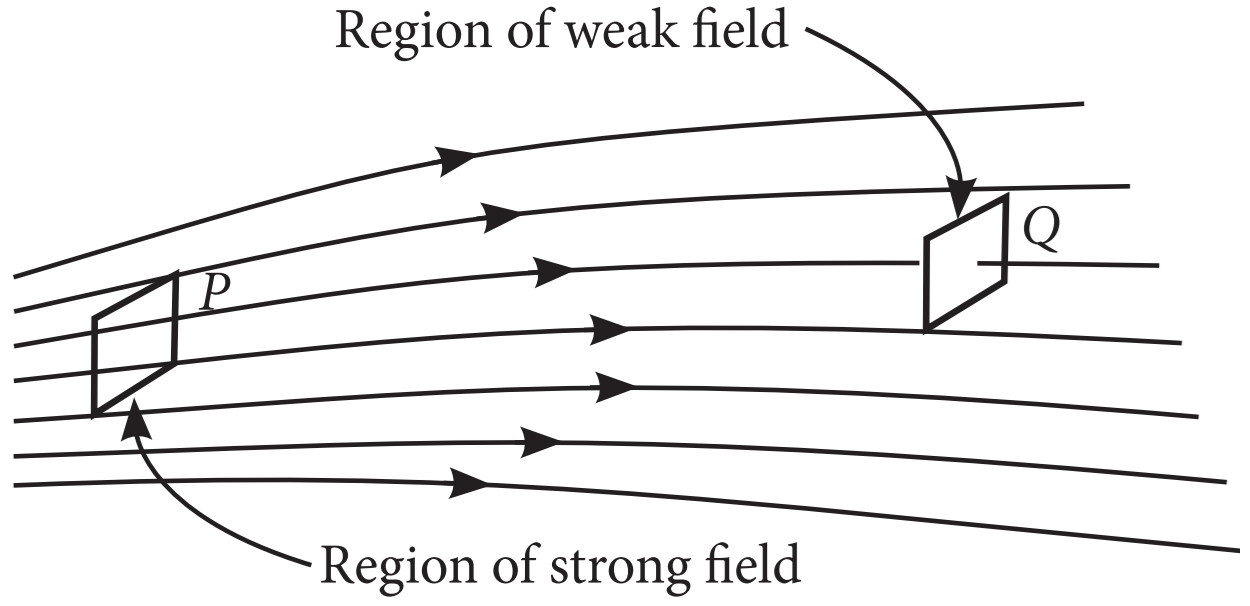
Electric field strength is proportional to the density of lines of force i.e., electric field strength at a point is proportional to the number of lines of force cutting a unit area element placed normal to the field at that point. As illustrated in the given figure, the electric field at P is stronger that at Q.

  1. Electric lines of force about a positive point charge are:
  1. Radially outwards.
  2. Circular clockwise.
  3. Radially inwards.
  4. Parallel straight lines.
  1. Which of the following is false for electric lines of force?
  1. They always start from positive charges and terminate on negative charges.
  2. They are always perpendicular to the surface of a charged conductor.
  3. They always form closed loops.
  4. They are parallel and equally spaced in a region of uniform electric field.
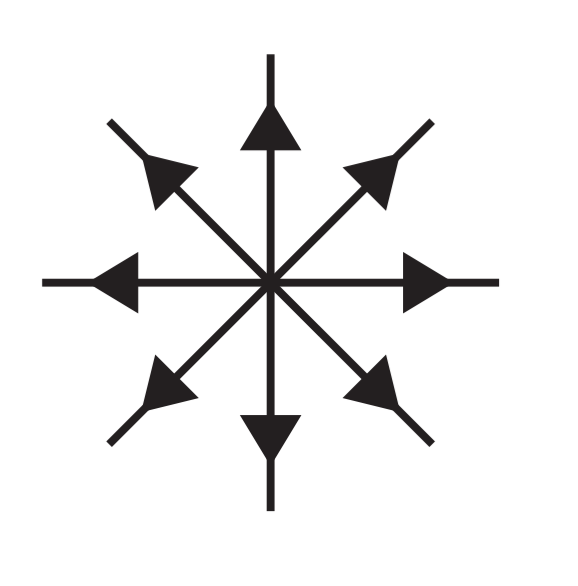
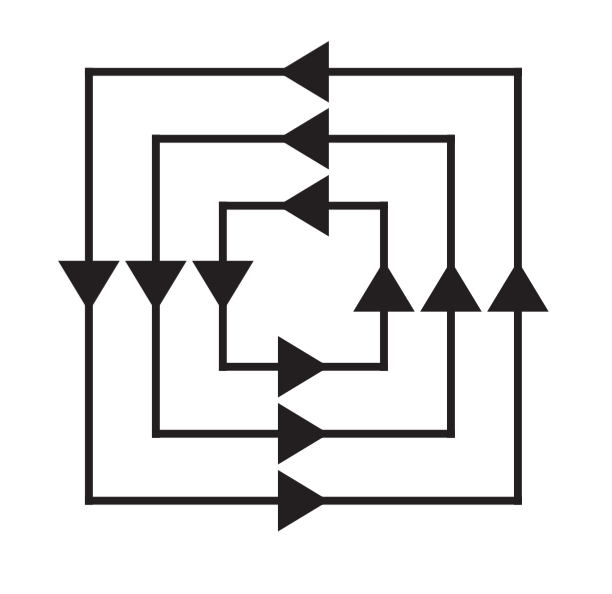
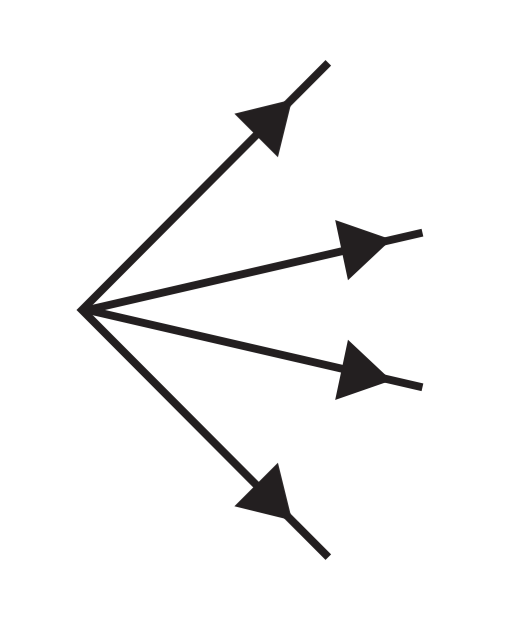
  1. Which one of the following pattern of electric line of force in not possible in filed due to stationary charges?
  1.  

  1.  

  1.  

  1.  

  1. Electric lines of force are curved:
  1. In the field of a single positive or negative charge.
  2. In the field of two equal and opposite charges.
  3. In the field of two like charges.
  4. Both (b) and (c).
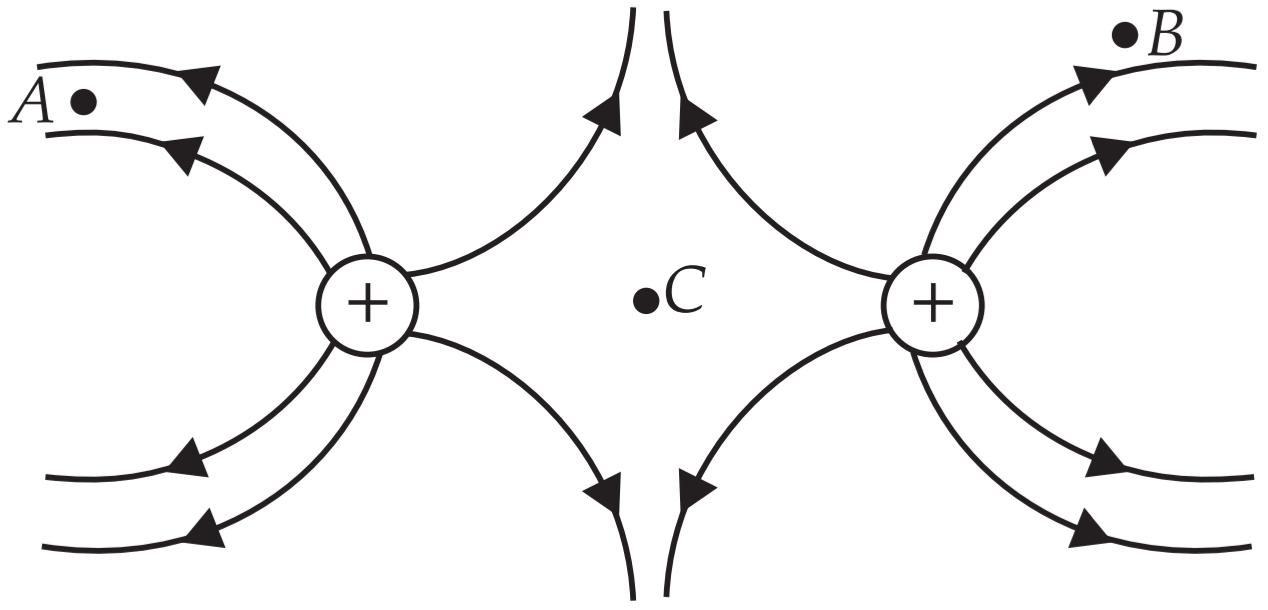
  1. The figure below shows the electric field lines due to two positive charges. The magnitudes EA, EB and EC of the electric fields at points A, Band C respectively are related as:

  1. EA > EB > EC
  2. EB > EA > EC
  3. EA = EB > EC
  4. EA > EB = EC
A silver ball of radius 4.8cm is suspended by a thread in a vacuum chamber. Ultraviolet light of wavelength 200 run is incident on the ball for some time during which a total light energy of 1.0 × 10⁻⁷J falls on the surface. Assuming that on the average one photon out of every ten thousand is able to eject a photoelectron, find the electric potential et the surface of the bell assuming zero potential at infinity. What is the potential at the centre of the bell?
Suppose the density of air at Madras is P0 and atomospheric pressure is P0. If we go up, the density and the pressure both decrease. Suppose we wish to calculate the pressure at a height 10km above Madras. If we use the equation P- P = pogz, will we get a pressure more than the actual or less than the actual? Neglect the variation in g. Does your answer change if you also consider the variation in g?
Calculate $\frac{\text{n(T)}}{\text{n}(1000\text{K})}$ for tungsten emitter at T = 300K, 2000K and 3000K, where n(T) represents the number of thermions emitted per second by the surface at temperature T. Work function of tungsten is 4.52eV.
Explain isotopes, isobar, isotones and isomers by giving examples.
A thick wire of $15 \Omega$ is stretched to three times its original length. Assuming that the density of the wire remains unchanged, calculate the resistance of the new wire.
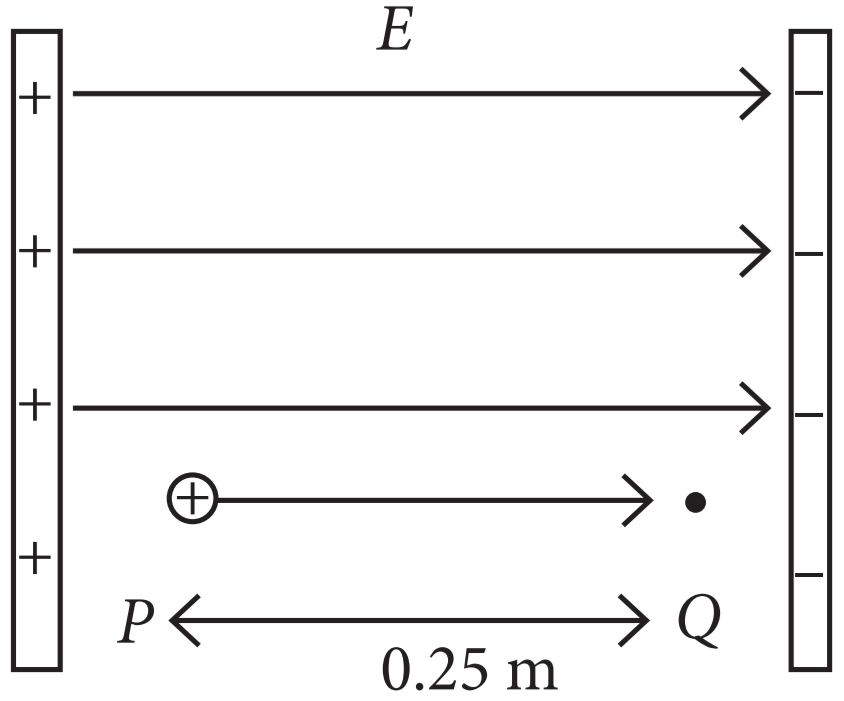
Potential difference $(\triangle\text{V})$ between two points A and B separated by a distance x, in a uniform electric field E is given by $\triangle\text{V}=-\text{Ex},$ where xis measured parallel to the field lines. If a charge q0 moves from P to Q, the change in potential energy $(\triangle\text{U})$ is given as $\triangle\text{U}=-\text{q}_0\triangle\text{V}.$ A proton is released from rest in uniform electric field of magnitude 4.0 × 108Vm-1 directed along the positive X-axis. The proton undergoes a displacement of 0.25m in the direction of E.

Mass of a proton = 1.66 × 10-27kg and charge of proton = 1.6 × 10-19C.

  1. The change in electric potential of the proton between the points A and B is:
  1. -1 × 108V
  2. 1 × 108V
  3. 6.4 × 10⁻¹⁹V
  4. -6.4 × 10⁻¹⁹V
  1. The change in electric potential energy of the proton for displacement from A to B is:
  1. 1.6 × 1011J
  2. 0.5 × 10²³J
  3. -1.6 × 10-11J
  4. 3.2 × 1022J
  1. The mutual electrostatic potential energy between two protons which are at a distance of 9 × 10-15m, in 92U235 nucleus is:
  1. 1.56 × 10-14J
  2. 5.5 × 10-14J
  3. 2.56 × 10-14J
  4. 4.56 × 10-14J
  1. If a system consistsoftwocharges 4mC and -3mC with no external field placed at (-5cm, 0, 0) and (5cm, 0, 0) respectively. The amount of work required to separate the two charges infinitely away from each other is:
  1. -1.1J
  2. 2J
  3. 2.5J
  4. 3J
  1. As the proton moves from P to Q, then:
  1. The potential energy of proton decreases.
  2. The potential energy of proton increases.
  3. The proton loses kinetic energy.
  4. Total energy of the proton increases.
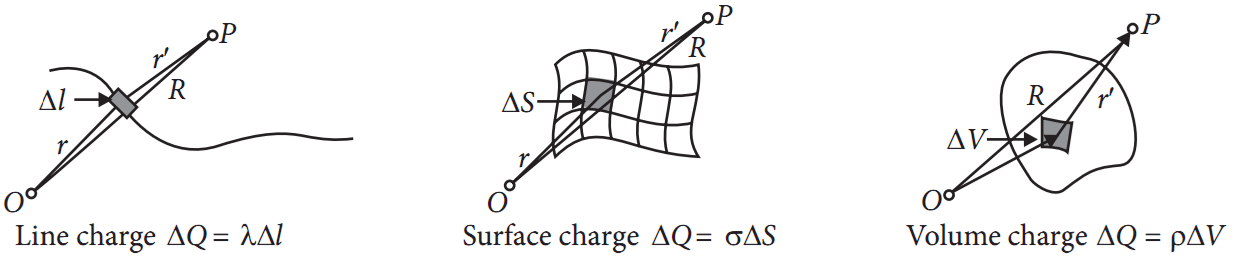
ln practice, we deal with charges much greater in magnitude than the charge on an electron, so we can ignore the quantum nature of charges and imagine that the charge is spread in a region in a continuous manner. Such a charge distribution is known as continuous charge distribution. There are three types of continuous charge distribution : (i) Line charge distribution (ii) Surface charge distribution (iii) Volume charge distribution as shown in figure.

  1. Statement 1: Gauss's law can't be used to calculate an electric field near an electric dipole.

Statement 2: Electric dipole don't have symmetrical charge distribution.

  1. Statement 1 and statement 2 are true.
  2. Statement 1 is false but statement 2 is true.
  3. Statement 1 is true but statement 2 is false.
  4. Both statements are false.
  1. An electric charge of 8.85 × 10-13C is placed at the centre of a sphere of radius 1m. The electric flux through the sphere is:
  1. 0.2NC-1 m2
  2. 0.1NC-1 m2
  3. 0.3NC-1 m2
  4. 0.01NC-1 m2
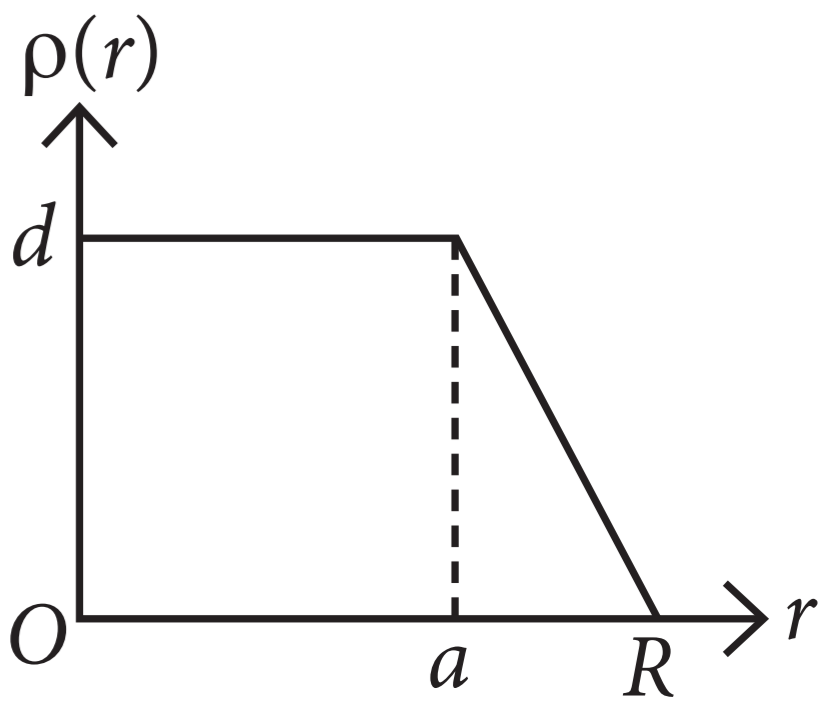
  1. The electric field within the nucleus is generally observed to be linearly dependent on r. So,

  1. a = 0
  2. $\text{a}=\frac{\text{R}}{2}$
  3. a = R
  4. $\text{a}=\frac{\text{2R}}{3}$
  1. What charge would be required to electrify a sphere of radius 25cm so as to get a surface charge density of $\frac{3}{\pi}\text{Cm}^{-2}?$
  1. 0.75C
  2. 7.5C
  3. 75C
  4. Zero
  1. The SI unit of linear charge density is:
  1. Cm
  2. Cm-1
  3. Cm-2
  4. Cm-3